


Only 12% individuals have bank accounts in Pakistan, literacy rate up from 61 to 63%
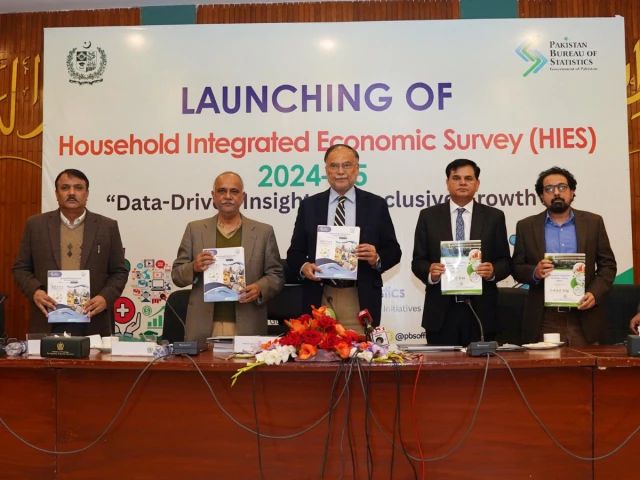
Minister for Planning, Development and Special Initiatives Ahsan Iqbal launches the Household Integrated Economic Survey (HIES) 2024–25 at a ceremony organised by the Pakistan Bureau of Statistics in Islamabad on Thursday, Jan 01, 2026. Photo: PID.
The number of out of school children has slightly decreased to below three out of every 10, due to the efforts by three provinces, except for the Punjab government. However, the food insecurity has significantly jumped this year, reveals an official survey released on Thursday.
According to the Household Integrated Economic Survey (HIES), out of school children remain a concern at 28% nationally. Rural girls, particularly in Sindh and Balochistan face the highest exclusion rates, while Punjab performed best and Balochistan the worst, despite recent improvement.
Although the survey did not give an absolute number, the number of out of school children dropped from 25.3 million to 20 million when compared with the school-going age population figure given in the 2023 census.
The survey was conducted from September 2024 to June 2025, after a gap of six years. The last report was released in 2019. It was finalised after a push from the International Monetary Fund.
Education
There is unequal access to education in various regions of the country but the proportion of out-of-school children has decreased to 28% from 30%, according to the report. The details showed that one out of every four boys remains out of school while this ratio is almost one out of three for girls.
It showed that the government of Punjab could not depict any progress in bringing the out of school kids to the schools and its ratio remained unchanged at 21%. However, it was the lowest ratio among all the provinces but was constant compared to the last survey.
In Sindh, the out of school children ratio decreased from 42% to 39%. The K-P government ‘reduced its out of school rate from 31% to 28%’, according to the report launched by Ahsan Iqbal.
In Balochistan, the out of school children ratio decreased from 59% to 45% -the maximum reduction in any province.
After the Digital Census, the Digital Agriculture Census, and the Economic Survey of Pakistan, the Ministry of Planning has now launched the Household Integrated Economic Survey (HIES) 2024–25 — another major milestone in Pakistan’s shift toward evidence-based policymaking.… pic.twitter.com/ejeC2ZsUGU
— Ministry of Planning and Development (@PlanComPakistan) January 1, 2026
Out of 28%, as many as 20% of the children never went to schools, while the remaining 8% first joined and then dropped out, according to the survey. Out of those who left school, four out of every 10 boys could not continue studies because they had to take odd jobs to help the family or the education was ‘too expensive’. The girls often leave due to financial constraints, unwillingness or restrictions by the family.
Pakistan’s education system has shown modest overall improvement with the proportion of individuals aged 10 and above who have ever attended schools rising from 61% to 67% and literacy increasing from 60% to 63%, according to the findings. However, significant disparities persist as male attendance and literacy remain higher than females and urban areas outperform rural areas.
The marginal improvement in social indicators is unsatisfactory and Pakistan cannot grow with 63% literacy rate, said Planning Minister Ahsan Iqbal.
Food insecurity
The survey depicts the impact of high inflation and low economic growth during the past many years on the living standards of the people.
Across Pakistan, around one-fourth of households experience moderate or severe food insecurity with marked disparities across provinces and income groups, according to the survey. Vulnerability remains the highest in Balochistan and Sindh while the lowest income quintile faces nearly five times greater risk than the highest, showed the results.
Food insecurity significantly increased in Punjab where it jumped from 14.4% to 22.6%, and the severe food insecurity almost doubled within six years. The food insecurity in K-P also increased from 16.7% to 21.5% in six years. The situation was more alarming in Balochistan where the food insecurity doubled to over 30% while in Sindh it increased by 10% to 29%.
Connectivity
Despite Prime Minister Shehbaz Sharif’s goal to have a digital Pakistan, the survey results showed that the country is lagging far behind in the connectivity indicators. “Barriers to internet access persist, including affordability, service quality and lack of perceived need, particularly in rural areas,” stated the report. Mobile phone usage has also declined from 91% to 83%.
Digital financial inclusion has been measured for the first time, revealing that only 12% of individuals own a bank account and 9% use mobile money service while 76% have no financial account, showed the survey.
At the household level, mobile and smartphone access has increased to 96% while internet connectivity has also increased from 34% to 69%. But the ownership of computing devices like laptops and desktops has halved to just 7%.
Meanwhile, information and communication skills remain at basic level of messaging and copy pasting but advanced digital competencies remain limited, especially among women, the survey revealed.
Population Welfare
Infant mortality rate is also reported on a downward path and decreased from 60 to 47 deaths per 1,000 live births while the national mortality rate fell from 41 to 35, according to the survey. There is also improved water availability within premises, which increased from 74% to 79%.
