



* The Seventh Tang Xianzu International Theatre Exchange Month was held in Fuzhou City, east China’s Jiangxi Province, attracting over 1,000 experts, scholars, students and drama enthusiasts from home and abroad. A centuries-old Kunqu Opera masterpiece staged by international performers highlighted fresh possibilities for the fusion of Eastern and Western theatrical traditions.
* Although great playwrights William Shakespeare and Tang Xianzu were unaware of each other’s existence, the characters in the plays they created share astonishing similarities, demonstrating the possibilities of dissolving the cultural boundaries for British and Chinese youth.
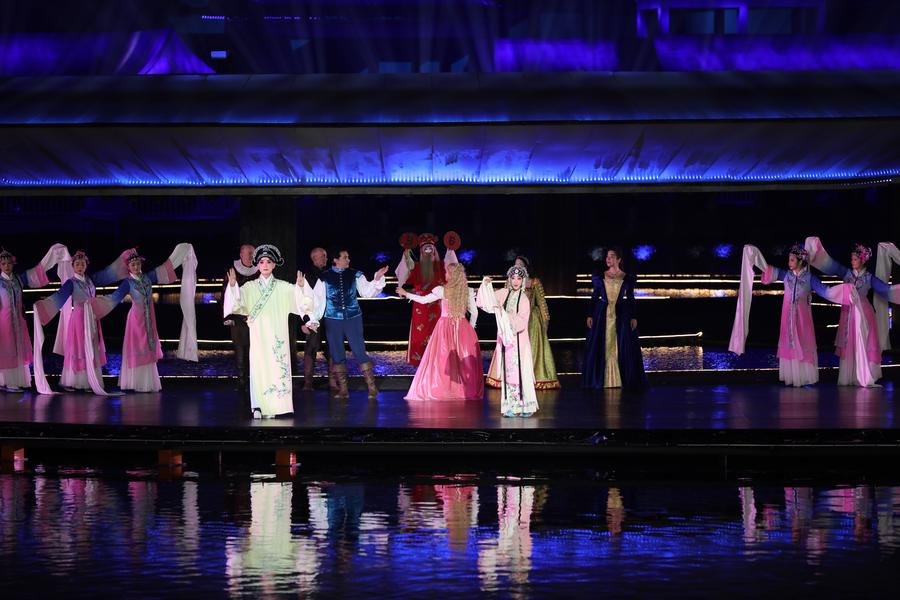
NANCHANG, Dec. 2 (Xinhua) — With a Chinese performer portraying Du Liniang, the female lead, and an Irish performer as Liu Mengmei, the male lead, an English-language rendition of the Kunqu Opera masterpiece “The Peony Pavilion” came to life at the Seventh Tang Xianzu International Theatre Exchange Month in Fuzhou City, east China’s Jiangxi Province.
Written in 1598, the same year as Shakespeare’s Romeo and Juliet, Tang Xianzu’s “The Peony Pavilion” tells the tale of Du Liniang, a young woman from a wealthy family who falls asleep beside a peony pavilion and dreams of a romantic encounter with a young scholar named Liu Mengmei.
The 600-year-old Kunqu Opera, an elegant fusion of poetry, music, intricate costumes and graceful performance, was inscribed on UNESCO’s list of World Intangible Cultural Heritage in 2001.
The theater festival, which opened in late October, concluded on Sunday. It attracted over 1,000 experts, scholars, students and drama enthusiasts from home and abroad. This year’s English-language program of plays and operas highlighted fresh possibilities for the fusion of Eastern and Western theatrical traditions.
BRIDGING THE GAP
According to Michael Dobson, director of the Shakespeare Institute at the University of Birmingham, who brought the English version of the Peony Pavilion from Shakespeare’s birthplace of Stratford-upon-Avon to Tang Xianzu’s hometown of Fuzhou, the reason why he had a Chinese youth play Du Liniang and an Irish portray Liu Mengmei was to enable Tang Xianzu’s plays to break through the original audience circle, reach a broader world and gain due influence.
“It’s as if Tang Xianzu and Shakespeare were living at the same time, had worked at the same time in the same place,” he said, adding that his crew included students from the United Kingdom, China, the United States, and Ireland.
“We’re playing it as though it was a Shakespeare play, really, the way we would do a Shakespeare play,” he added.
Bridging the cultural divide was never easy, yet each performance forged its own path to interpret the masterpiece and unite Eastern and Western theatrical traditions.
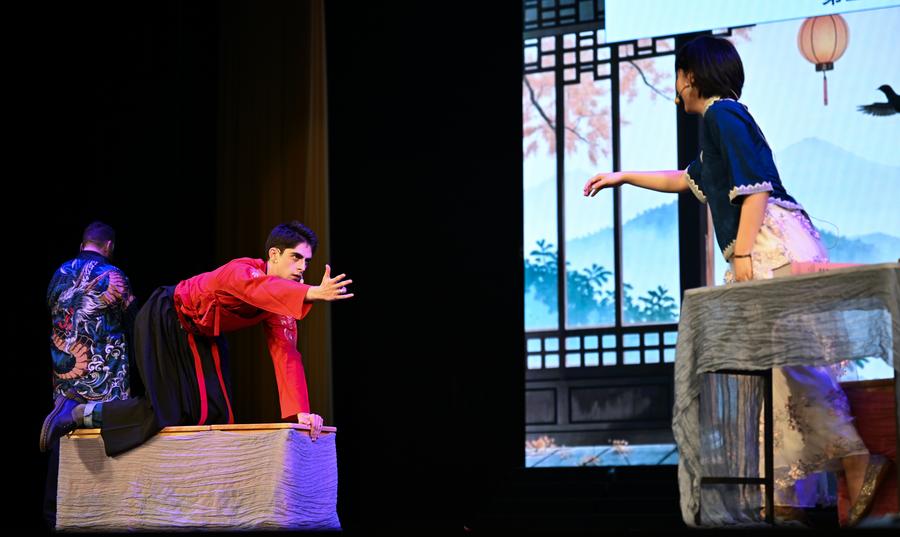
For British actor Liberty Myers O’Dell, his approach was to conduct extensive research and study various adaptations of “The Peony Pavilion.” “I looked at the ancient Chinese opera and tried to integrate the same large movements, but did them a little faster. My intention is still to connect the physicality with the vocal tradition that I saw I when I did my research,” he said.
At the same time, Chinese performer Zhou Jingxuan was inspired by the language. “One of the things that strikes me most is that when reciting English lines in British theater, there are lots of combinations of consonants and vowels in your lines, which makes you more powerful and dramatic when you express that line in English on stage. This is the most different thing between Chinese and British theater,” Zhou said.
DISSOLVING CULTURAL BOUNDARIES
Steve Ansell, artistic director of stage@leeds in the United Kingdom, has been to Fuzhou many times. Ansell recalled that when he first worked with Chinese performers a decade ago, it took several weeks for them to build a connection. This time, however, the experience was very different.
Ansell noted that during a 2016 tour, actors from different countries and regions only began to bond once they arrived in China. This time, by contrast, they had already arranged to go shopping together as friends on the very first night they met.
According to Ansell, the cross-cultural resonance is precisely the heart of the project, because young people around the world are, at their core, so alike. People’s eating habits may differ, but the human experiences of love and fear are universal, he said.
Although Shakespeare and Tang Xianzu were unaware of each other’s existence, the characters in the plays they created share astonishing similarities in some ways, demonstrating the possibilities of dissolving the cultural boundaries for British and Chinese youth.
In the eyes of Dobson, Shakespeare depicted the complexity of human nature, while Tang Xianzu wrote about the pursuit of the soul. Both were asking ‘what is life,’ which is the core of the continuous dialogue between Eastern and Western dramas, he said.
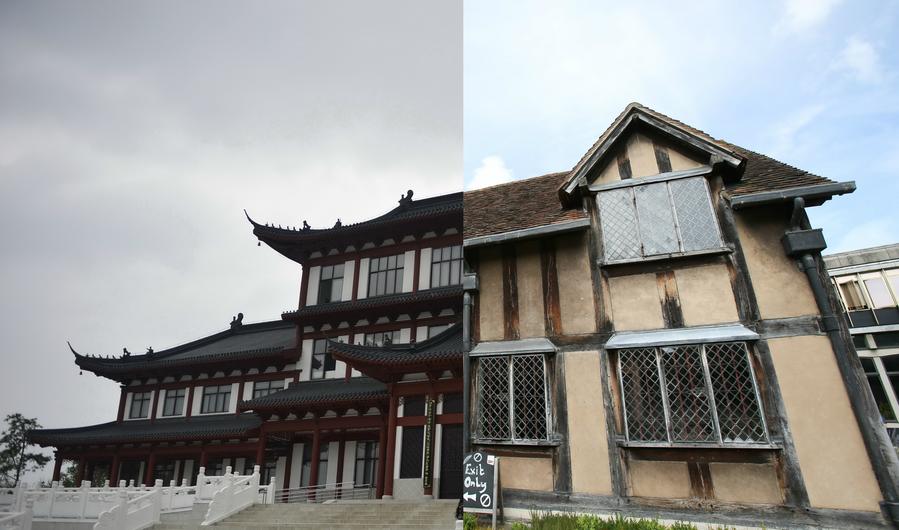
What truly touches people’s hearts is those emotions shared by all humanity. According to Wu Fengchu, director of the Center for International Studies of Tang Xianzu in Fuzhou, the root and soul of Tang Xianzu’s plays lie in “emotion” and “dream,” such as the persistence in love, the yearning for freedom, the pursuit of beautiful things, and the determination to live as one’s true self, which precisely serve as the bridge connecting the hearts of audiences in the East and the West.
“When Du Liniang sacrificed herself for love, Western audiences naturally thought of Juliet, who died for love too, and this kind of understanding and resonance that comes from the bottom of one’s heart is more powerful than any verbal explanation,” Wu said.
For British actor Matt Grey, the cultural connection was what attracted him to be a part of this year’s festival. “That’s really exciting because it makes you realize that for hundreds and thousands of years, people all around the globe have been experiencing very similar things — love, jealousy, deceit, kindness, and all those universal human traits,” he said.
“When those are explored across cultures, it gives you a deeper, more clear understanding of what it means to be a human being,” he added.
MUTUAL EFFORT
The exchange of cultures between East and West is never a one-way process, but a mutual effort.
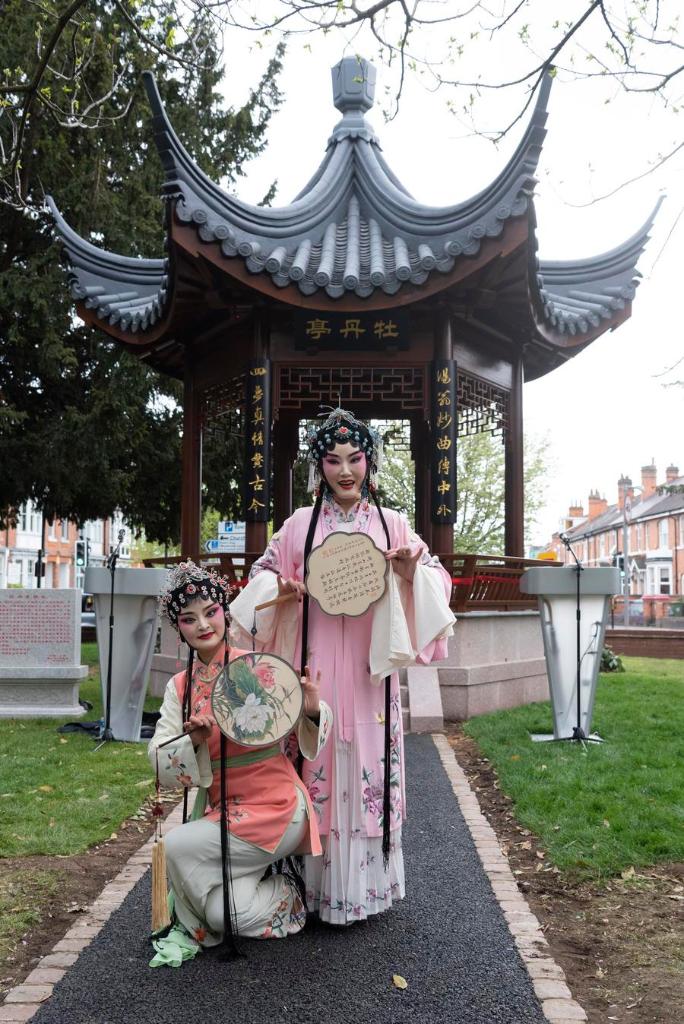
A replica of the pavilion, based on pictures recorded in ancient books of the play, presented by the government of Fuzhou at Shakespeare’s hometown, is a representation of two-way efforts, connecting the hearts of the people.
“It’s right by the Shakespeare Institute. We had our last rehearsal there before we got to the place and we love the pavilion,” Dobson said.
According to Wu Fengchu, the global journey of Tang Xianzu’s theatrical culture is rooted in an interactive model of “using play as a medium and building connection through play,” which not only expands the international influence of Tang Xianzu’s plays but also promotes sustainable cultural exchanges.
Fuzhou established a sister-city relationship with Stratford-upon-Avon in 2016. Over the years, people-to-people exchanges have been boosted between the two cities. For example, students in Fuzhou went to the United Kingdom to participate in the commemoration activities of Shakespeare’s birthday.
During their return visit, British students experienced the artistic essence of Tang Xianzu’s plays within traditional Chinese gardens. These direct exchanges have not only revitalized cultural heritage but also strengthened the spiritual connections between the cities.
The dialogue between Tang Xianzu and Shakespeare not only realizes the connection between the Eastern and Western stages, the interaction between the audience and the exchanges between scholars, but has also become a broad platform for radiating to many fields such as history, philosophy and literature, said Ji Yongjun, vice secretary-general of the Chinese People’s Association for Friendship with Foreign Countries.
Dobson also expressed his hope to unlock the artistic treasures of Shakespeare and Tang Xianzu through the collaborative efforts of China and other countries, using multilingual and multi-format performances to bring their works to a wider global audience.
(Video reporters: Peng Jing, Cheng Di; Video editors: Zhang Mocheng, Zhu Cong, Zhao Xiaoqing) ■
