


Despite 10 year delay on implementing Supreme Court’s 2014 orders, govt accused of ‘rushing’ legislation
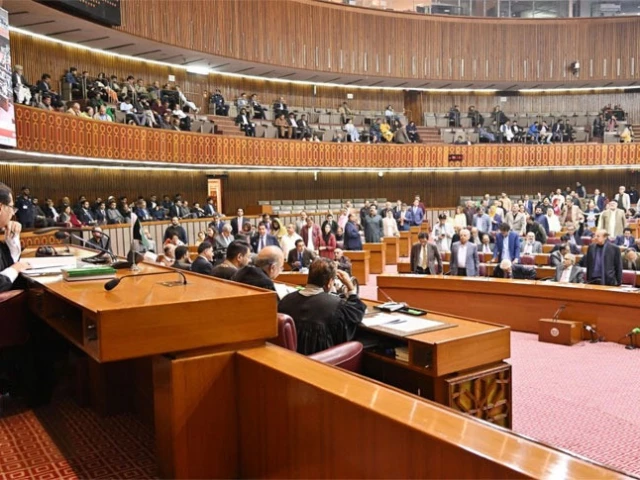
The National Assembly has passed the 27th Constitution (Amendment) Bill, 2025 on Wednesday. PHOTO: RADIO PAKISTAN
A joint session of Parliament on Tuesday formalised long-delayed protections for non-Muslims in Pakistan.
The National Commission for Minority Rights Bill 2025 was passed by the National Assembly and Senate, despite intense debate, ending years of delay in the passage. The legislation establishes a dedicated commission to safeguard minority rights and monitor constitutional guarantees.
The bill follows a 2014 Supreme Court directive, which mandated the creation of a commission “to monitor the practical realisation of the rights and safeguards provided to minorities under the Constitution and law” and to “frame policy recommendations for safeguarding and protecting minorities’ rights.” The apex court had also called for a special task force to protect places of worship and curricula promoting religious tolerance.
Down in 2025, two decades after the court’s directive, Law Minister Azam Nazir Tarar moved the bill, saying, “The bill was delayed for 10 years and politics should not influence it. Its passage marks a historic step toward formalising protections for minority rights in Pakistan.”
Read: 2014 verdict on minorities yet to be implemented: SC
Minister Tarar said the Minority Rights Commission “will review and oversee government departments to ensure minority rights are protected. It will identify gaps, deficiencies, and violations, and submit recommendations to strengthen protections.”
The commission is empowered to intervene in judicial proceedings, inspect police stations, jails, and detention facilities, investigate issues affecting minorities, provide policy recommendations, monitor the implementation of court decisions related to minority rights, and identify hate speech and discriminatory social media content for legal action. It can also prepare reports for Parliament and liaise with international human rights organizations.
The session saw heated debate over Clause 35, which originally raised concerns regarding potential conflicts with existing protections for the Qadiani (Ahmadi) community.
Clause 35 stated that the provisions of the National Commission for Minority Rights Act “shall be in addition to and not in derogation of the provisions of any other law for the time being in force.”
Minister Azam Nazir Tarar assured lawmakers that the bill implemented the Supreme Court directive without contravening the Quran and Sunnah.
JUI-F member Alia Kamran presented an amendment to remove Clause 35, which was passed by majority vote. Tarar clarified, “The Constitution states Ahmadis are non-Muslims. We will remove Clause 35 to address concerns.”
Senator Noorul Haq Qadri said, “PTI and JUI have no issue regarding Hindus, Sikhs, and Christians, but we are concerned about Ahmadis.” Qadir Patel added, “No law should be enacted that could be misused, and accountability will be on the Day of Judgment.”
During the session, opposition leaders, including Maulana Fazlur Rehman, criticised the 27th Constitutional Amendment, saying it failed to meet democratic requirements and created social divisions. He warned against following Western models, saying, “Today, we are following the path of the Jews and Christians,” and called for corrections in the Constitution. Raja Nasir Abbas highlighted Pakistan’s ongoing human rights challenges, questioning the hurried pace of legislation.
Composition of the commission
The 16-member commission will include two minority members from each province, one member representing Islamabad nominated by the Chief Commissioner, and three members from the National Commission for Human Rights, National Commission on the Status of Women, and the Child Rights Commission.
Officials from the Ministries of Law, Religious Affairs, Interior, and Human Rights at Grade 21 will also serve. Members and the chairperson must be at least 35 years old, with the chairperson required to have human rights experience.
The bill defines minorities as individuals who are non-Muslims, and minority rights as those guaranteed under Article 20 of the Constitution and related laws, including religious freedom and worship. Tarar said, “This commission will ensure the continuous protection and promotion of these constitutional rights.”
Read More: Two more bills to protect minorities’ rights on cards
The chairperson must be appointed within 60 days. Tarar explained, “A four-member parliamentary committee, with equal representation from government and opposition, will recommend the chairperson. If there is no consensus, the Prime Minister will appoint the chairperson from among the committee members.”
In addition, an 18-member Minority Council will also be formed, including representatives from Hindus, Christians, Sikhs, Bahai/Parsis, Muslims, provincial human rights offices, and Islamabad’s minority community. Members will be appointed by the Prime Minister for three-year terms.
Other legislative business
The joint session also passed the Biological and Toxic Weapons Convention Implementation Bill 2024. Tarar said, “Biological weapons will be completely banned. Use will carry penalties including death, life imprisonment, and fines up to ten million rupees.”
Other legislation included the establishment of the National University of Security Sciences Islamabad, the Akhowat Institute, and additional science and education initiatives.
