


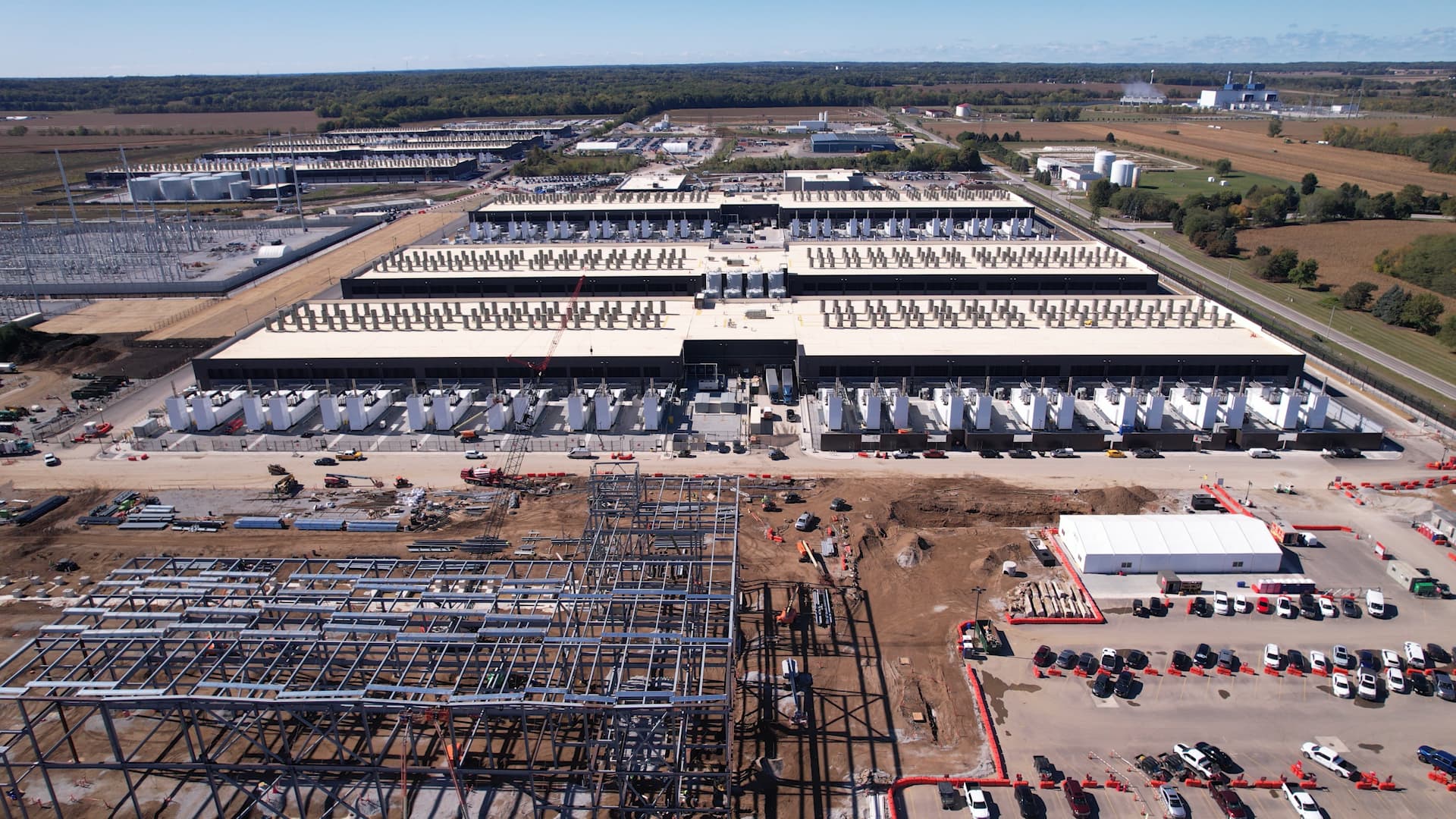
Global data centers dealmaking surged to hit another record high this year, driven by a rush to build out the infrastructure required for energy-intensive AI workloads.
That surge came even as investors grew increasingly wary of inflated artificial intelligence valuations and the financing underpinning the rapid expansion of data centers. Global stocks sold off in November as worries of an AI-fueled bubble persisted.
But S&P Global reported that more than $61 billion has flowed into the data center market this year, up slightly from $60.8 billion last year, amid what it called a “global construction frenzy.”
A surge in debt financing contributed to the record high as hyperscalers increasingly tap private equity markets rather than funding the expensive infrastructure themselves.
That trend has sparked concerns from some investors as they question the value of the advanced tech that data centers house.
Shares of cloud company Oracle fell 5% on Wednesday following a report that Blue Owl Capital was pulling out of a deal to back a $10 billion data center in Michigan. Oracle has denied the report, but Broadcom, Nvidia and Advanced Micro Devices retreated after it was published. The Nasdaq Composite lost 1.81% in its worst day in nearly a month.
Iuri Struta, TMT analyst at S&P Global Market Intelligence, said his team expects market concerns around AI and Oracle to be temporary and unlikely to have a “massive impact” on data center buildout and M&A in the near future.
“The competitive dynamic among frontier AI model providers, like OpenAI, Alphabet and Anthropic, is changing quickly, and this can have an impact on investor sentiment in public markets. But overall, we see demand for AI applications continuing to grow strongly in 2026.”
Despite the recent pullback in AI stocks, many analysts remain bullish on the sector. Bank of America said “the AI trade may still have room to run into 2026,” while warning that shares going up does not mean a bubble isn’t forming.
“There are two sides to the development of AI, one that would cater for optimism such as faster development of medicine and at the same time there would be concerns typically around (public) safety,” Wim Steenbakkers, managing director of ING’s global lead satellite and technology, told CNBC.
“Hence uncertainty remains around the monetisation of the technology and business models. Questions around the high levels of investment will only be answered in the future when the uncertainties diminish and the applications of the technology and its advantages become clearer.”
There were more than 100 data center transactions in the first 11 months of the year, whose total value already exceeds all the deals done in 2024, according to S&P Global Market Intelligence data. The majority of those deals took place in the U.S., followed by the Asia-Pacific region.
“In Europe, the buildout of data centers is expected to grow at a lower rate than other regions, but it remains to be seen if this results in an M&A rush amid scarcity of assets,” Struta said.
The pace of growth in the U.S. is leaving Europe “in the dust” according to a recent report from ING which predicted data center investment in the U.S. could be fivefold higher. Growth is also increasingly coming from the Middle East, as the wealthy Gulf States look to position themselves as the next global AI hub.
Debt issuance nearly doubles in 2025
Debt issuance nearly doubled to $182 billion in 2025, up from $92 billion last year, according to the data from S&P. It noted that Meta and Google were among the most active issuers, with Facebook’s owner raising $62 billion in debt since 2022 — nearly half of that total was issued in 2025 alone.
Google and Amazon raised $29 billion and $15 billion, respectively, according to the report, which noted that hyperscalers are increasingly working with AI labs to buy assets to finance construction in an “unusual arrangement” that underscores the significant capital required to meet demand.
Struta expects more “robust” M&A investment activity in the data center space in 2026.
“I wouldn’t be surprised if already high valuations get even higher,” he told CNBC.
“The buildout of new data centers can be temporarily tempered by a lack of energy supply, making already built data centers more valuable. As the availability of large data center companies remains scarce, we could see more asset sales by companies that don’t view data centers as their core business.”
