


Ministries to suggest steps to rationalise budget, attract investment and exit IMF
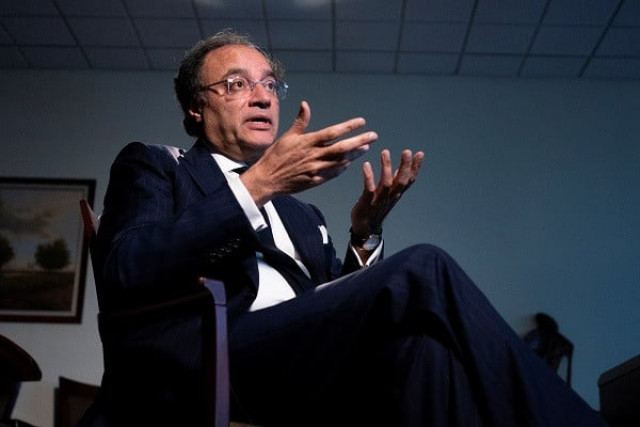
Finance Minister Muhammad Aurangzeb is interviewed during the G20 Finance Ministers and Central Bank Governors’ Meeting at the IMF and World Bank’s 2024 annual Spring Meetings in Washington. PHOTO: REUTERS
ISLAMABAD:
The government has formally asked for proposals from key economic ministries to identify possible concessions from the International Monetary Fund (IMF) to remove obstacles to economic growth and introduce greater realism into the budget framework.
The decision to seek input from the ministries was taken at the highest level after a recent review of the nation’s economic landscape revealed that the existing economic structure is neither capable of attracting meaningful foreign investment nor delivering sustainable growth, said government sources.
They said Finance Minister Muhammad Aurangzeb held the first meeting with economic ministries on Thursday and asked them to submit proposals outlining a future roadmap. The objective of the exercise is to obtain recommendations and assess whether these can be implemented before the next budget or should be incorporated into it.
The discussions are taking place in the context of making necessary adjustments while remaining in the IMF programme until September 2027, said the sources. Separately, another exercise has also begun to explore options for exiting the IMF programme after the expiry of the current $7 billion bailout package.
However, Planning Minister Ahsan Iqbal has linked a permanent exit from the IMF to Pakistan’s ability to raise exports to $63 billion by 2029. This target would require a 100% increase in exports over four years, with an annual addition of $7.8 billion.
According to the sources, once proposals from the ministries are received and refined, the authorities may take them up with the IMF for vetting. A friendly country has also assured the government of its support at the IMF for measures that are currently impeding growth and undermining economic rationality.
The Ministry of Finance spokesperson did not respond to questions regarding the rationale behind the exercise, its implications for the IMF programme, or questions about the current budget and whether it is practical or not.
The sources said the finance ministry has circulated a detailed proforma to all economic ministries, asking them to submit proposals for achieving sustainable growth. The ministries have been asked to provide macroeconomic analyses of their proposals and explain how these measures would contribute to higher growth.
They have also been directed to explicitly state the budgetary cost of their proposals, including any subsidies required or the potential impact on tax revenues.
Convincing the IMF, however, is expected to be difficult. The Fund is closely monitoring the implementation of the three-year programme through 64 separate conditions. A prime ministerial panel has already proposed tax relief of Rs1 trillion to kick-start the economy, but the IMF has so far shown reluctance to even waive taxes on contraceptives, the sources said.
Earlier this week, the Planning Commission briefed the civil and military leadership on what it described as a trap of low growth, weak investment and high unemployment, which is contributing to rising social unease.
The government’s decision to initiate these discussions have confirmed apprehensions that Prime Minister Shehbaz Sharif’s strategy of hiring foreign consultants and relying heavily on external creditors may not be sufficient to address Pakistan’s chronic issues.
The sources said Pakistani and Saudi authorities have recently carried out a comprehensive review of Pakistan’s economy to assess conditions before taking any decisions on major Saudi investment. Their assessment found that Pakistani industries lack complete value chains required for export competitiveness and that existing policies need substantial changes.
Pakistan and Saudi Arabia are seeking to deepen commercial ties under the Saudi-Pakistan Economic Cooperation Framework. Pakistan has prepared a 90-day roadmap to operationalise 12 joint working groups focused on eight priority areas where Saudi investment is considered feasible.
The 90-day activation plan and sectoral deep dives are aimed at identifying structural gaps and guiding targeted economic corrections with measurable outcomes.
The 12 working groups cover agriculture and food security, information technology and business process outsourcing, mining, industry and manufacturing, tourism, human resource development, finance, commerce, investment and energy.
The prime minister has also instructed the ministries to prepare comprehensive value-chain mappings for each of the eight sectors where Saudi Arabia could potentially invest. These mappings are to identify value addition opportunities, bottlenecks and areas where competitiveness can be improved.
In parallel, Pakistan plans to develop a targeted investment framework to attract both domestic and foreign investment into export-oriented industries, including textiles, information technology, food and agriculture, mining, and value-added manufacturing, in support of export-led growth.
However, the assessment found that even the textile sector does not have a complete value chain, said the sources.
They added that Pakistan cannot fully benefit from foreign investment unless it raises the share of skilled workers in export-linked sectors from 6% to 23% and aligns its development plans with global market trends and the requirements of the digital economy.
The government aims to complete the ongoing assessments by March next year, with the dual objective of attracting Saudi investment and seeking relief from the IMF during the next programme review, scheduled for the last week of February.
According to the sources, during the initial meeting with economic ministries, concerns were raised about the budget and the consequences of missing tax targets. Officials also flagged the practice of using delayed refunds to inflate revenue figures, saying it was adversely affecting businesses.
It was also pointed out that the levy imposed on captive power plants has significantly undermined the financial viability of public sector gas companies. Some industries, rather than relying on the national grid, have opted to develop their own indigenous energy sources.
The All Pakistan Textile Mills Association has already called for the suspension of the levy, at least during the winter months. However, the government has recently assured the IMF that it would further increase levy rates to compel industries to shift to grid electricity.
