


US offers locomotives, seeks collaboration on mineral assessments during talks with Finance Minister
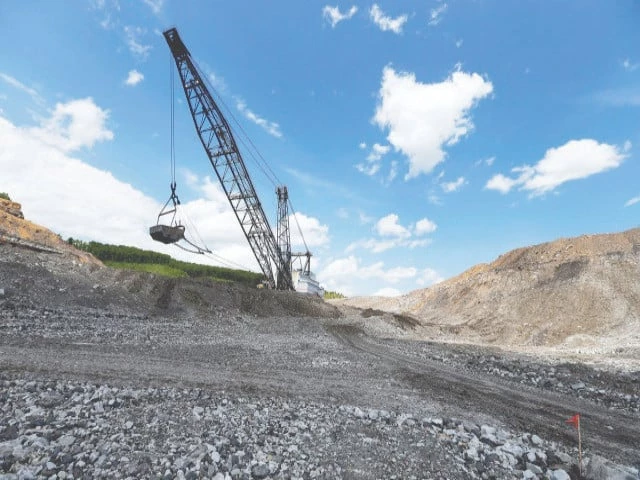
According to sources, Lersten proposed collaboration to assess reserves and secure offtake agreements for expedited mineral extraction. Photo: Reuters
ISLAMABAD:
The United States President Donald Trump’s administration has approached Pakistan for the sale of American locomotives and offered collaboration on assessment studies to determine the country’s mineral reserves, as well as the signing of agreements for their expeditious extraction.
According to government sources, these discussions took place during Finance Minister Muhammad Aurangzeb’s visit to Washington in October. They said Pakistani authorities have also held internal meetings to assess US interest in the transportation and minerals sectors.
The finance minister held multiple meetings with the US administration on the sidelines of the annual meetings of the International Monetary Fund (IMF).
The Ministry of Finance and the Ministry of Railways did not offer comments on the development.
Sources said that the finance minister met Raymond Emory Cox, Special Assistant to the President for International Economic Relations, and Ricky Gill, Special Assistant to the President of the United States and senior director for South and Central Asia, on the sidelines of the IMF annual meetings.
Gill requested the Pakistani government’s support for the purchase of American locomotives, for which a tender had already been issued, said the Pakistani authorities. A few years ago, Pakistan had purchased 55 locomotives from the United States.
The secretary railways did not respond to a question regarding the US request.
Pakistan Railways is facing serious liquidity issues and is not in a position to make major purchases. It is largely relying on the repair and refurbishment of its existing fleet of locomotives.
The federal government has recently upwardly revised the Rs16 billion project for the repair of 100 diesel electric locomotives, which were frequently going out of order.
Sources said Gill also sought favourable consideration of Starlink’s licence application to launch high-speed internet services in Pakistan, particularly to benefit rural and remote communities.
During the meeting, Gill briefed the Pakistani delegation that protecting and advancing US commercial interests was a top priority for the Trump administration. The president’s envoy also sought a level playing field for American companies and appreciated the removal of the 5% digital services tax.
The government had imposed the 5% tax in the budget but had to withdraw the levy in order to reach a trade deal with the United States.
Gill informed the Pakistani delegation that the four pillars of President Trump’s economic agenda were tax reforms, deregulation, energy and critical minerals, and tariff policy.
Sources said that US officials had emphasised the importance of cooperation in critical minerals for President Donald Trump. The US Congress has already set up a $135 billion fund to invest in critical minerals across the world. The board of the US Exim Bank recently approved a $1.25 billion loan for the Reko Diq Mining Company, the country’s largest discovery to date, located in Balochistan.
The United States is heavily investing in critical minerals to secure a share of the world’s mineral reserves, which are largely controlled by Chinese companies.
Sources said that in a separate meeting with Thomas Lersten, a senior bureau official at the Bureau of Economic, Energy and Business Affairs of the US Department of State, Lersten reiterated US interest in Pakistan’s critical minerals sector.
According to the sources, Lersten proposed collaboration to assess reserves and secure offtake agreements for expedited mineral extraction. He also stressed that artificial intelligence would be a strategic priority for the United States, and that US Under-Secretary of State for Energy Jacob Helberg may soon visit Pakistan in this regard.
Aurangzeb also met Robert Kaproth, Assistant Secretary of State for International Finance. Kaproth inquired about whether Pakistan’s security agreement with Saudi Arabia would generate financial inflows.
Pakistan and Saudi Arabia have reached a defence deal, and the government is also expecting Saudi investment in eight major sectors of the economy. Saudi authorities have recently undertaken a comprehensive review of Pakistan’s economy, particularly the value addition chains of various sectors and their ability to sustain foreign investment.
Kaproth outlined the US focus on private-sector digital finance solutions, building on a stablecoin framework rather than central bank digital currencies, highlighting the interoperability of solutions and expressing interest in collaborating with Pakistan on cross-border digital frameworks.
