


BEIJING, Dec. 28 (Xinhua) — In early 2025, the Chinese artificial intelligence (AI) start-up DeepSeek grabbed headlines abroad with models promising high performance at a fraction of the usual cost. Yet while international discussion focused on how the company trained models and managed computing resources, another story has been unfolding inside China.
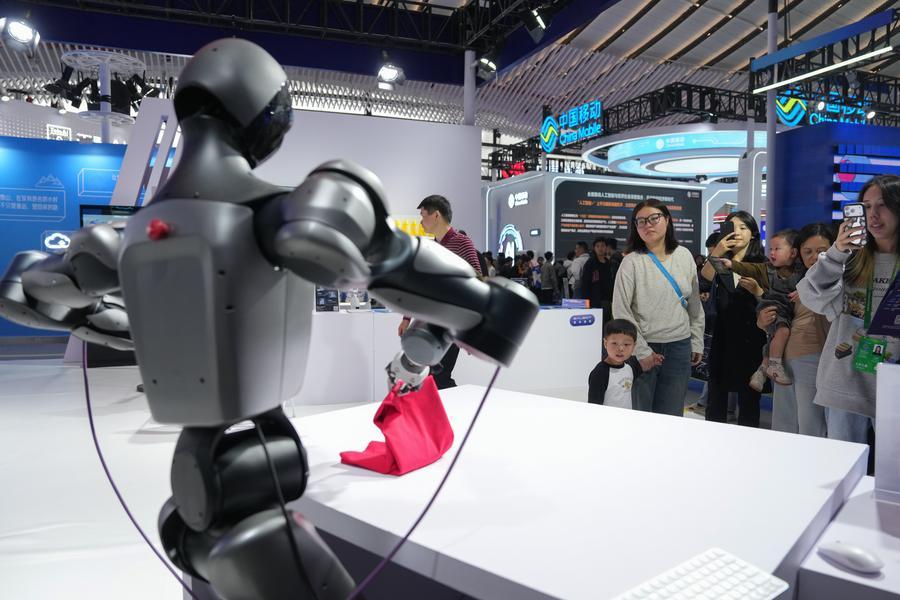
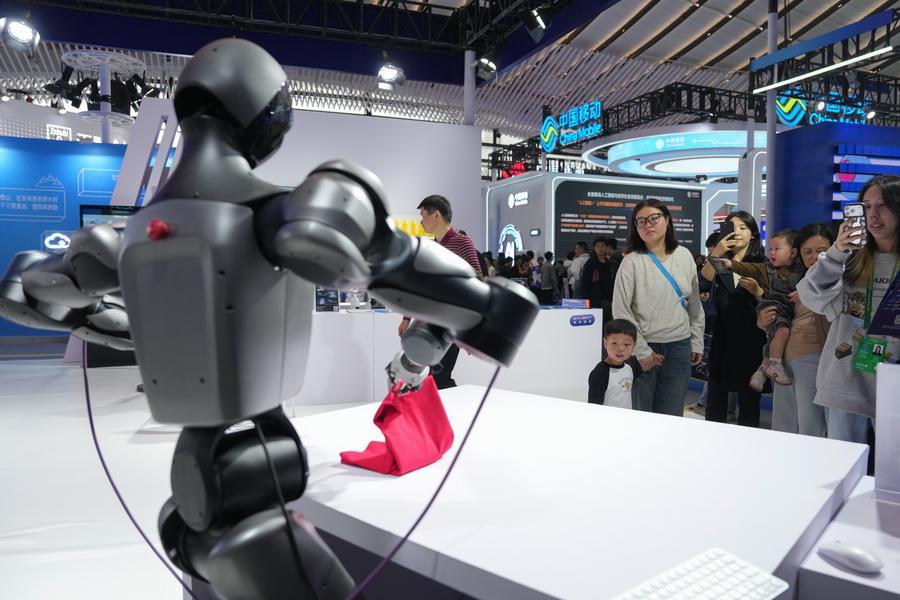
Largely invisible to outside eyes, algorithms have been quietly moving off screens and onto factory floors across workshops in the world’s manufacturing powerhouse.
With robots handling much of the work around the clock, factories are increasingly deploying sensors to track steps of the assembly line, feeding streams of data into algorithms that adjust workflows and coordinate production in real time.
Analysts say AI’s deeper integration into China’s real economy is beginning to reshape industrial value chains, allowing manufacturers to capture more value beyond low-margin assembly and compete in higher-margin segments long dominated by global peers.
CHANGE IN MOTION
At the Maextro super factory in east China’s Hefei city, jointly built by carmaker JAC Group and tech giant Huawei, dual-tone painting robots move with quiet precision, coating car bodies in two colors at once.
Robots are evolving from simple mechanical arms into AI-enabled intelligent systems with enhanced perception and decision-making capabilities, reflecting a broader shift from experience-driven production, long reliant on tacit human expertise, toward precision manufacturing.
“It took six months of training and refining AI models to achieve this level of precise control,” said plant manager Wei Dawei.
Further south in Guangzhou, at GAC Aion’s manufacturing plant, robotic arms operate in near-continuous motion along assembly lines, turning out a vehicle roughly every 53 seconds. The facility has earned a reputation as a “dark factory,” where lights are rarely needed.
Across the country, similar “dark factories” are operating with minimal human supervision. At Yongsheng Rubber Group in east China’s Shandong Province, automated guided vehicles and robotic arms now manage material transport and tire production, with over 95 percent of core equipment under numerical control.
Such changes are unfolding nationwide. Data from the International Federation of Robotics shows that China accounted for more than half of the world’s newly installed industrial robots in 2024, surpassing Japan, the United States, and the Republic of Korea.
BOTS AND BRAINS
Industry observers say China’s AI development reflects a pragmatic approach, pairing global advances in foundational models with domestic strengths in engineering and cost optimization, underpinned by a large engineering talent pool and a highly integrated industrial system.
“Supported by a growing ecosystem of open-source models, large model technology, just like water and electricity and the Internet, is increasingly becoming a convenient and widely accessible basic capability in China,” Shao Yu, chief economist at the Innovation Center of School of Management of Fudan University, told Xinhua in an interview.
The application of AI in smart manufacturing is creating new opportunities for China’s manufacturing sector to upgrade toward greater intelligence and higher-value-added production, said Wei Hongxu, a researcher with the Anbound think tank.
Its significance extends beyond upgrading alone, Wei noted. “More critically, it is improving efficiency and quality in traditional industries by enabling digitalized, data-driven production, thereby optimizing existing manufacturing capacity.”
As a major manufacturing country, China has the world’s most comprehensive industrial categories, which provides a vast array of application scenarios for various products, and a broader stage for the deployment of large language models in industrial settings, according to Zhu Qigui, associate director of the China Academy of Financial Research at the Shanghai Jiao Tong University.
Zhu pointed to the country’s 15 flagship smart factories spanning multiple key industries. “These factories are emerging not only as technology application benchmarks, but also as key nodes in industrial ecosystems, supporting the diffusion of mature solutions to smaller firms along the industrial chain,” Zhu added.
Beyond factories and technologies, human capital plays a decisive role. A large pool of engineers, embedded in fast-growing sectors such as biotech, humanoid robotics, and AI applications, is helping translate innovative technologies into deployable, scalable solutions.
A report from the Development Research Center of the State Council shows that the number of engineers in China surged from around 5.21 million in 2000 to over 17.65 million in 2020. Their innovation capacity has supported rapid iteration across manufacturing, from electric vehicles and drones to consumer electronics, Shao added, citing enterprises such as DJI, Huawei and a new generation of AI and robotics firms.
STEP BY STEP
Given the complexity of manufacturing sub-sectors and multiple stages of production, analysts say the AI-driven smart manufacturing is necessarily a gradual, step-by-step process.
“Despite rapid progress, smart manufacturing continues to face significant challenges and remains short of full commercial maturity, limiting its potential for large-scale deployment,” Wei noted. “Progress generally unfolds sector by sector, stage by stage, rather than through a sweeping rollout.”
“Each incremental advance, however, can yield significant efficiency gains, demanding patience and confidence in the long-term potential of intelligent production,” he added.
The recent Central Economic Work Conference has emphasized deepening and expanding the nationwide “AI Plus” initiative, echoing the actions outlined in a recommendations document for the formulation of the 15th Five-Year Plan (2026-2030).
Under the guidance of clear national strategies, the country’s manufacturing sector is moving toward higher-value segments of the global value chain via the deep integration of digital technologies, such as AI, with industries, and the reconstruction and upgrading of industrial chain ecosystem, Zhu said.
According to the China Academy of Information and Communications Technology, the scale of the country’s core AI industry is expected to exceed 1.2 trillion yuan (about 170 billion U.S. dollars) in 2025, while the broader digital economy, fueled by the new generation of smart devices and intelligent systems, is expected to exceed 70 trillion yuan by 2030.
As 2025 draws to a close, the manufacturing sector’s AI-driven transformation continues, with the potential to drive upstream and downstream industrial chains. “It could generate spillover effects and broader economic benefits that may extend beyond the development of large AI models,” Shao added. ■
