


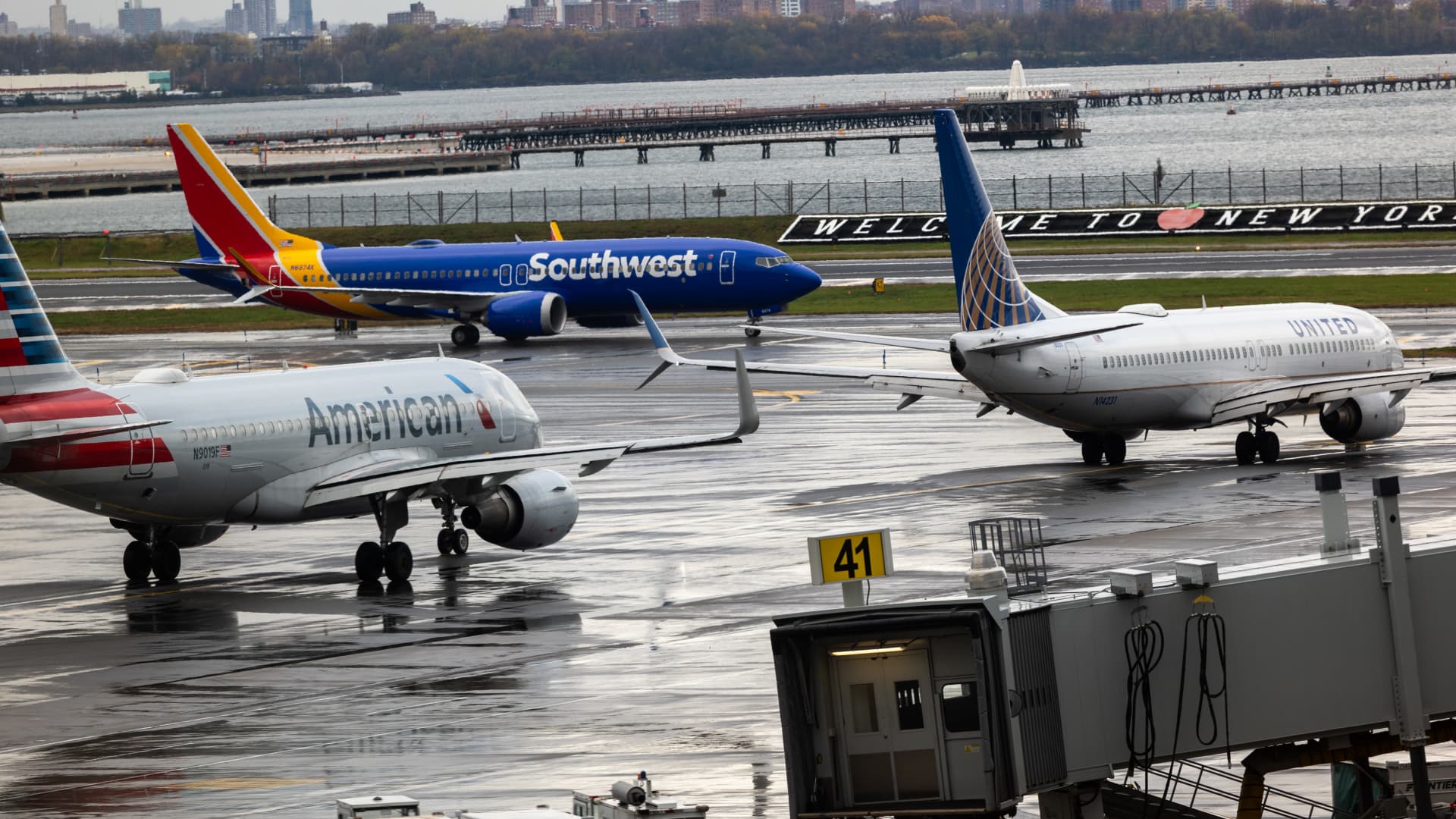
Planes line up on the tarmac at LaGuardia Airport on November 10, 2025 in New York City.
Spencer Platt | Getty Images News | Getty Images
From Spirit Airlines’ fight for survival to American Airlines‘ planned glow-up, from new international routes and brand-new airport lounges to stingier frequent flyer policies, class divides in the sky will intensify in 2026.
Airlines went into 2025 upbeat: Delta Air Lines CEO Ed Bastian forecast a record year for the century-old carrier. But concerns about President Donald Trump’s trade war, skittish consumers and an oversupply of domestic seats brought U.S. airfare down and weighed on industry profits.
“It’s the airline version of the K-shaped economy. Monetize the top of the K and minimize the shortfall at the bottom,” said Robert Mann, who has worked at several airlines and is president of aviation consulting firm R.W. Mann & Co.
Now, the leaders of the country’s biggest airlines are putting even more focus on customers who will pay extra for their tickets in exchange for a little more space or other perks like earlier boarding and access to never-sufficient overhead bin space.
The view into American Airlines first-class cabin on a Boeing 737.
Leslie Josephs/CNBC
They still face continued problems, like a shortage of air traffic controllers and aging infrastructure. Despite billions of additional federal spending to fix some of the problems, major improvements will take years.
Mann said airlines need to do more to improve reliability. U.S. carriers had a 77% on-time rate, according to the Department of Transportation, which defines on-time as arrival within 15 minutes of the schedule.
“When the flight is late or canceled, it doesn’t matter if you’re at the top of the K or the bottom of the K,” he said.
Here’s how the next year is shaping up for the airline industry:
Winners take (almost) all
Through the first nine months of the year, Delta and United Airlines accounted for nearly all of U.S. airline profits.
It’s an industry divide that’s been brewing for years, further fueled by a surge in costs and shifting consumer tastes as wealthier travelers have increased their share of overall spending.
While the economy has been resilient for the most part, any weakening in 2026 could have an outsize effect on more price-sensitive consumers and, therefore, airlines that are more exposed to coach-class domestic travel, like lower-cost carriers.
Those airlines have been making moves of their own. JetBlue Airways, for example, has been shifting its focus to more profitable routes and premium seats. It plans to debut a domestic business class in mid-2026 with seats up at the front of the cabin that are roomier but not quite as elaborate as its top-tier lie-flat Mint suites.
Stable fares
Airfare will likely remain steady next year over 2025, according to an American Express Global Business Travel forecast in mid-November.
Demand has rebounded after dropping during a record-long government shutdown, but it’s not clear whether 2026 will be a blockbuster.
Southwest Airlines CEO Bob Jordan told CNBC in December that the “first quarter looks strong” but that “it’s hard to say,” whether it will be better than a year ago.
Whither Spirit
Struggling budget travel icon Spirit Airlines is in its second bankruptcy in less than a year after a court-blocked acquisition by JetBlue, an engine grounding, a surge in costs and other problems, raising questions about its ability to survive.
Industry insiders and airline analysts have said the yellow-plane airline will have to make much bigger moves with this bankruptcy.
“We do not expect it to remain a standalone company this time next year, with a merger or Chapter 7 outcome likely to drive upside to our earnings forecast,” said a Raymond James note on Dec. 19.

Analysts expect that merger partner would be Frontier Airlines, the fellow budget airline that has attempted to combine with Spirit repeatedly since 2022, but it’s not clear whether the two sides will reach a deal. Spirit said earlier this month that it’s in “active negotiations” for a stand-alone reorganization or a transaction. Frontier and Spirit declined to comment further.
Southwest transformed
Southwest’s preparing for a major change in 2026. The airline’s decades-long cattle call will end on Jan. 27 when assigned seating begins.
It’s coming off a slew of changes it already put into place last year. It debuted extra legroom seats that command higher prices and started charging many customers to check bags for the first time, a service that brought in more than $7 billion for its U.S. rivals in 2024, the last full year of available data, according to the Transportation Department.
The carrier’s stock is the top gainer of U.S. passenger airlines. Southwest shares rose nearly 23% in 2025 compared with the NYSE Arca Airline Index’s 5% advance, and beat out profit leaders Delta and United as well as the broader market.
Investors have been bullish on the company’s transformation to a more traditional, segmented airline, which has been sped along by a stake from activist investor Elliott Investment Management.
American makeover
American is expanding its lounges and launching a fleet of Airbus 321XLR planes in 2026 as it aims to catch up in the luxury travel boom. Free inflight Wi-Fi is also coming for loyalty program members starting in January, American said last spring.
The airline already made more minor changes, like adding Lavazza coffee for all its passengers and Champagne Bollinger for its top-tier lounges and cabins, to uplift its brand as well, but it has a long path to reach Delta’s and United’s profitability.
American Airlines and Delta planes on the tarmac at LaGuardia Airport (LGA) in the Queens borough of New York, US, on Friday, Nov. 7, 2025.
Michael Nagle | Bloomberg | Getty Images
Just before Christmas, American also announced that it will no longer award customers on its no-frills basic economy tickets with frequent flyer miles, following a similar move by Delta several years ago.
American hasn’t yet announced changes to its elite status requirements for 2027, but the carrier is under pressure because Delta and United have said they will hold status thresholds steady.
The airline is also making some changes that aim to improve reliability, recently announcing it will increase so-called banks, or clusters of flights at its largest hub, Dallas Fort Worth International Airport, from nine to 13.
American also said it is testing out two electronic gates there, where passengers on narrow-body domestic flights scan their own boarding passes, in hopes of getting travelers on planes faster, and in September, it said it will remove bag sizers from gates.
