



It’s the week Sin City turned sci-fi.
Humanoid robots shadowboxed, danced and pretended to run small shops. Singapore-based Sharpa displayed a robotic hand playing table tennis and dealing blackjack hands.
Across Las Vegas, technology companies used the annual CES trade show to reveal their visions of the future and to loudly proclaim that physical artificial intelligence is poised for a breakout year.
“The humanoid industry is riding on the work of the AI factories we’re building for other AI stuff,” Nvidia CEO Jensen Huang said at a news conference on Tuesday.
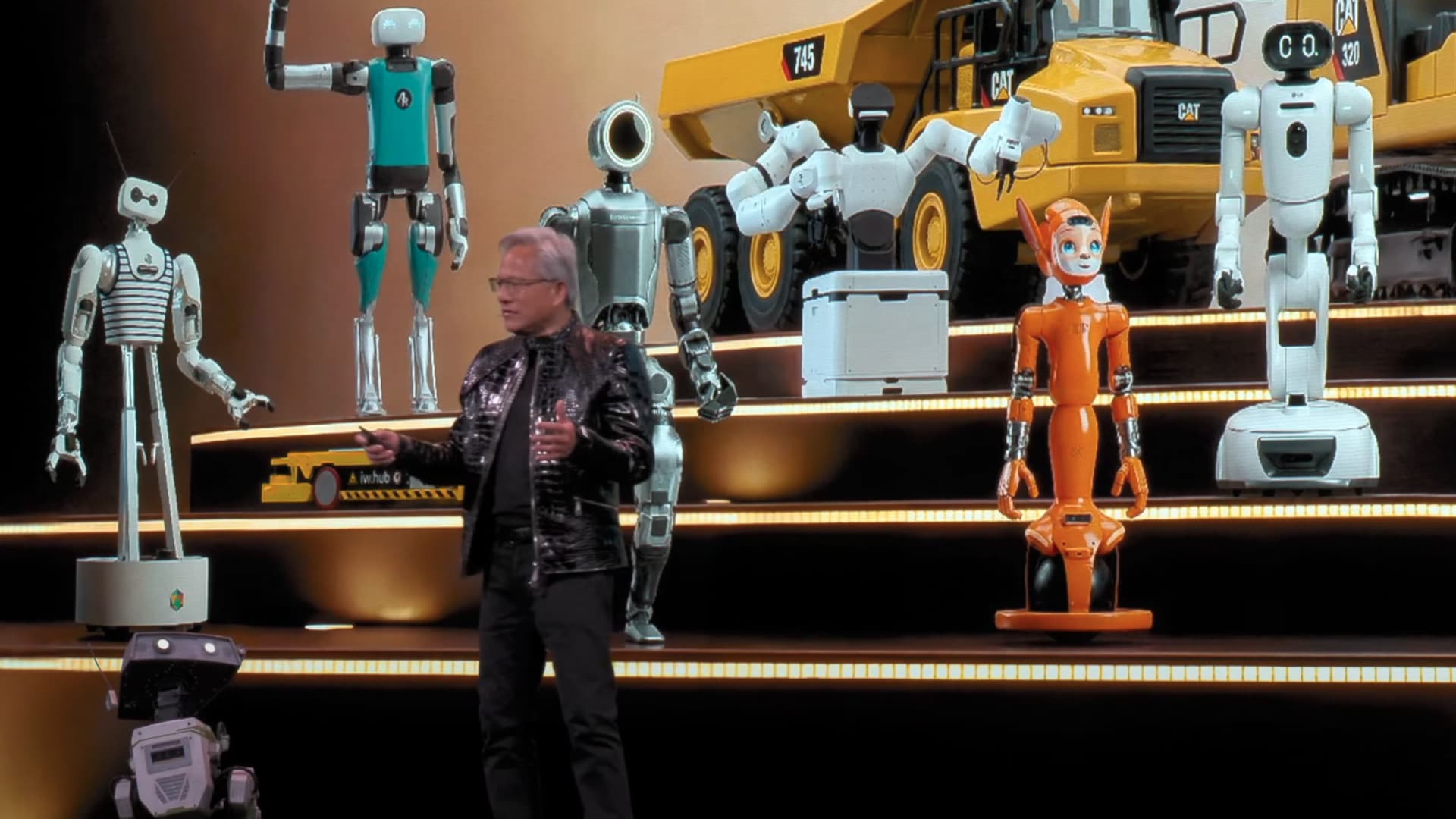
Nvidia Founder and CEO Jensen Huang stands in front of a photo of several humanoid robots during his keynote at CES in Las Vegas on January 5, 2026.
Nvidia
Nvidia, which last year became the world’s most valuable company, announced a new version of its vision language models called Gr00t for humanoid robots that can turn sensor inputs into robot body control, as well as a version of its Cosmos model for robot reasoning and planning.
Huang said he expects to see robots with some human-level capabilities this year.
“I know how fast the technology is moving,” he said. His company highlighted partnerships with the likes of Boston Dynamics, Caterpillar and LG.
Science fiction writers have dreamed of this moment for decades. “The Jetsons” had Rosey, a robot maid. In “Star Wars,” C-3PO helped Luke Skywalker save the galaxy. However, in real life, humanoids have so far been unable to demonstrate the intelligence or flexibility that would make them truly useful, a problem that’s long eluded engineers.
Then came generative AI with the launch of OpenAI’s ChatGPT in late 2022. The same deep learning technology that underpins ChatGPT can be used to teach the robots how to walk, use a hand or fold laundry. Many in the industry see self-driving cars as the first major commercial manifestation of physical AI.
Industry heavyweights are going big.
In addition to Nvidia, fellow chipmakers Advanced Micro Devices and Qualcomm made splashy robot-related announcements at CES. On Monday, Google’s DeepMind said it would work with Hyundai’s Boston Dynamics, formerly a division of Google, to develop new AI models for its Atlas robot.
The humanoid GENE.01 robot was showcased by AMD because it uses its chips and AI technology.
Kif Leswing / CNBC
McKinsey estimates that the market for what it calls general-purpose robotics could reach $370 billion by 2040, with top use cases including “warehouse logistics, light manufacturing, retail operations, agriculture, and healthcare.”
But some analysts were quick to point out that it’s a long way from the show floor to the factory floor, or to the home.
“Although the humanoids were the ones that grabbed everyone’s attention, and it was the best kind of eye candy for the show, we’re still a very, very long way from the commercial implementation of these,” Ben Wood, chief analyst at CCS Insight, said in an interview.
Building the brain
According to CES’ official exhibitor list, 40 companies at the event mentioned humanoid robots on the show’s website. The Consumer Technology Association, which produces CES, hasn’t said how many humanoid robot companies presented at this year’s event, but CTA President Kinsey Fabrizio said the number of industrial and consumer robots at the show has been growing.
AMD CEO Lisa Su on Monday revealed a new humanoid robot from Italy’s Generative Bionics, a company that it’s backing financially. The robot, Gene.01, is scheduled be deployed later this year in industrial environments like shipyards.
LG’s CLOiD robot made its debut this week, folding towels and loading the washing machine.
Kif Leswing / CNBC
Generative Robotics is using AMD’s cloud-based graphics processing units to train and fine-tune its models.
“This allows us to customize the next generation of the models on their GPUs,” said Generative Robotics CEO Daniele Pucci. “That is the brain.”
For now, robot chip sales are a small fraction of Nvidia’s business, and AMD reports them as “embedded” sales, a term for industrial chips. Qualcomm’s “internet of things” revenue was about 18% of the company’s sales in the latest fiscal year.
But they see an opportunity to win business from a new crop of robot makers by offering them not just chips, but an entire software ecosystem to make development easier.
“This is all about any of the major players establishing themselves as a one-stop shop for the robotics development community,” Wood said.
While the tech industry has become enamored with large language models in the generative AI boom, many robots are being enabled by vision language models. They can pair sensor data from a robot with traditional AI models to allow for reasoning or planning, such as a route through a messy floor of obstacles.
LEM Surgical says its spine surgery robot is a “humanoid.”
Kif Leswing / CNBC
Along with Nvidia’s VLM announcements at CES, Qualcomm showed off a new line of robot chips called Dragonwing that can use the company’s VLMs. Qualcomm is using tele-operations to teach its VLM specific skills like how to use actuators to grasp an object.
One particular area of excitement for Nvidia is medicine.
The company showcased a robot from a company called LEM Surgical using its Thor chip. The robot was described as a humanoid, but it didn’t have legs. Rather, it had three arms, two for using tools and one that controlled a face-like module of cameras and sensors. Its sole function is to help doctors with spine surgery.
Down the exhibit hall, Nvidia demonstrated a Chinese humanoid robot called Agibot that used a large language model to chat with attendees, though it had trouble standing on the conference center’s plush carpets.
What robots can do right now
California-based 1X became the first to launch a multi-modal home helper robot in October 2025 with its $20,000 “Neo” humanoid.
1X
Also at the show, Korea’s LG showed off its wheeled humanoid CLOiD robot for the first time.
In the demonstration, CLOiD, which is designed for the home, promised to make breakfast and took a wet towel from the presenter and stuck it in a washing machine.
But it was slow. Folding a rectangular towel that was laid out by a presenter took CLOiD about 30 seconds.
Speed isn’t the only concern. Experts are also worried about safety and the damage that could be caused by consumer robots.
“Home is very unstructured,” said Jeff Burnstein, president of the Association for Advancing Automation. “You can’t plan for a child running into the robot or the robot running over a pet.”
China-based UniTree’s G1 humanoid Koid sells for around $70,000 in the U.S.
UniTree
Some of the first humanoid robots on the market could be more about fun and flash than productivity. China’s Unitree Robotics displayed its $70,000 G1 robot at CES. Large crowds of onlookers were treated to a performance of boxing and dancing on the show floor.
The largest tech companies in the world are betting that the market is rapidly evolving. Nvidia’s Huang said this week that robots are having their “ChatGPT moment.”
Modar Alaoui, general partner at ALM Ventures, sees robots rapidly moving from novelty to reality.
“The next generation is just going to grow up with these machines whether we accept it or not,” he said.
— CNBC’s Katie Tarasov contributed to this story.
