


PUBLISHED
January 11, 2026
KARACHI:
Italian Marxist philosopher Antonio Gramsci never intended his Prison Notebooks to be flattened into slogans or soundbites; into what Argentine post-Marxist political theorist Ernesto Laclau would later describe, in his elaboration of ‘populist reason’, as empty signifiers.
Yet few sentences from twentieth-century political thought have travelled as far or been as thoroughly repurposed as Gramsci’s remark that “the old is dying and the new cannot be born; in this interregnum a great variety of morbid symptoms appear.” Written during the rise of European fascism, the phrase captures moments when established systems lose legitimacy but no coherent alternative has yet consolidated power. In recent years, it has been invoked everywhere from academic panels to sensational headlines, as a shorthand for a world that feels politically unmoored, economically brittle and morally exhausted.
Slavoj Žižek, who cheerfully admits to popularising a punchier paraphrase — “The old world is dying and the new world struggles to be born. Now is the time of monsters” — recently warned in an essay for The New Statesman that we may be misunderstanding Gramsci altogether.
The interregnum, Žižek argues, is too often treated as a temporary waiting room between one stable order and the next, as if history were merely buffering. This comforting illusion allows us to believe that today’s crises are aberrations rather than symptoms or structural failures.
But Gramsci knew better. The ‘monsters’ do not appear because history momentarily loses its way. They appear because the old order is collapsing while stubbornly refusing to die, and because the new threatens to emerge before it can be safely contained. The monsters are structural products of crisis itself. Fascism, reactionary populism, and ideological hysteria are not interruptions to history’s progressive flow. They are how capitalism and democracy respond to moments of breakdown.
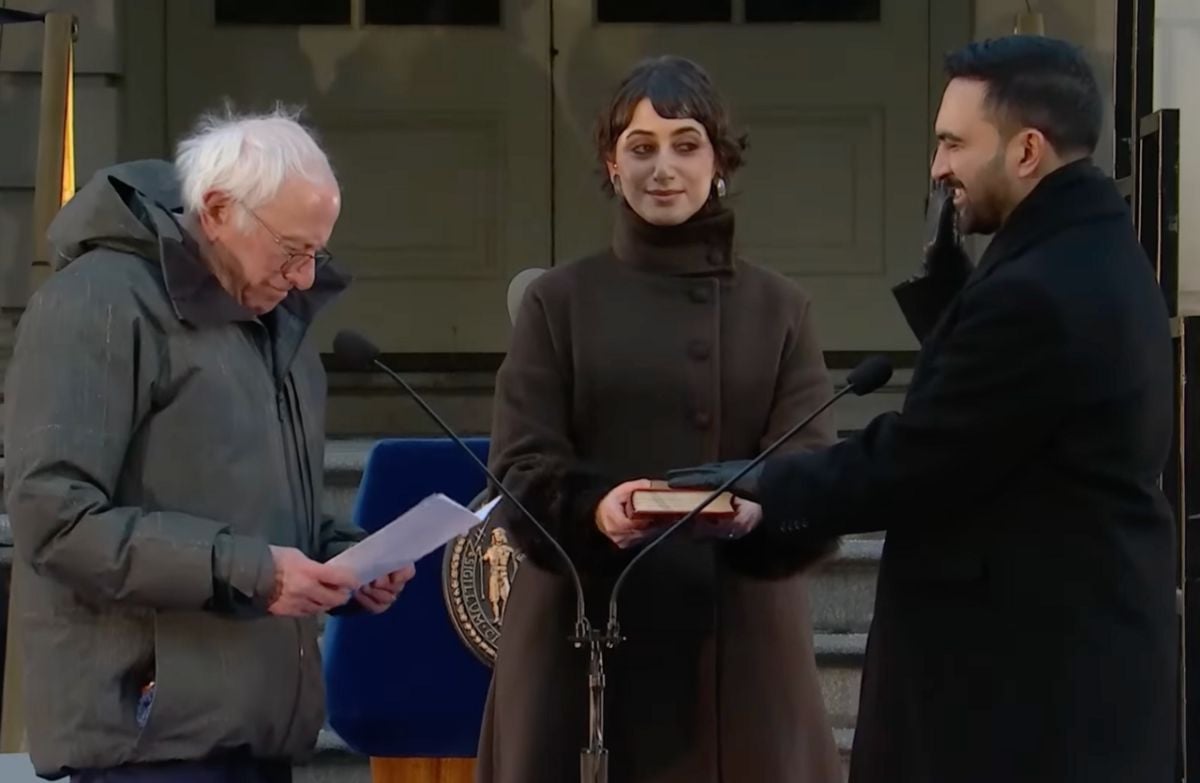
In the reign of Trump 2.0, few moments illustrate this dynamic better than right-wing America’s recent moral panic over New York City mayor Zohran Mamdani’s invocation of ‘collectivism’ in his inaugural address.
The great collectivism scare
When Mamdani declared that his politics sought to replace “the frigidity of rugged individualism with the warmth of collectivism,” one could have reasonably interpreted it as a standard social-democratic sentiment: a critique of atomisation, a call for social solidarity in a city buckling under inequality. But that is not how conservative America chose to hear it.
Fox News and its political echo chamber responded as if a Cold War time capsule had burst open.
Florida’s Republican Governor Ron DeSantis warned darkly of the body count associated with collectivist ideologies. “The ‘warmth’ of collectivism that always requires coercion and force. How many dead over the past 100 years due to collectivist ideologies?” he wrote in a post on X.
Congresswoman Lisa McClain branded Mamdani a “dangerous communist who is likely to DESTROY NYC through his dedication to communist ideology.”
“Let’s be clear: COMMUNISM HAS FAILED everywhere it has been tried. NYC will be no different,” she posted on X.
Ted Cruz announced, with the gravity of an Old Testament prophet, that “When communists rule, individual rights — invariably — are taken away.”
“Collectivism isn’t warm… It’s as cold as ice and locks the poor into perpetual poverty,” declared Republican Senator Mike Lee in a post.
Chip Roy, who is running for Texas attorney general, went further still, collapsing Mamdani’s politics, ethnicity, and religion into a single existential threat: “The Marxist and the Islamist are the enemy. The Mayor of New York is both.”
None of these claims seriously engage Mamdani’s actual politics or policy positions. Instead, they function symbolically, activating a familiar Cold War vocabulary of fear. The script was familiar, even nostalgic. Communism is back. The republic is under threat. Freedom itself hangs in the balance.
What was striking was not the disagreement but the intensity, the way a single line from an inaugural address was inflated into a civilisational emergency. Gramsci’s concept of hegemony is essential here: dominant groups do not maintain power through force alone, but through the ability to define which ideas are legitimate, dangerous, or unthinkable. By framing “collectivism” as inherently murderous and un-American, the American populist conservatives participate in a hegemonic project that forecloses meaningful alternatives to neoliberal capitalism.
The fragility of rugged individualism
To understand why “collectivism” triggers such hysteria in the American imagination, one must confront the mythology of rugged individualism. This story of self-made men, lone pioneers, and bootstrap capitalism has long served as the moral backbone of American political culture. It reassures citizens that success is earned, failure is deserved, and inequality is natural. From the frontier myth to Silicon Valley libertarianism, individualism is presented as the moral foundation of American identity.
The problem, of course, is that the story no longer holds. In fact, it never truly did. This myth has always been selective and exclusionary. It erases the role of collective labour, state intervention, slavery, indigenous dispossession, and public infrastructure in producing American prosperity.
The American state has always been deeply involved in shaping markets, distributing opportunity, and protecting capital. From westward expansion to the New Deal, from wartime mobilisation to Silicon Valley subsidies, collectivism, though rarely named as such, has been foundational. What changed is not the reality of collective dependence, but the credibility of the myth that denies it.
In an era of stagnant wages, obscene wealth concentration, unaffordable housing, and collapsing public services, rugged individualism has begun to look less like a virtue and more like a cruel joke.
Mamdani’s critique of “rugged individualism” challenges not only an economic philosophy but a national self-image. In Gramscian terms, it threatens common sense. That threat explains why the reaction is so disproportionate. To accept collectivism, even in a limited social-democratic sense, would require acknowledging that individual success is inseparable from social structures. For a political culture built on moralising inequality, this acknowledgment is intolerable. That is precisely why it provoked panic.

The American Dream, in freefall
Closely tied to individualism is the American Dream — the promise that hard work will be rewarded with stability, dignity, and upward mobility. For decades, this dream functioned as a powerful anaesthetic. Inequality could be tolerated so long as it appeared temporary. Poverty could be moralised so long as escape seemed plausible.
But dreams, like empires, decay quietly before they collapse loudly. Today, the American Dream survives mostly as branding. For millions, especially younger generations, it has become an object of irony rather than aspiration. Student debt, precarious work, medical bankruptcy, and permanent housing insecurity have made the promise of upward mobility feel almost obscene.
Here, Žižek’s provocation cuts sharply: the real “morbid symptom” is not the radical critique of the system, but the fantasy that the system can continue unchanged. When that fantasy begins to crumble, ideology does not retreat. It doubles down. And so “collectivism” becomes a curse word, a stand-in for everything that threatens to expose the lie.
McCarthyism, rebooted
There is something eerily familiar about the Mamdani backlash. It echoes the logic, if not the exact conditions, of McCarthyism, the mid-century communist panic that turned dissent into treason and critique into subversion. Then, as now, accusations of communism were less about actual political programmes than about enforcing the boundaries of acceptable thought.
McCarthyism emerged during another interregnum, when the post Second World War industrial capitalism was mutating into a Cold War order defined by militarisation, surveillance and corporate power. Rather than address these transformations directly, the political system displaced its anxieties about racial integration, class-consciousness and decolonisation onto an internal enemy.
Today’s collectivism scare performs a similar function. Gramsci reminds us that when ruling groups lose moral authority, they increasingly rely on coercive narratives rather than consent. Mamdani is dangerous not because of any specific policy, but because he disrupts the carefully managed illusion that no alternatives exist. His politics gesture, however modestly, toward class as a meaningful category. Class, in American discourse, remains the most taboo subject of all.
Manufacturing panic, manufacturing consent
None of this would work without media institutions willing to launder fear into common sense. This is where the old idea of “manufactured consent” remains painfully relevant, even if Noam Chomsky himself has become controversial. The goal is not to persuade audiences through evidence, but to structure the field of debate so that certain questions never arise.
Fox News did not ask whether collectivist policies might alleviate housing crises or healthcare inequities. It asked how many millions collectivism has killed. The move is deliberate. By framing the issue in moral absolutes, the network ensures that the conversation ends before it begins.
Gramsci would recognise this immediately. Hegemony, after all, is not about silencing opposition outright; it is about making opposition appear unthinkable, dangerous, or absurd. In moments of crisis, this process intensifies. The louder the panic, the weaker the underlying legitimacy.
The monster is not Mamdani
Žižek reminds us that monsters do not emerge because politics has gone wrong, but because politics is doing exactly what it does when confronted with its own limits. Trump was one such monster, Biden another, each embodying a different response to systemic decay. Mamdani, by contrast, represents something else entirely: a crack in the narrative.
The true morbidity is not collectivism, but the desperate attempt to preserve a world that no longer works by turning every alternative into an existential threat. The irony, of course, is that this strategy only accelerates the very instability it seeks to contain.
Gramsci never promised redemption. He did not believe that the interregnum would resolve itself neatly, or that monsters would politely step aside once reason prevailed. Politics, for him, was always a struggle — messy, embodied, ideological to its core.
If the reaction to Mamdani tells us anything, it is that America remains very much in that struggle. The old myths are dying. The new possibilities are still contested. And the monsters, loud and panicked, are working overtime to convince us that nothing must ever change.
Whether they succeed is the only question that matters.
Zeeshan Ahmad is a freelance journalist and media scholar who writes about politics, security, technology and media narratives
All facts and information are the sole responsibility of the author
