




“Under the Belt and Road Initiative, universities in China and Africa are fighting side by side for the shared development of education,” said Mammo Muchie, a professor at Tshwane University of Technology in Pretoria, South Africa.
HANGZHOU/JOHANNESBURG, Jan. 13 (Xinhua) — In July 2025, braving Typhoon Co-may’s gales, a planeload of 20 Zhejiang Normal University students and teachers landed at Port Elizabeth in South Africa, becoming one more wave in an unfaltering stream of China-Africa educational exchanges launched in recent years.
With the 2026 China-Africa Year of People-to-People Exchanges now underway, the university sustains its grassroots bonds by sending roughly 100 personnel south annually as new African cohorts arrive each term.
Throughout the years, the influence of China-Africa collaboration in classrooms has extended far beyond the educational sphere. It stands as a vivid testimony to a partnership that has empowered tens of thousands of students and drawn the two sides ever closer across continents.
BUILDING BRIDGES
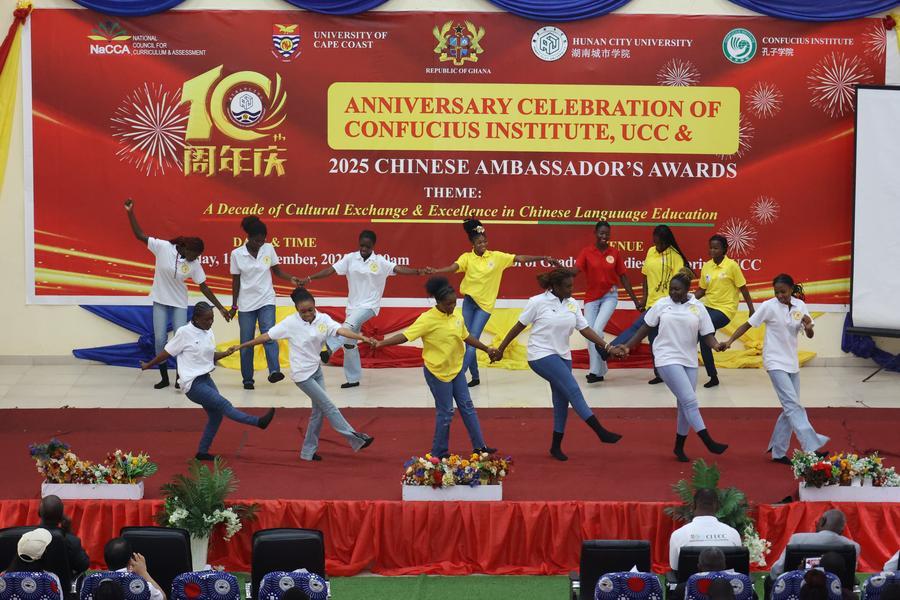
The past year marked the 10th anniversary of the Chinese language being formally incorporated into South Africa’s national education system.
The impact is often measured in policy terms, but its most revealing effects are quieter, unfolding through the choices of young people.
For Musfirah Yasir, those choices are deeply personal. Born in Pakistan and raised in Johannesburg, she is now a global marketing student at the University of Johannesburg. After class, she practices Mandarin tones repeatedly, then studies the fine details of traditional Chinese dance in front of a mirror.
Performing at cultural events organized by the Chinese Embassy in South Africa, Yasir felt the distance between herself and China begins to narrow. “It stopped feeling abstract,” she said. “It felt closer.”
Her experience reflects the work of the Confucius Institute at the University of Johannesburg over the past 10 years. Students from universities encounter Chinese in the classroom, then carry it beyond campus — toward study opportunities in China or early careers with Chinese-linked companies.
Practical language programs for public institutions and businesses have helped Mandarin move from the classroom to everyday use.
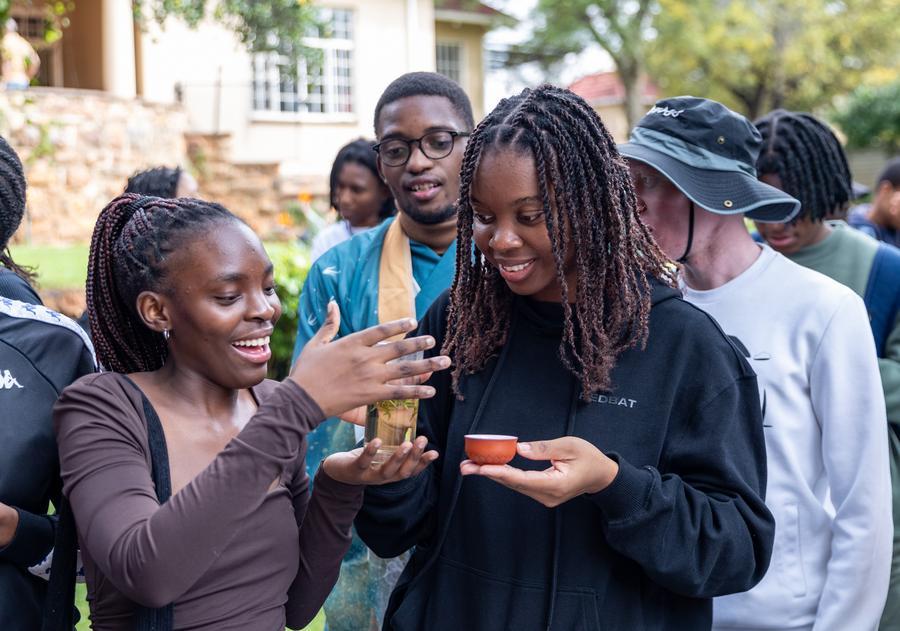
For Yasir, this shift brings clarity. Language study, cultural practice and academic ambition now converge, where China-Africa educational cooperation is no longer an idea, but daily effort, measured in pronunciation drills, careful dance movements, and a future slowly coming into focus.
“With over 1,000 students enrolling each year, the impact is tangible,” said Li Baosheng, Chinese director of the Confucius Institute at the University of Johannesburg. “Our goal is to help more young people turn language learning into real opportunities, and I believe every institute shares the same mission.”
Nait Si Youssef, once a German major at Hassan II University in the Moroccan city of Casablanca, changed his degree to Chinese after his first class at the campus Confucius Institute.
That single decision, he says, rerouted his life: He is now a Ph.D. candidate at the Institute of African Studies at Zhejiang Normal University.
“I discovered I loved the tones and the characters, but more importantly, I saw a future attached to them,” said Youssef.
Within months, he switched majors. Within years, he crossed continents.
Now focusing his research on China-Africa relations, Youssef hopes to pursue a future in diplomacy after graduation and to help build wider cultural links between China and Morocco. “Language opens doors,” he said. “Understanding keeps them open.”
THE “LAGOS BOY”
Since 1964, when China first offered government scholarships to Nigerian students, more than 1,700 Nigerians have studied in China on such grants. Over the years, Chinese students have also been heading to this West African nation.
Liu Hongwu, founder and director of the Institute of African Studies at Zhejiang Normal University, is now 67. Among the earliest Chinese to engage in academic exchange in Africa, he arrived at the University of Lagos as a visiting scholar about 35 years ago.
While there, Liu went far beyond his coursework, determined to walk the length and breadth of Africa.
He observed that many African countries paid scant attention to history; in numerous primary and secondary schools, the subject was not taught at all, leaving countless young Africans ignorant of their own past.
Ten years later, drawing on the contacts and materials he had gathered, Liu published “From Tribal Society to Nation-State: A Survey of the National Development of Nigeria.” An English edition, released in 2024, is now available in Nigeria.
“This work is one of the most detailed books on Nigeria’s history and by a foreigner,” said Ikenna Emewu, editor-in-chief of Africa China Economy Magazine. “His book teaches Nigerians the Nigerian history.”
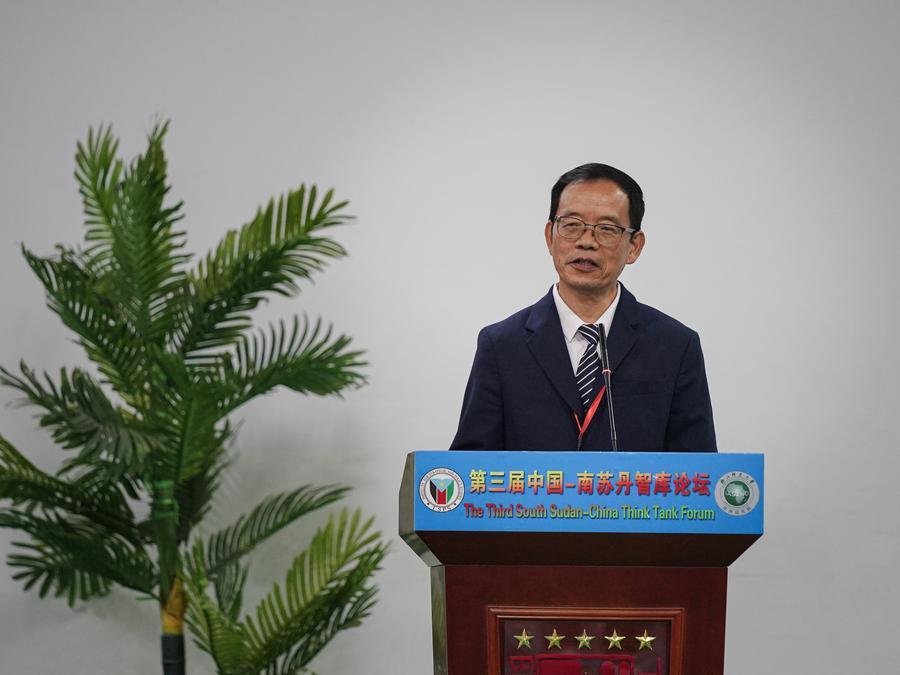
To many in Nigeria, the arrival of the book feels like Liu’s homecoming. Young and old alike have taken to calling him the “Lagos Boy,” greeting him as a return of a long-lost family member, and as living proof that China-Africa exchanges run straight into people’s hearts.
“I love the nickname,” Liu said. “It means my African friends have taken me in.” From the moment he first set foot on African soil, he believed every partnership must be built on trust.
Guided by that conviction, Liu founded China’s first university-based African studies institute at Zhejiang Normal University in September 2007. Starting from scratch, he rallied the university, government and African partners to forge China’s research on Africa into what it is today.
Modern Africa, scarred by colonial conquest, was long denied sound technical schooling. After independence, many nations never managed to build an education system capable of feeding economic and technological advances.
Liu boiled it down to one idea: tailor education to African realities and tie it straight to development.
Today, Zhejiang Normal University’s annual training sessions have attracted more than 4,000 African participants.
With his initiative, the institute joined forces with the China Scholarship Council to open a West African branch at Nigeria’s University of Ibadan. Every year, more than 100 staff and students travel to Africa for study, fieldwork, or exchanges.
“People-to-people ties are the cornerstone of cooperation,” Liu said. “In Africa, I’m not a professor, not a director, just a ‘Lagos Boy’ back home.”
LASTING BOND
A representative case of China-Africa cooperation in recent years is the educational cooperation between Zhejiang Normal University and Nelson Mandela University.
The partnership took a decisive turn on Sept. 10, 2019, when the two universities jointly hosted the 2nd China-South Africa Youth Innovation and Entrepreneurship Forum in South Africa.
Despite a six-hour time difference, collaboration between the two universities has remained in lockstep. That event marked their first formal, institutional collaboration. Six years on, what began as an experiment has matured into a durable academic relationship.
“From our university’s perspective, the partnership with Zhejiang Normal University has developed in a steady, structured and increasingly institutionalized manner,” said Johannes van Rensburg, director of partnerships and programs of the SAC Think Tank at Nelson Mandela University.
“What started as academic engagement and exploratory exchanges has gradually evolved into a formal cooperation framework covering student mobility, short-term study programs, joint research activities and academic visits,” he added.
Li Zhaoying, director of the China-Africa Media Research and Communication Center at Zhejiang Normal University, spent six months in 2024 and 2025 as a visiting scholar at Nelson Mandela University.
“They are genuinely interested,” Li said of her South African students. “They recognize China’s rapid rise in recent decades and its progress in science and technology, but they know much less about China’s humanities and social sciences.”
Her lectures on China’s social science traditions and differences between Chinese perspectives on international relations and Western frameworks were warmly received.
“That curiosity is what makes the exchange meaningful,” she said.
“Under the Belt and Road Initiative, universities in China and Africa are fighting side by side for the shared development of education,” said Mammo Muchie, a professor at Tshwane University of Technology in Pretoria, South Africa.
“If we strengthen action-oriented research, teaching, training and community-based problem-solving,” Muchie said, “the China-Africa partnership can achieve genuine and lasting impact.”■
