


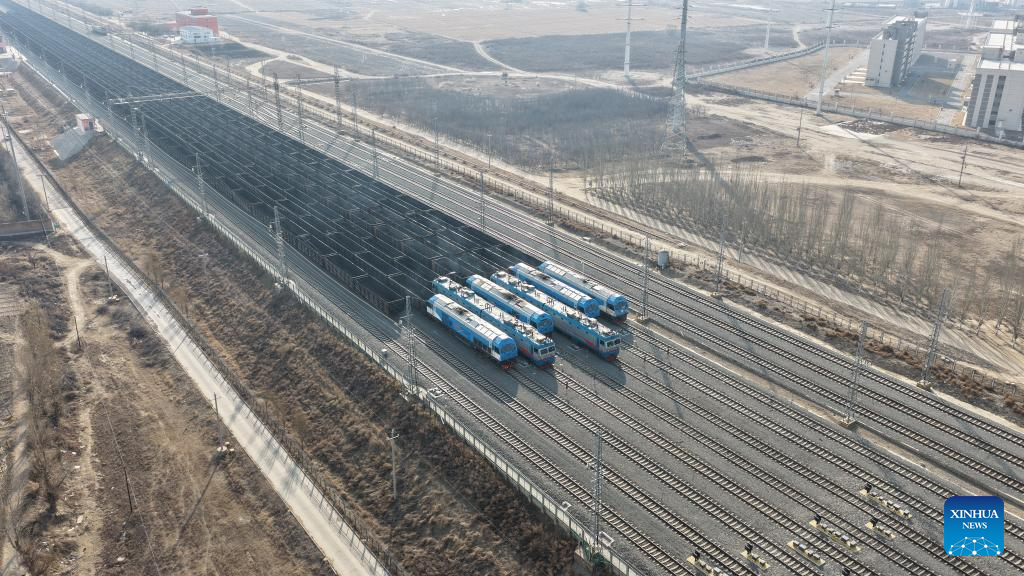
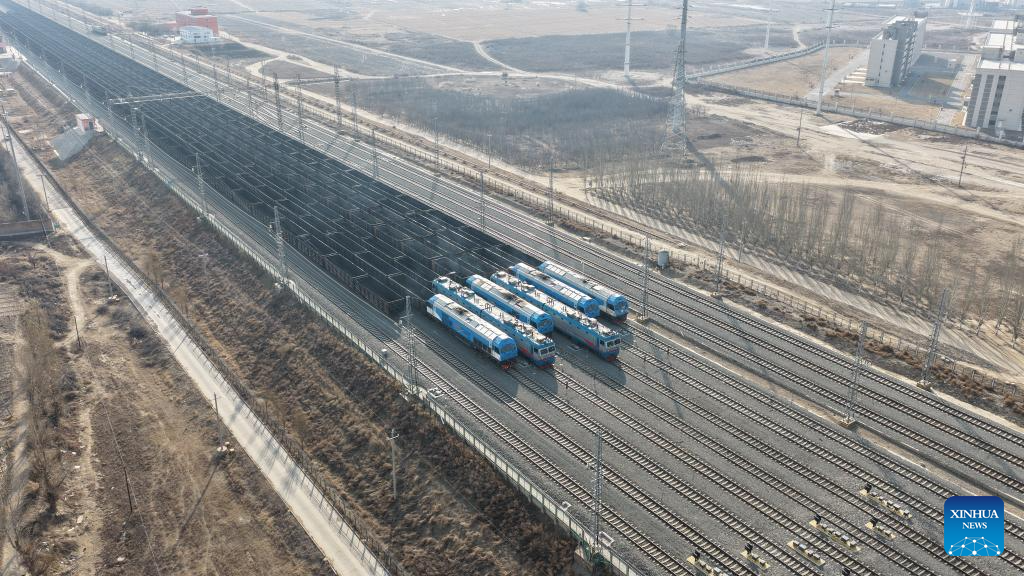
An aerial drone photo taken on Dec. 8, 2025 shows seven 5,000-tonne heavy-haul freight trains after an inaugural trial in north China’s Inner Mongolia Autonomous Region. (CHN ENERGY Baoshen Railway Co., Ltd./Handout via Xinhua)
HOHHOT, Jan. 14 (Xinhua) — The vast grasslands of Inner Mongolia Autonomous Region in north China is witnessing a new kind of migration this winter. It is not the movement of herds, but rather that of “mountains” in motion.
Seven colossal trains, carrying a total of 35,000 tonnes of coals, glided across the Baotou-Shenmu Railway, which connects Baotou City of Inner Mongolia and Shenmu City of Shaanxi Province, in perfect, silent unison. They were not chained together by steel, but bound by an invisible thread of data, which promises to unlock the next era of rail freight.
This world-first trial of a heavy-haul “group train” achieved what had long been considered a physical limit. By replacing heavy metal couplers with high-speed wireless signals, engineers have taught massive freight trains to move as one coordinated unit, dramatically boosting capacity on existing tracks.
Following a successful inaugural trial on Dec. 8, 2025, such trials have been carried on over the past month and are being expanded from five to eight stations, incorporating data collection on station operations and autonomous driving tests, said Liu Zhaohui, general manager of the CHN ENERGY Baoshen Railway Co., Ltd, organizer of the trials.
These efforts provide measured evidence for engineering applications in transport organization and management, laying a solid foundation for future group train systems, Liu told Xinhua on Wednesday.
DIGITAL HANDSHAKES REPLACE STEEL
For over a century, moving more cargo meant building longer trains. But physics fights back. The longer the train, the more violent the forces slamming through its steel couplings during starts and stops, risking breakages. Safe operation also demands certain distances between trains, creating a natural ceiling limiting how many can run each day.
The Chinese solution, developed by the China Railway Signal & Communication (CRSC) Research & Design Institute Group, is elegantly simple in concept and yet complex in execution, basically letting the trains “talk” instead of tugging.
During the inaugural trial of the 35,000-tonne heavy-haul group train, the longest and the heaviest such formation in the world, seven individual 5,000-tonne freight trains, stationed separately at four stations, dynamically assembled into one synchronized group using a “virtual coupling” system.
Operating as a single entity under tight cooperative control, the virtually coupled train traveled in close formation before automatically decoupling upon arrival at its destination, which was the Wanshuiquannan station. This successful test validated the core coordination technology, said Liu.
The system, poised for future operational deployment, is expected to significantly boost transport efficiency and yield substantial economic benefits, he noted.
Dubbed “virtual coupling,” the system uses a secure network to create a real-time digital link between independently powered trains.
Think of a precisely coordinated fleet of self-driving trucks on a highway. A central ground control system, developed by the CRSC Research & Design Institute Group, feeds real-time data on position, speed and commands to all units simultaneously.
“It’s like a highly disciplined convoy,” said Zhang Guozhen, the project lead at CRSC Research & Design Institute Group. “Each train knows the exact position, speed and intention of the others. When the lead train brakes, the signal flashes back through the group in milliseconds, and all seven brake in perfect sync.”
This “soft connection” eliminates the destructive forces of traditional long trains and slashes the mandatory safety buffer. During the trial, the loaded trains maintained a gap of less than 1,100 meters, with empty trains closing to 943 meters — distances impossible for conventional heavy-haul operations, according to Zhang.
CAPACITY REVOLUTION WITHOUT NEW TRACKS
The most immediate impact is on the bottom line, namely raw transport capacity. The Baotou-Shenmu Railway, a critical coal corridor, currently sees an annual freight about 180 million tonnes. This new system, requiring no expansion or modification of tracks or stations, is calculated to lift that capacity by over 50 percent, according to Liu.
“The beauty lies in using intelligence instead of iron,” he explained. “We are squeezing more efficiency from the infrastructure we already have.”
According to Zhang, the world’s most powerful traditional heavy-haul trains currently have a load capacity of around 20,000 tonnes and a length of up to 2.8 kilometers. Such trains require specialized locomotives, and their extreme length poses challenges for existing platforms, which often need modification to accommodate them.
However, with “virtual coupling” system, the combined unit can split back into separate trains to dock individually upon arrival or when routing adjustments are needed. This method, therefore, eliminates the need to modify existing platforms while increasing overall transport capacity.
For a country like China reliant on long-haul rail to transport vital resources like coal and ore from west to east, this software-driven boost is a strategic leap.
Additionally, synchronized movement eliminates the damaging jolts that wear out tracks and couplers, while drivers are able to transition from the stressful task of manually managing extreme forces to supervising a highly automated system.
“At first, seeing a train so close ahead was a bit frightening, fearing a collision. Gradually, I got used to it because the system’s calculated safety margin is safe,” said train driver Shi Haogang, who participated in the first trial.
While the concept of digitally coordinating trains has been explored abroad, primarily for passenger services, China’s trial marks its definitive arrival in the demanding world of heavy freight. The scale, 35,000 tonnes and involving seven trains coordinating across multiple stations, is unprecedented, according to Liu Hongfei, chief engineer on the project.
“Our system, allowing the flexibility for trains starting from different stations to dynamically form a single, virtual unit, is a significant step forward,” said Liu.
The successful trial offers a new template for global rail logistics. At a time when many economies seek greener transport alternatives, enhancing rail capacity is crucial. China’s demonstration provides a viable pathway.
“It’s a major boost in efficiency achieved not through pouring concrete, but through deploying code and connectivity,” said Liu. ■
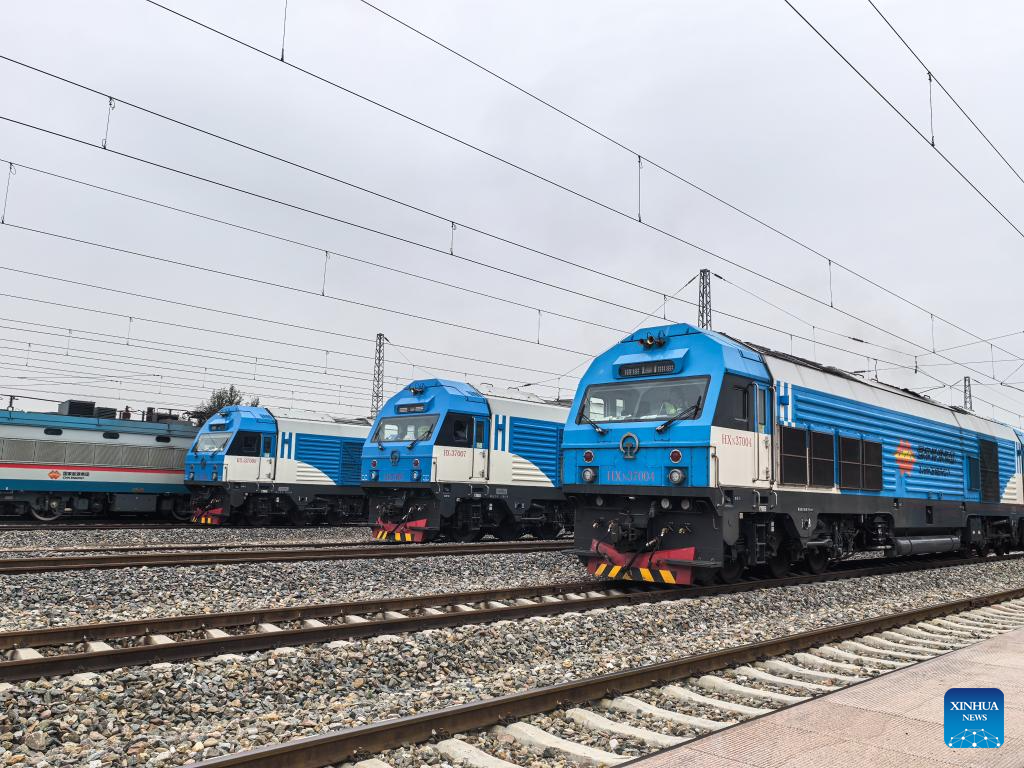
The 35,000-tonne heavy-haul group train moves during the inaugural trial along the Baotou-Shenmu Railway in north China’s Inner Mongolia Autonomous Region, Dec. 8, 2025. (Photo by Song Gaojie/Xinhua)
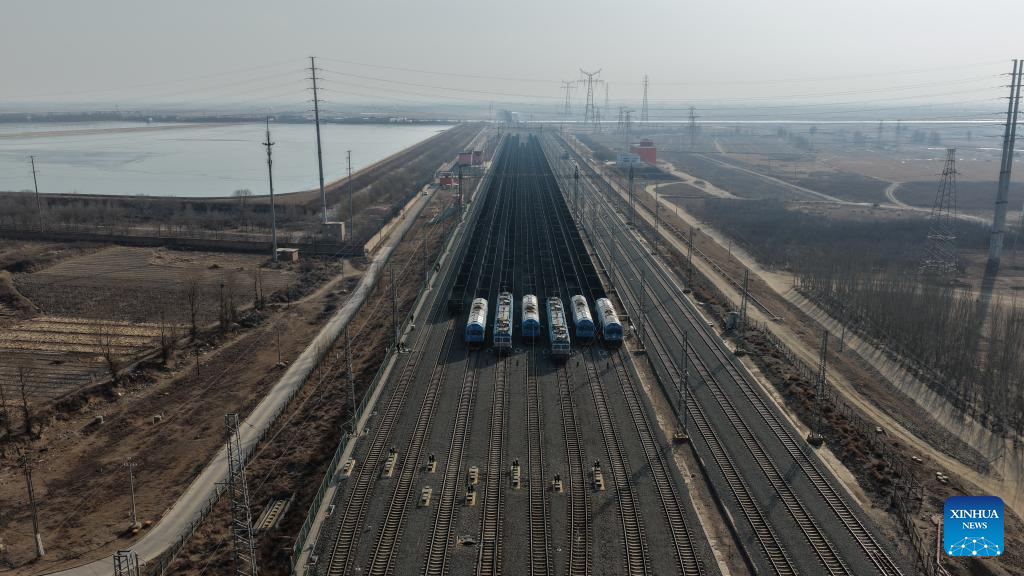
An aerial drone photo taken on Dec. 8, 2025 shows the 35,000-tonne heavy-haul group train during an inaugural trial along the Baotou-Shenmu Railway in north China’s Inner Mongolia Autonomous Region. (CHN ENERGY Baoshen Railway Co., Ltd./Handout via Xinhua)
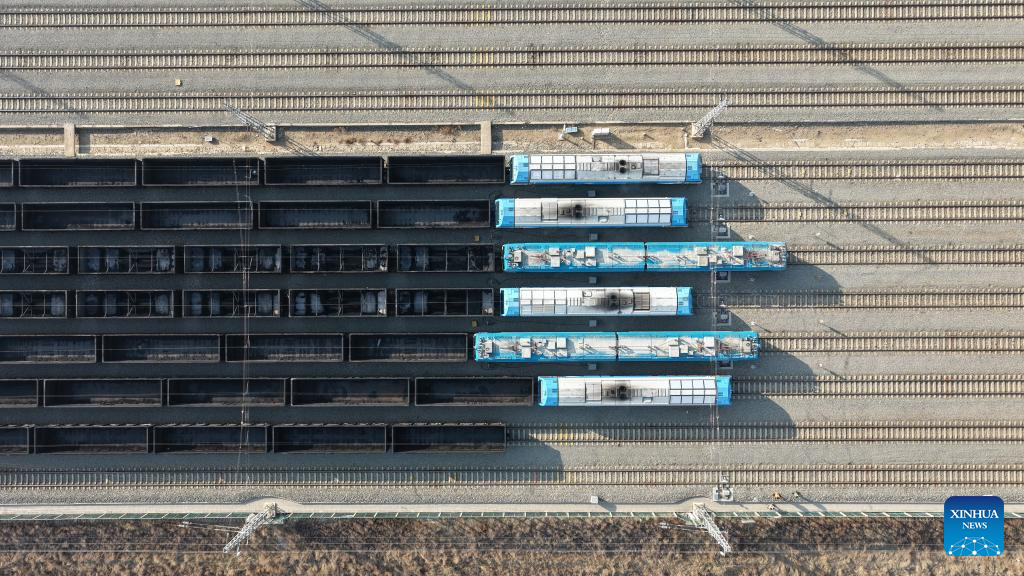
An aerial drone photo taken on Dec. 8, 2025 shows seven 5,000-tonne heavy-haul freight trains after an inaugural trial in north China’s Inner Mongolia Autonomous Region. (CHN ENERGY Baoshen Railway Co., Ltd./Handout via Xinhua)
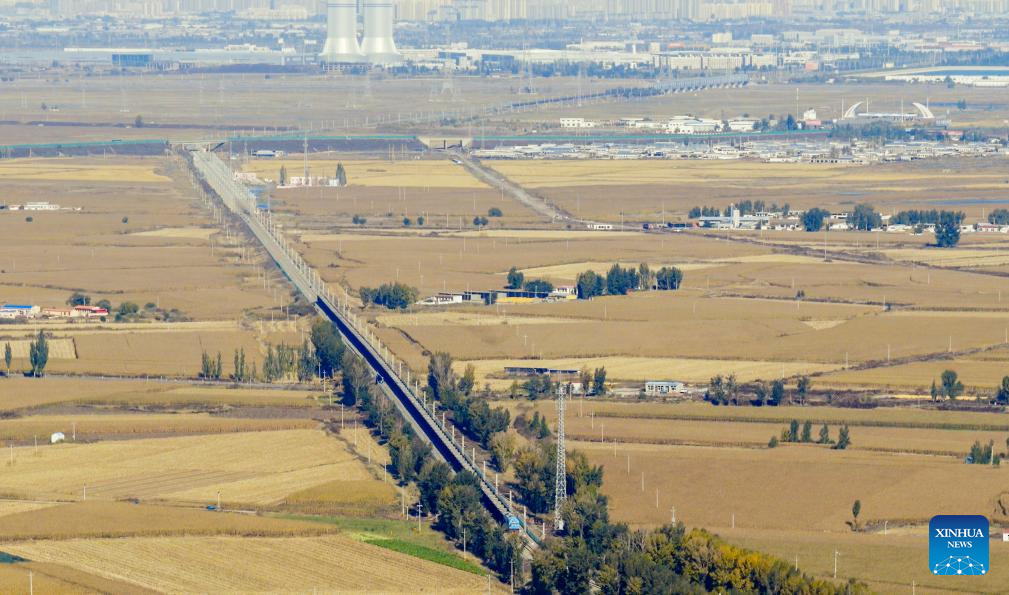
An aerial drone photo taken on Dec. 8, 2025 shows the 35,000-tonne heavy-haul group train during an inaugural trial along the Baotou-Shenmu Railway in north China’s Inner Mongolia Autonomous Region. (CHN ENERGY Baoshen Railway Co., Ltd./Handout via Xinhua)
