


Abbas Araghchi conveys his ‘deep appreciation’ to PM Shehbaz and Pakistanis, praises Islamabad’s ‘principled stance’
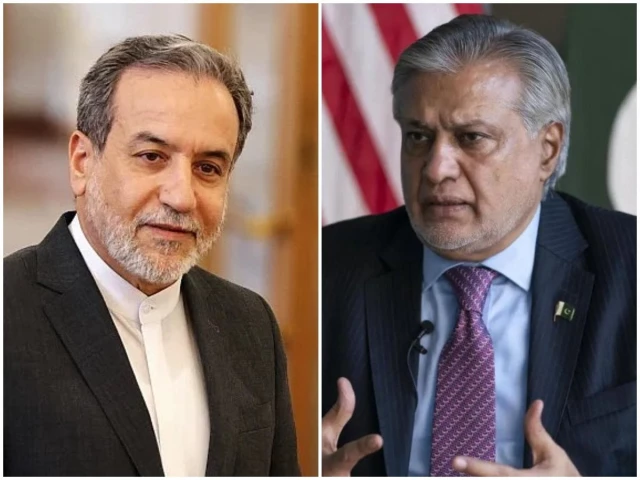
Iran Foreign Minister Abbas Araghchi (L) and Foreign Minister, Ishaq Dar (R). Photo: Files
Iranian Foreign Minister Abbas Araghchi on Saturday called Deputy Prime Minister Ishaq Dar, and expressed gratitude for Pakistan’s strong support for Iran at the United Nations Human Rights Council in Geneva.
The call followed developments a day earlier, when the 47-member UN Human Rights Council voted to expand its investigation into Iran over its violent crackdown on protests that UN officials say left thousands dead, including children.
Read here: UNHRC decries ‘unprecedented’ Iran crackdown
With 25 votes in favour, seven against and the rest abstaining, the council decided to extend and broaden the mandate of independent investigators gathering evidence to ensure accountability for human rights violations in Iran. The council voiced alarm over “the unprecedented scale of the violent crackdown on peaceful protests by security forces”. However, Pakistan and China voted against the resolution.
According to the Ministry of Foreign Affairs, FM Dar received the call while in Dubai. During the conversation, the two leaders discussed regional and international developments, including evolving regional dynamics and issues of mutual interest.
Araghchi thanked Dar for Pakistan’s position at the UN Human Rights Council, including Islamabad’s call for a vote and its decision to vote against a resolution concerning Iran.
Deputy Prime Minister / Foreign Minister, Senator Mohammad Ishaq Dar @MIshaqDar50, while in Dubai today, received a telephone call from the Foreign Minister of the Islamic Republic of Iran, Seyed Abbas Araghchi @Araghchi.
The two leaders exchanged views on current regional and… pic.twitter.com/gYwWASEnyG
— Ministry of Foreign Affairs – Pakistan (@ForeignOfficePk) January 24, 2026
He also conveyed his “deep appreciation” to Prime Minister Shehbaz Sharif, the government and the people of Pakistan for what he described as their “principled stance”.
The two foreign ministers reaffirmed their commitment to continued engagement and cooperation on regional and international issues.
Iran’s ambassador to Pakistan had publicly thanked Islamabad a day ago for opposing the United Nations Human Rights Council resolution.
“I extend my sincere gratitude to the esteemed Government of the Islamic Republic of Pakistan, under the leadership of the Honourable Prime Minister, H.E. Muhammad Shehbaz Sharif, and the Deputy Prime Minister and Minister for Foreign Affairs, H.E. Muhammad Ishaq Dar,” Iran’s Ambassador Raza Amiri Moghadam said in a post on X.
He said Pakistan provided “historic and unwavering support” to Iran at the UN Human Rights Council in Geneva by calling for a vote and casting a negative vote against what he described as an “unjustified resolution targeting Iran.”
“I convey my special appreciation to the competent and professional representatives of the Permanent Mission of Pakistan in Geneva for their tireless efforts and dedication in the pursuit of justice,” he said.
I extend my sincere gratitude to the esteemed Government of the Islamic Republic of Pakistan, under the leadership of the Honorable Prime Minister, H.E. Muhammad Shehbaz Sharif, and the Deputy Prime Minister and Minister for Foreign Affairs, H.E. Muhammad Ishaq Dar, for their… https://t.co/hamR0E4JhD pic.twitter.com/xpSpQ2exhG
— Reza Amiri Moghadam (@IranAmbPak) January 23, 2026
Moghadam said Pakistan’s stance marked “the third consecutive defeat of unprovoked and politically motivated actions against Iran over the past year”, referring to what he called “the unprovoked 12-day aggression, recent foreign-backed riots aimed at destabilising the country, and the misuse of international organisations to pursue capricious and hostile agendas by certain members”.
“Such steadfast support is a clear reflection of Pakistan’s enduring commitment to justice, multilateralism, respect for human rights, and national sovereignty, and will be remembered with deep appreciation,” he added.
Read here: UNHRC decries ‘unprecedented’ Iran crackdown
The adopted text of the resolution extended the mandate of the UN special rapporteur on Iran for another year and prolonged for two years the work of a separate fact-finding mission established in November 2022 after protests erupted over the death in custody of Mahsa Amini, an Iranian Kurdish woman.
The resolution empowered investigators to probe “allegations of recent and ongoing serious human rights violations and abuses, and crimes perpetrated in relation to the protests”.
The vote followed an urgent session of the council requested by Britain, Germany, Iceland, Moldova and North Macedonia, a move sharply criticised by Iran.
In opening remarks to the council, UN rights chief Volker Turk said Iranian security forces had used “live ammunition” against protesters, adding that “thousands” had been killed, including children.
“I call on the Iranian authorities to reconsider, to pull back, and to end their brutal repression, including summary trials and disproportionate sentences,” Turk said.
