


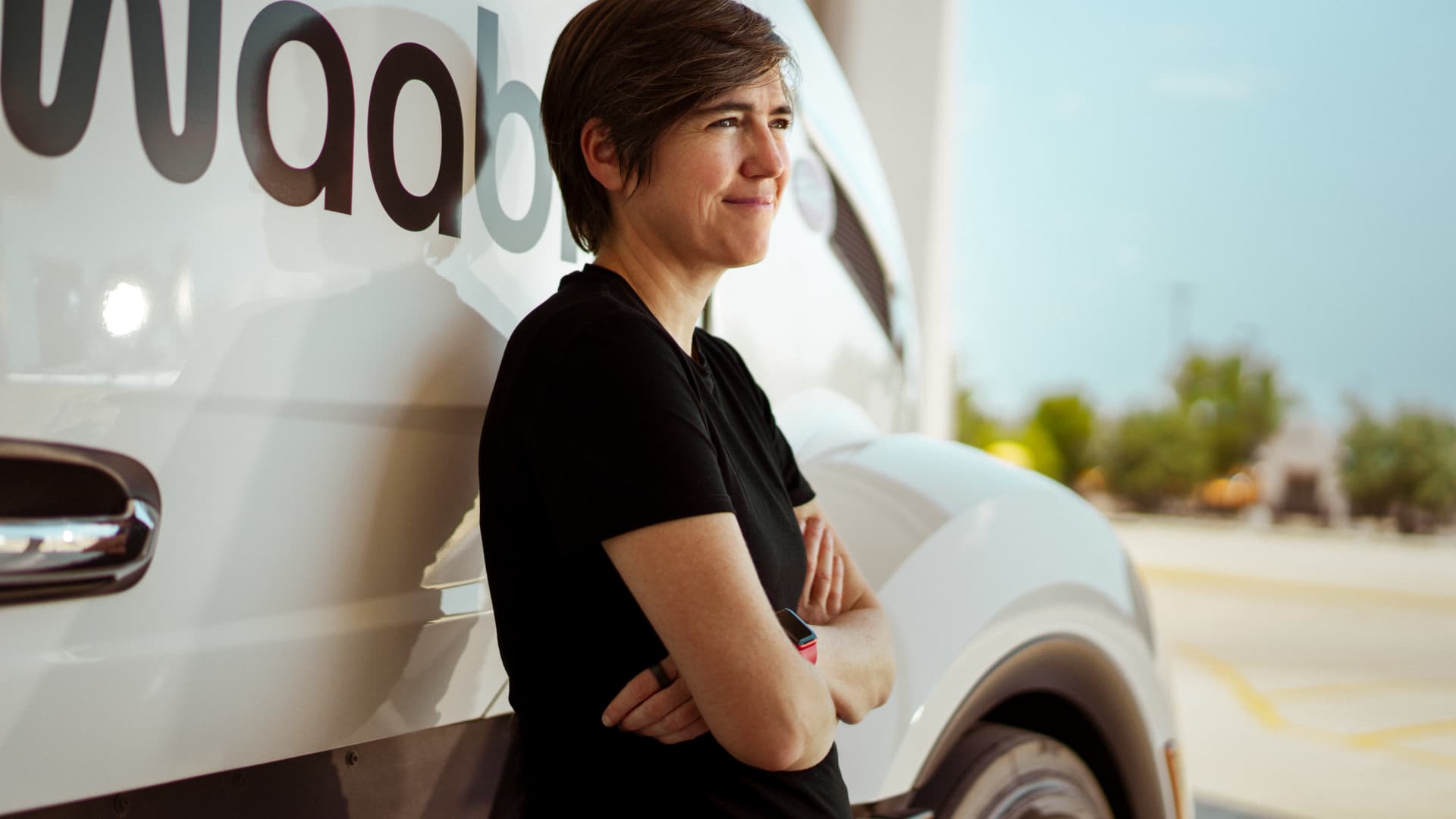
Waabi founder and CEO Raquel Urtasun
Courtesy of Waabi
Autonomous trucking startup Waabi has raised $750 million in a new round of venture funding to expand into the robotaxi market, the company announced Wednesday.
Waabi’s series C round is led by Khosla Ventures and G2 Venture Partners, the startup announced Wednesday. The deal is one of the largest single rounds ever raised by a Canadian tech startup.
In addition to Waabi’s series C, Uber has committed to invest $250 million into the startup based on future milestones. With Uber’s additional funding, Waabi will exclusively deploy at least 25,000 autonomous vehicles via the ridehail platform. Urtasun was previously a chief scientist at Uber’s Advanced Technologies Group that worked on AV technology.
Ranking 35 on CNBC’s 2025 Disruptor 50 list, Waabi is based in Toronto with some operations in Texas.
Founder and CEO Raquel Urtasun told CNBC the new funding will enable the company to adapt its “physical AI” to develop driverless systems that can be made to work in new locations, conditions and form factors with a high level of safety relatively quickly.
“For me, it’s been 16 years in self-driving,” she said. “But this is — it’s finally here, scale is here. And the next couple of years, it’s going to be amazing.”
Waabi has not yet revealed the vehicle models that will feature its systems.
The startup previously developed driverless, trailer-hauling trucks made in partnership with automakers Volvo and, before that, Peterbilt. While Waabi has operated a fleet of its own driverless trucks to haul customers’ cargo, it is now shifting to a “driver as a service” business model, said Urtasun, who is also a full professor of computer science at the University of Toronto.
Vinod Khosla, Founder, Khosla Ventures, backstage of Centre Stage during day one of Collision 2024 at the Enercare Centre in Toronto, Canada.
Vaughn Ridley | Sportsfile | Getty Images
Vinod Khosla, founder of Khosla Ventures and cofounder of computer hardware firm Sun Microsystems, told CNBC his fund is backing Waabi because it has taken a “capital efficient” approach to “physical AI,” and has a late mover’s advantage.
What predecessors in the autonomous vehicle industry achieved with thousands of engineers and billions of dollars spent on research, development and safety testing, Waabi can do for a fraction, Khosla said.
Urtasun agreed, pointing to profound advances in artificial intelligence, sensor technology and more since the earliest days of the DARPA Grand Challenge in 2004, which was an influential competition to inspire development of self-driving ground vehicles.
Because Waabi is focused on safety, time to market and cost, the startup does not compromise on the technology it uses, Urtasun said.
“We use multiple sensors, lidar, camera and radar,” she said. “That’s important because they each have very different characteristics and failure modes, and they’re much more robust if you use them all.”
Many driverless trucking startups have come and gone, but Waabi’s truck tech still faces competition from Aurora, Kodiak AI, Bot Auto and Tesla. Elon Musk’s automaker Tesla is poised to produce more of its Semi electric trucks in 2026, and has promised to develop self-driving systems for them.
The competition is even more fierce in the nascent robotaxi market.
Competitors already operating or developing driverless, light duty passenger vehicles include other Uber partners such as Alphabet-owned Waymo, Nuro and WeRide as well as automakers developing their own driverless systems including Tesla and Rivian in the U.S., and Xiamoi and BYD in China.
Additional investors in Waabi’s series C round include Nvidia venture capital arm NVentures, Volvo Group Venture Capital and Porsche Automobil Holding SE, among others.
WATCH: Uber CEO Dara Khosrowshahi: The consumer remains strong, but employment market strength is a worry

