


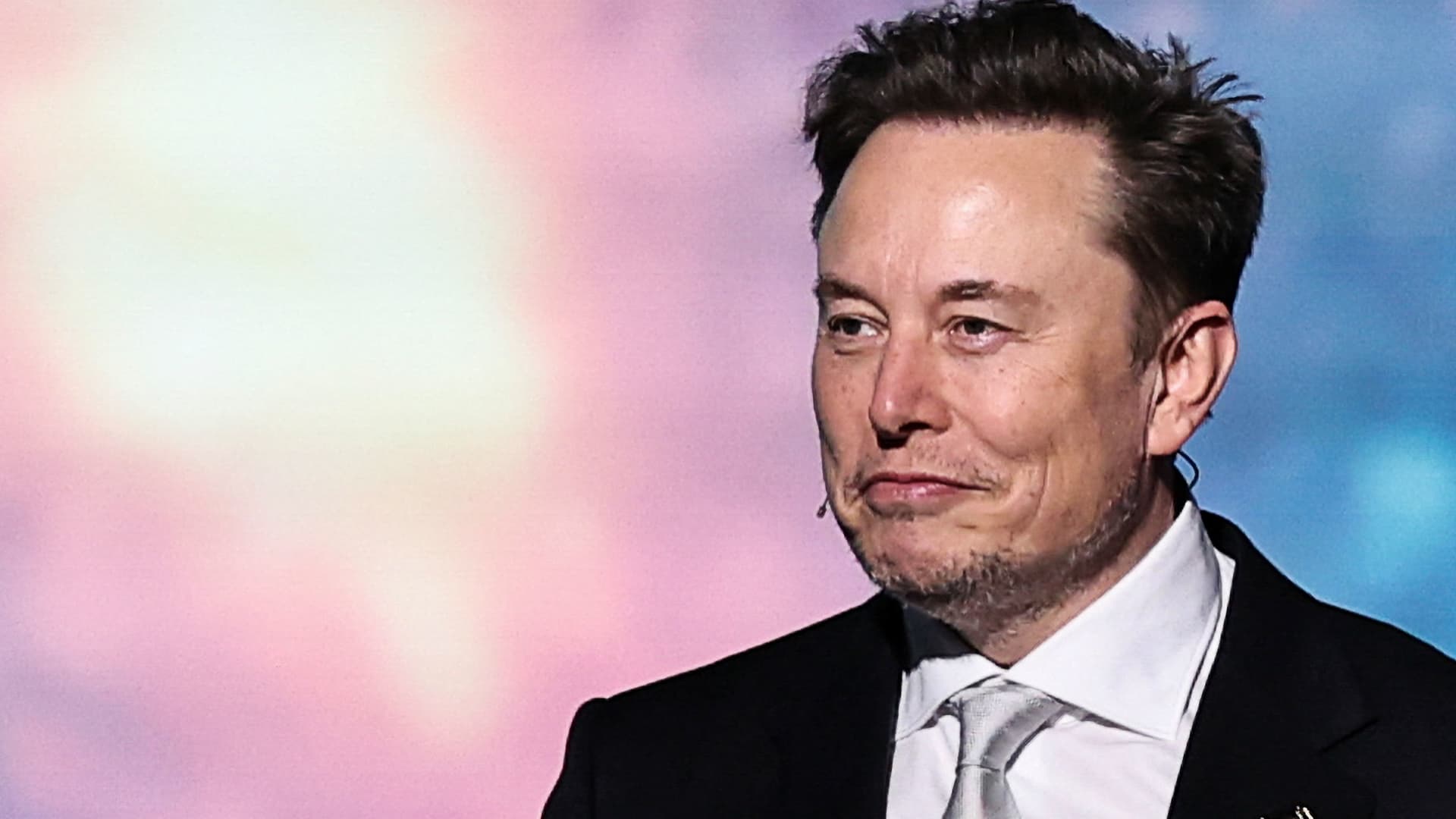
Tesla CEO Elon Musk attends the Saudi-U.S. Investment Forum, in Riyadh, Saudi Arabia, May 13, 2025.
Hamad I Mohammed | Reuters
Tesla reported better-than-expected fourth-quarter results after the bell on Wednesday, but revenue for the year dropped 3%, the first time on record the company has recorded an annual decline. The stock rose 2% in extended trading.
Here’s how the company did, compared with estimates from analysts polled by LSEG:
Earnings per share: 50 cents adjusted vs. 45 cents estimatedRevenue: $24.90 billion vs. $24.79 billion estimated
Auto sales have been sluggish in recent quarters for Tesla, as the company faces an onslaught of competition in various parts of the world, most notably from BYD in China.
Revenue in the fourth quarter slid 3% from $25.7 billion a year earlier, with the auto segment falling 11% to $17.7 billion from $19.8 billion.
Full-year revenue fell to $94.8 billion from $97.7 billion in 2024, the company said in an earnings release. The decline was caused, in part, by a “decrease in vehicle deliveries” and “lower regulatory credit revenue,” Tesla said.
Earlier this month, Tesla reported a 16% plunge in vehicle deliveries for the fourth quarter and 8.6% decline for the full year. Deliveries are the closest approximation of sales reported by Tesla, but are not precisely defined in the company’s shareholder communications.
Some of Tesla’s 2025 problems were related to CEO Elon Musk’s work with President Donald Trump, as well as his incendiary political rhetoric and endorsements of far-right figures in Europe. That sparked a consumer backlash, which persisted through the year.
Part of the decline also related to Tesla’s aging lineup. In the company’s earnings call on Wednesday, Musk said Tesla would put an end to production of its Model S and X vehicles, which were first sold in 2012 and 2015, respectively.
While Tesla’s core autos business has been struggling, Musk has tried to focus investor attention elsewhere. In particular, he’s touted the company’s nascent Robotaxi business and its Optimus humanoid robots, which have yet to hit the market.
Tesla plans to convert the factory lines where it had produced the Model S and X in Fremont, California, to lines that will make the forthcoming Optimus humanoid robots, Musk said.
“We’re really moving into a future that is based on autonomy,” Musk said, bracing investors for a high level of capital expenditures.
Tesla CFO Vaibhav Taneja said investors should expect some $20 billion in capex this year.
In 2025, Tesla launched a Robotaxi-branded ride-hailing app, and has been running a pilot service in Austin, Texas. Last week, Tesla executives said they had taken human safety supervisors out of a handful of cars in the Austin fleet to conduct driverless passenger rides.
The company said in its investor deck that it plans to have coverage in seven additional U.S. markets in the first half of this year. Those cities are Dallas, Houston, Phoenix, Miami, Orlando, Tampa and Las Vegas.
Tesla said that it has begun “tooling” in advance of production of its forthcoming Cybercab, which is a two-seat, “purpose-built” driverless car that will not include a steering wheel or pedals.
As for robots, Tesla said it plans to unveil the third generation of Optimus this quarter. “The Gen 3 is our first design meant for mass production,” the company said. Tesla is developing Optimus with the aim of someday selling it as a bipedal, intelligent robot capable of everything from factory work to babysitting.
Net income in the quarter plunged 61% to $840 million, or 24 cents per share, from $2.1 billion, or 60 cents per share, a year earlier, as operating expenses jumped 39%. Tesla said in its deck that some of the increase in costs was “driven by AI and other R&D projects.”
Revenue in the energy generation and storage business increased 25% to $3.84 billion from $3.06 billion a year ago. In the services and other segment, revenue rose 18% to $3.37 billion from $2.85 billion.
Tesla said that on Jan. 16, it entered into an agreement to invest about $2 billion in Musk’s artificial intelligence startup, xAI, “as part of their recent publicly-disclosed financing round.” Earlier this month, the OpenAI competitor said it raised $20 billion, exceeding its prior target of $15 billion, with Nvidia and Cisco participating in the round.
The xAI investment, along with a partnership with the company, is “intended to enhance Tesla’s ability to develop and deploy AI products and services into the physical world at scale,” Tesla said.
Capital expenditures fell 14% in the period to $2.39 billion from $2.78 billion a year earlier.
This is breaking news. Please check back for updates.
WATCH: Robotaxi will be major focus of Tesla’s earnings call

