


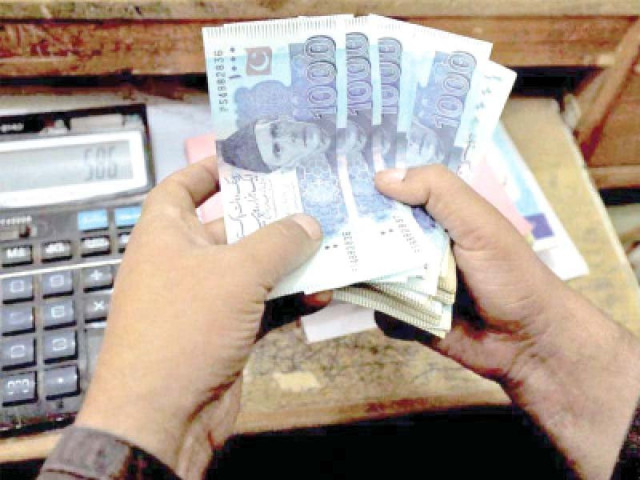
Last month, Prime Minister Imran and Shaikh had claimed that the public debt remained unchanged at Rs36.4 trillion during July-October period of this fiscal year. PHOTO: FILE
ISLAMABAD:
Pakistan’s total public debt remained Rs17 trillion higher than the maximum statutory limit set by Parliament to ensure fiscal discipline during the last fiscal year, but the government has still managed to reduce refinancing risks by extending the tenor of domestic loans.
The Debt Policy Statement 2026 disclosed that, against the maximum permissible debt limit of 56% of Gross Domestic Product (GDP), public debt surged to 70.7%. The statement has been prepared for the information of the National Assembly under the requirement of the Fiscal Responsibility and Debt Limitation Act (FRDLA). Public debt was higher by Rs16.8 trillion, or 14.7% of GDP, compared to the limit set in the FRDL law for fiscal year 2024-25, the report showed.
The higher and unsustainable debt levels are now consuming half of the annual budget, leaving no space for productive financing and constantly putting an additional tax burden on ordinary and already burdened segments of society.
The Federal Board of Revenue (FBR) is also failing the prime minister and has not been able to achieve even its downward revised tax targets, despite slowing refund payments, taking advances and benefiting from a favourable super tax judgment by the Federal Constitutional Court.
The FBR pooled Rs7.174 trillion during the JulyJanuary period of the current fiscal year, falling short of the significantly downward revised target by Rs347 billion. It also achieved hardly 10.5% growth in collections over last year’s revenues, which is half the rate required to meet the annual target. The monthly target was also missed by an Rs18 billion margin, despite the bonanza from the super tax judgment.
In its debt policy statement, the Ministry of Finance apprised Parliament that the “debt-to-GDP ratio has increased during fiscal year 2025”. However, the government assured Parliament that it remained committed to the objectives of the FRDL Act, 2005, with the aim of reducing public debt to sustainable levels over the medium term.
The ministry said this would be achieved by following a path of fiscal consolidation, generating primary surpluses and narrowing the fiscal deficit to place debt on a downward trajectory.
However, another document – the Fiscal Policy Statement 2026 – showed that the federal fiscal deficit was also 2.7% of GDP higher than the maximum prudent limit defined by Parliament under the FRDL law. The finance ministry said the new debt management strategy includes maturity lengthening through higher issuance of medium- to long-term debt instruments, including zero-coupon bonds, increasing the share of fixed-rate debt to manage interest rate risk, deepening the domestic debt market, diversifying investors and instruments, and diversifying access to international markets through Panda bond issuance and frequent investor engagement.
The debt policy statement further showed that the government has reduced refinancing risks, primarily by extending the tenure of domestic debt. External debt maturity marginally declined last fiscal year due to an increasing share of foreign commercial loans.
The report showed that the share of short-term Market Treasury Bills (MTBs) continued to decline from 24% as of June 2024 to 16.6% by the end of the last fiscal year. As a result, the average time to maturity of domestic government securities increased from 2.8 years to 3.8 years by June 2025.
The finance ministry said that, by taking advantage of a declining interest rate environment, the government focused on replacing maturing short-term Treasury Bills through increased issuance of medium- to long-term Pakistan Investment Bonds (PIBs) and Sukuk instruments.
However, the average time to maturity of external loans stood at around 6.1 years as of June 2025, slightly lower than the preceding year, due to the government taking $1.6 billion in additional commercial loans. As a result, commercial loans rose from $5.5 billion to $7.2 billion during the last fiscal year.
The finance ministry said that as of September 2025, 84% of loans were sourced from multilateral and bilateral lenders.
Overall, there was also a decline in the share of external debt in total public debt, from 34% to 32% in the last fiscal year, in compliance with the 40% ceiling set under the Medium-Term Debt Strategy.
As of June 2025, total public debt increased by 13% year-on-year to Rs80 trillion, of which domestic debt stood at Rs54.4 trillion and external debt at Rs26.1 trillion.
The policy statement showed that external debt rose by 6% to $91.8 billion as of June 2025, reflecting an increase of $5.3 billion. The major increase in external debt came from multilateral development partners, including the International Monetary Fund (IMF), which rose by 8.7% or nearly $4.3 billion. Borrowing from commercial banks increased by $1.6 billion, largely due to a $1 billion loan secured against an Asian Development Bank (ADB) policy-based guarantee.
More than half of Pakistan’s external debt is owed to multilateral development financial institutions, including the IMF. The second-largest source is bilateral partners, including the Paris Club and bilateral country deposits, accounting for around 26% of external debt, according to the finance ministry.
The report showed that during the last fiscal year, total domestic debt increased by Rs7.3 trillion to Rs54.4 trillion, representing a rise of 16%.
