


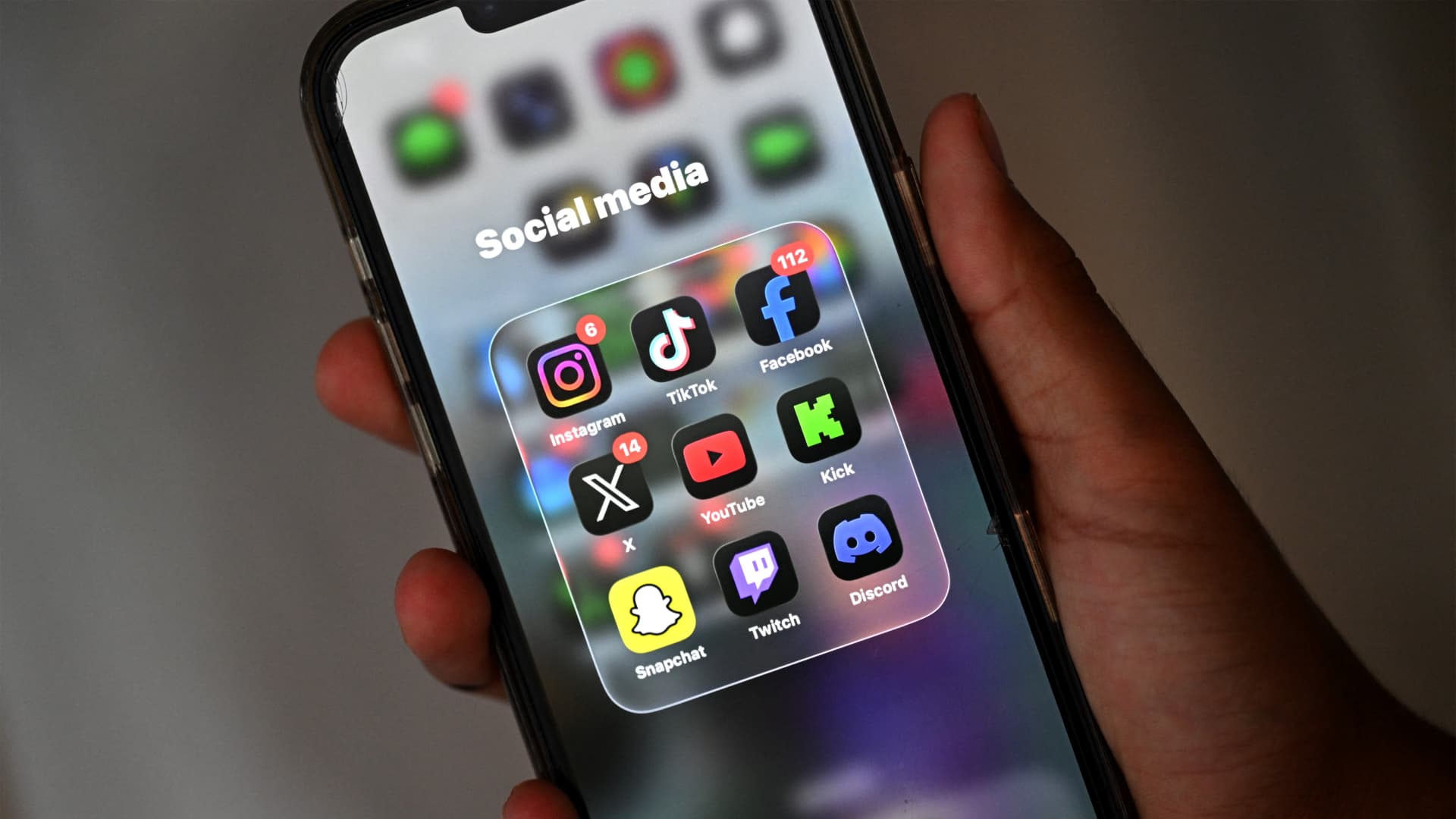
A 13-year-old boy poses at his home as he looks at social media on his mobile phone in Sydney on December 8, 2025. (Photo by Saeed KHAN / AFP via Getty Images)
Saeed Khan | Afp | Getty Images
Spain announced plans on Tuesday to introduce an Australia-style social media ban for under-16s as part of a broader crackdown on tech giants over systemic failures to protect users from harm.
Pedro Sanchez, the prime minister of Spain, spoke at the World Government Summit in Dubai and decried the misconduct of social media platforms. Sanchez said teens under 16 will be unable to access social media platforms starting next week as part of a series of five government measures targeting the platforms.
“Social media has become a failed state, a place where laws are ignored, and crime is endured, where disinformation is worth more than truth, and half of users suffer hate speech,” Sanchez said. “A failed state in which algorithms distort the public conversation and our data and image are defied and sold.”
He explained that to enforce a ban for under-16s, “platforms will be required to implement effective age-verification systems — not just checkboxes, but real barriers that work.”
Sanchez added: “Today, our children are exposed to a space they were never meant to navigate alone: a space of addiction, abuse, pornography, manipulation, and violence. We will no longer accept that. We will protect them from the digital wild west.”

Spain is the first European country to officially introduce a ban after Australia’s Online Safety Amendment Act came into effect in December.
It effectively required platforms such as Meta’s Instagram, ByteDance’s TikTok, Alphabet’s YouTube, Elon Musk’s X, and Reddit to implement age-verification measures or face a fine of up to 49.5 million Australian dollars ($32 million) for non-compliance.
Spain has yet to define which firms are affected by its new rules, but Sanchez criticized major platforms, including TikTok, for allowing accounts to share “AI-generated child abuse materials,” Elon Musk’s X for enabling its AI chatbot Grok to “generate illegal sexual content,” and Instagram for “spying on millions of Android users,” amongst other misdoings.
CNBC has reached out to TikTok, X and Instagram regarding these claims and is awaiting comment.
Spain’s four other measures focus on legal accountability for executives who fail to remove unregulated or hateful content, and turning “algorithmic manipulation and the amplification of illegal content” into a new criminal offense.
Sanchez mentioned that five other European countries had joined Spain in enforcing stricter rules on social media platforms.
France’s National Assembly recently voted in favor of a bill that would restrict social media access for under-16s, but the bill still needs to be approved by the Senate before it officially passes. Similarly, the U.K. House of Lords backed a ban on social media for under-16s, but it must first pass through the House of Commons for approval.
Tech firms respond
While Australia’s social media ban was closely watched worldwide, Spain’s new announcement sets a precedent that more countries will follow. This has left major tech companies in the lurch.
Meta, the owner of Instagram, Facebook, and Threads, said in January that it had removed 550,000 accounts believed to belong to under-16s in Australia across its platforms. It urged the Australian government to reconsider its decision.
“We call on the Australian government to engage with industry constructively to find a better way forward, such as incentivising all of industry to raise the standard in providing safe, privacy-preserving, age-appropriate experiences online, instead of blanket bans,” Meta said.

Meta has warned that teens will still try to find ways to access social media apps in other ways, without the safeguards registered users are provided with.
Meanwhile, Reddit has launched a legal challenge against Australia, saying the new law is ineffective and limits political discussion.
“This is a global issue, and governments everywhere are under pressure to respond,” Daisy Greenwell, co-founder of U.K.-based Smartphone Free Childhood, previously told CNBC. SFC is a grassroots campaign urging parents to delay smartphone and social media use for children.
“We’re already seeing countries move in this direction, and as confidence builds and evidence accumulates, more will follow. No one thinks the status quo is working for children, parents, or society – and this is one of the clearest policy responses currently on the table,” Greenwell added.
