


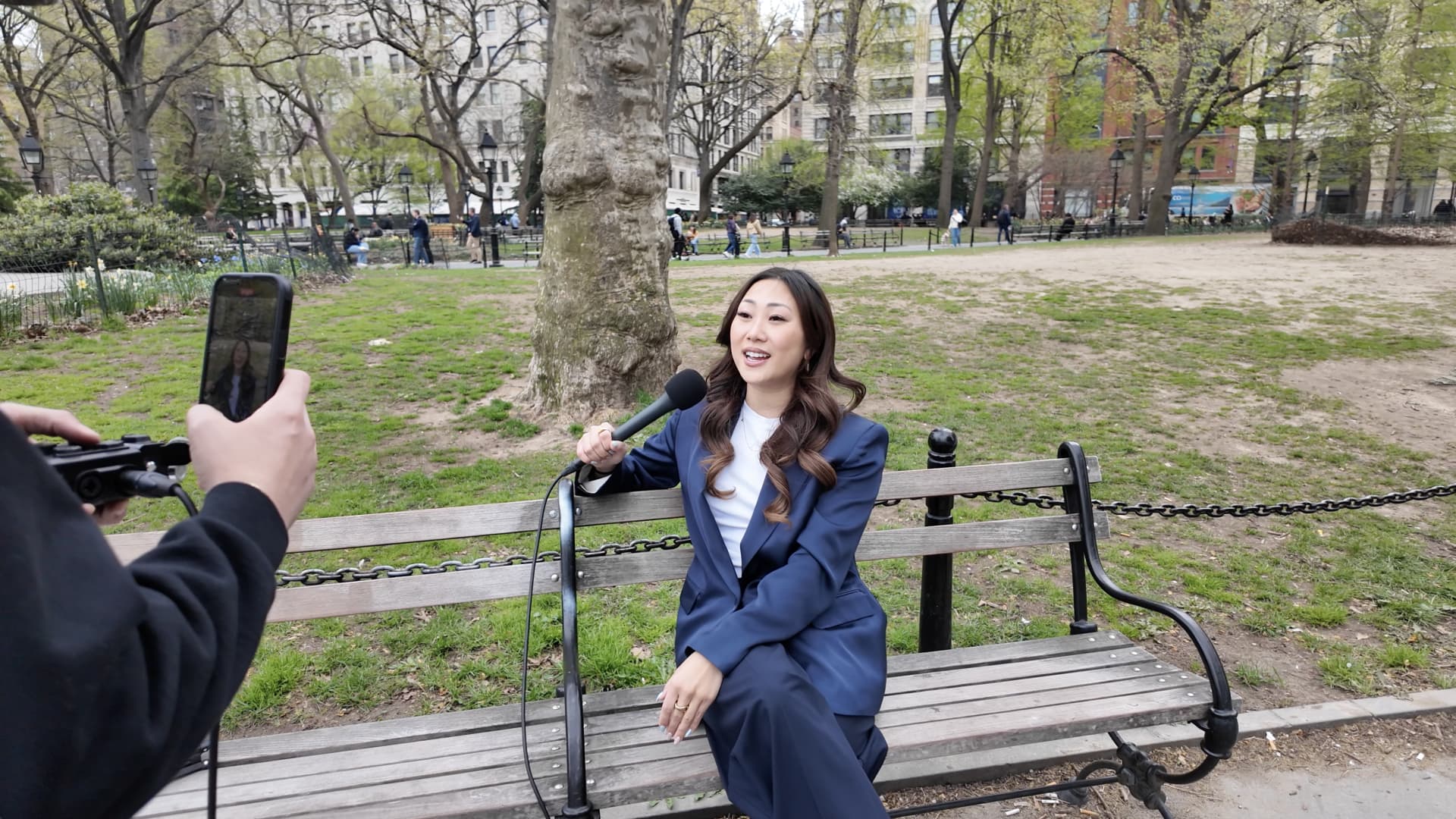
Megan Lieu is an influencer who makes content about tech and gives career advice on social media.
Tech companies like Microsoft and Google are going after new users for their AI services the way any marketer tries to make their products look cool: through social media influencers.
Other artificial intelligence players, including OpenAI, Anthropic and Meta, are also hiring social media creators to post sponsored content on apps like Facebook, Instagram, YouTube and even LinkedIn. The payout for these promotions can reach into the hundreds of thousands of dollars, according to industry experts.
AI companies have increased advertising considerably over the past year. Generative AI platforms spent more than $1 billion on digital ads in the U.S. in 2025, according to Sensor Tower, up 126% from the year prior. Influencer marketing is now emerging as one of the next battlegrounds for users in the AI boom.
The ad race is making its way to the biggest sporting event of the year in the U.S. Anthropic is spending millions of dollars to air a 60-second pregame and 30-second in-game spot during the Super Bowl on Sunday, aimed at OpenAI’s recent decision to start showing ads within ChatGPT.
In the emerging creator space, influences are getting paid by tech companies to promote their respective AI tools to social media users. That could be through writing a LinkedIn post on how to use Anthropic’s Claude Code or by posting an Instagram videos about fun things to do with Microsoft Copilot or Perplexity’s Comet assistant.

Those services have come a long way since OpenAI ushered in the generative AI era in late 2022 with the launch of ChatGPT. Google has bolstered its position in the market with the release of Gemini 3, its latest model, in November, while Anthropic, Microsoft and Meta have continued rolling out updates.
Microsoft and Google have paid creators between $400,000 and $600,000 for long-term partnerships spanning several months, according to a person familiar with the deals who asked not to be named because the terms are private.
“What we’re seeing is a massive increase in creator spend from these AI brands,” said AJ Eckstein, founder and CEO of Creator Match, an agency that connects brands to creators. The firm works with multiple AI-focused brands, including Anthropic, HeyGen and Notion.
“Every month, we’re getting way more interest from AI brands,” he said, adding that AI companies are looking for ways to market their tools and build stronger connections with users in more authentic ways.
Representatives from Microsoft and Google declined to comment.
Anthropic has emerged as one of the more aggressive AI companies in creator marketing. In March, the company hired Lexie Barnhorn, who previously worked at Notion, to lead its influencer marketing across social media and podcasts. The AI lab has inked multiple brand deals with content creators.
One of those creators is Megan Lieu, who makes content about AI and tech. Lieu told CNBC that her background as a data scientist helped her attract AI brands, and that she landed her first such deal in mid-2025.
“These brands really want their customers to know we are associated with AI,” said Lieu, who has nearly 400,000 followers across platforms.
Lieu said her most significant brand deal to date was with Anthropic to promote its Claude products. Lieu declined to specify how much Anthropic paid her, but she said her sponsored content deals typically range from $5,000 to $30,000 depending on the campaign.
“If you want to take your programming to the next level, Claude Code helps you do it with the power of agentic AI,” Lieu wrote in a LinkedIn post sponsored by Anthropic.
Anthropic didn’t provide a comment for this story.
‘So much money to spend’
AI companies are willing to spend a lot more than others, Eckstein said. There’s a lot of money to go around. Anthropic recently raised over $10 billion at a $350 billion valuation, while OpenAI was valued at $500 billion late last year. Microsoft, Alphabet and Meta have market caps in the trillions.
Creators can charge up to $100,000 per post, Eckstein said.
“Some of these bigger companies have so much money to spend,” he said, “that they don’t care to negotiate.”
Digital ad spending by Google and Microsoft to promote their AI products jumped roughly 495% last month compared with a year earlier, according to Sensor Tower. OpenAI also increased its digital ad spending more than 10 times in 2025.
Beyond sponsored posts, AI companies are also spending heavily on creators by inviting them to events, offering early access to new tools and paying for travel and accommodations.
“We work with all kinds of creators — including artists, filmmakers, designers, and cultural partners — giving them early access to our tools and ultimately, giving them the freedom to show us what’s creatively possible with AI,” an OpenAI spokesperson told CNBC in a statement.
But not all creators are willing to accept brand deals tied to AI products.
Jack Lepiarz posts about his performances at Renaissance Fairs to his seven million followers on social media.
G Lepiarz
Some said they have turned down deals with AI companies due to ethical, environmental and creative concerns. Others said their audiences can be hostile toward AI sponsorships, creating fear of backlash or getting “canceled.”
“AI is lame, unsubscribed,” read a comment on a sponsored post promoting Google’s AI video generator tool Veo by Steve Sells, a creator. Sells didn’t respond to the comment.
Roughly half of U.S. adults say they are more concerned than excited about AI, according to Pew Research data published in October.
Some creators told CNBC that they’re walking away from potentially tens of thousands of dollars in sponsored deals related to AI. Creator agency experts said backlash tends to be strongest around tools that generate images or video, which many creators see as directly replacing their artistic labor.
Content creator Jack Lepiarz, who goes by the name Jack the Whipper and has more than 7 million followers across platforms, told CNBC he immediately declines any brand deal involving AI.
“I cannot in good conscience support something that’s going to make it harder for normal people to make a living,” said Lepiarz, whose content tends to focus on his performances at Renaissance fairs.
Lepiarz said he previously turned down a $20,000 brand deal to tout an AI product promoting generative image tools.
“Even if they came back with $100,000 or $500,000, I couldn’t see myself saying yes to that,” Lepiarz said. “It’s too far of a thing for me. It’s too far a bridge to cross.”
