


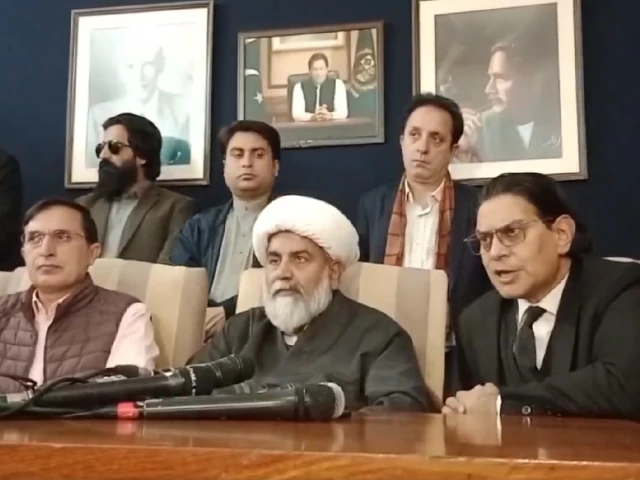
PTI Secretary General Salman Akram Raja addresses a press conference in Islamabad on Wednesday, flanked by Vice Chairman Tehreek-e-Tahafuz-e-Ayin-e-Pakistan Senator Allama Raja Nasir Abbas and PTI Chairman Barrister Gohar. SCREENGRAB
ISLAMABAD:
Even as the administration moves to tighten security and curb mobilisation to deter opposition’s strike call, the Pakistan Tehreek-e-Insaf (PTI) and its allied opposition platform, Tehreek-e-Tahafuz Ayeen-e-Pakistan (TTAP), on Saturday reaffirmed their resolve to go ahead with their planned countrywide protest and strike, framing February 8 (today) as both a Black Day and a Day of Mourning.
The government launched a crackdown on PTI workers and leaders, who have gone underground to avoid arrests. In addition, administration also imposed Section 144.
Addressing a joint news conference alongside senior opposition leaders, Senate Opposition Leader Allama Raja Nasir Abbas lamented that the attack, carried out during prayers inside a mosque, betrayed the state’s failure to protect its citizens.
He said innocent worshippers, including university students, were martyred in the blast, pointing out that the tragedy took place in the heart of the federal capital and not in any remote or conflict-hit region.
“This was an attack carried out while people were in prostration,” Abbas said, adding that for decades, Pakistanis had grown up witnessing bodies falling to terrorism.
He lamented that celebrations were often held over the corpses of ordinary citizens and questioned the purpose of ongoing security operations, asking where and how such operations were actually being conducted.
Rejecting any sectarian framing of the violence, Abbas stressed that there was no ShiaSunni divide in the country and accused hostile elements of deliberately seeking to pit communities against one another.
He argued that until power was transferred to the people, conditions would not improve. Announcing the opposition’s programme, he said February 8 would be observed as both “Youm-e-Siyah” (Black Day) and “Youm-e-Sog” (Day of Mourning), while a nationwide protest would be held the following Friday.
PTI leader Salman Akram Raja said February 8, 2024 marked the imposition of what he described as a system of injustice and deception. Calling the present moment one of collective grief, he said the opposition stood with the oppressed and would express its rejection of what he termed “thieves” who had usurped public mandate.
“Our voice has been stolen,” Raja said, adding that a system built on oppression could not endure. He maintained that the protest would also be a rejection of all forces acting against the state and constitutional order.
Former National Assembly speaker Asad Qaiser said more than 3,000 Pakistanis had fallen victim to terrorism in just one week, declaring the government a complete failure in its primary responsibility of providing security.
He urged the authorities to focus on governance instead of attempting to break political parties, reiterating that Shias and Sunnis remained united in the country.
Qaiser stressed the need for constitutional and legal supremacy and confirmed that protests would go ahead as planned.
Former senator Mustafa Nawaz Khokhar said there was hardly a day without a violent incident in the country, adding that serious questions demanded serious answers. He criticised the culture of issuing religious verdicts against political opponents and said such divisions must be dismantled.
Warning that failure to unite would lead to recurring bloodshed, Khokhar called for an All Parties Conference (APC) to forge a consensus policy against terrorism. He said the country faced simultaneous challenges of economic collapse and deteriorating law and order, pointing to Balochistan, where violence was followed by routine political transitions without accountability.
He appealed to the public to remain indoors on February 8, observe a day of mourning, and express dissent peacefully.
TTAP chief and Leader of the Opposition in the National Assembly, Mahmood Khan Achakzai, struck a cautionary note, urging restraint and reflection. He said the country was reaping what it had sown by turning Pakistan into a battleground for others’ wars, recalling the long-term fallout of the Afghan conflict and the assassination of over 1,300 tribal elders in former Fata.
Achakzai said coercion had no place in religious or political affairs and argued that Pakistan’s crisis was the result of its own collective actions, involving not only politicians but also institutions such as the military and bureaucracy. He claimed that the country’s 250 million people had been intimidated at gunpoint and that injustice could not sustain a state.
Calling out disparities in compensation, he said those who sold loyalty were rewarded with billions, while the poor were left with token payments after losing their lives. Addressing police forces in Punjab and Sindh, he urged them not to act as “slaves” but to stand with the people.
Achakzai appealed to Prime Minister Shehbaz Sharif to join the nation in mourning and urged citizens to avoid emotional reactions, insisting that the protest would remain peaceful.
