


by Xinhua writer Yuan Quan
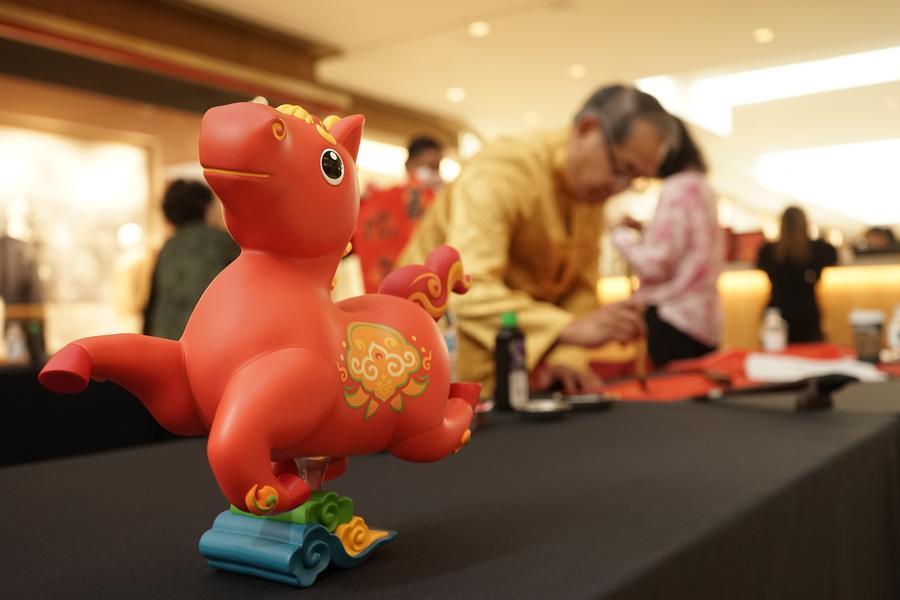
BEIJING, Feb. 13 (Xinhua) — As the Year of the Horse approaches, festive greetings across China are filled with idioms referring to this auspicious zodiac animal, in conveying good wishes.
Such cultural aspirations have also galloped into the realm of China’s latest technological advancements, where the spirit of the horse inspires ambition, speed and forward-looking creativity.
AT THE FOREFRONT
“One horse leading the way.” This saying refers to being the first or leading a race. It could not be more appropriate in describing China’s advanced position in the artificial intelligence (AI) arena.
The country is now home to over 6,000 AI enterprises, with its core AI industry expected to have surpassed 172 billion U.S. dollars in scale in 2025.
China’s domestic open-source large models have achieved more than 10 billion global downloads, while the country is the world’s largest holder of AI patents, accounting for 60 percent of the global total.
These figures sketch the landscape of China’s AI industry as it was in 2025. Notably, this considerable growth momentum is expected to continue in 2026. According to a think tank under China’s Ministry of Industry and Information Technology, China’s AI market is forecast to expand by over 30 percent this year, making it one of the fastest-growing and most dynamic AI markets worldwide.
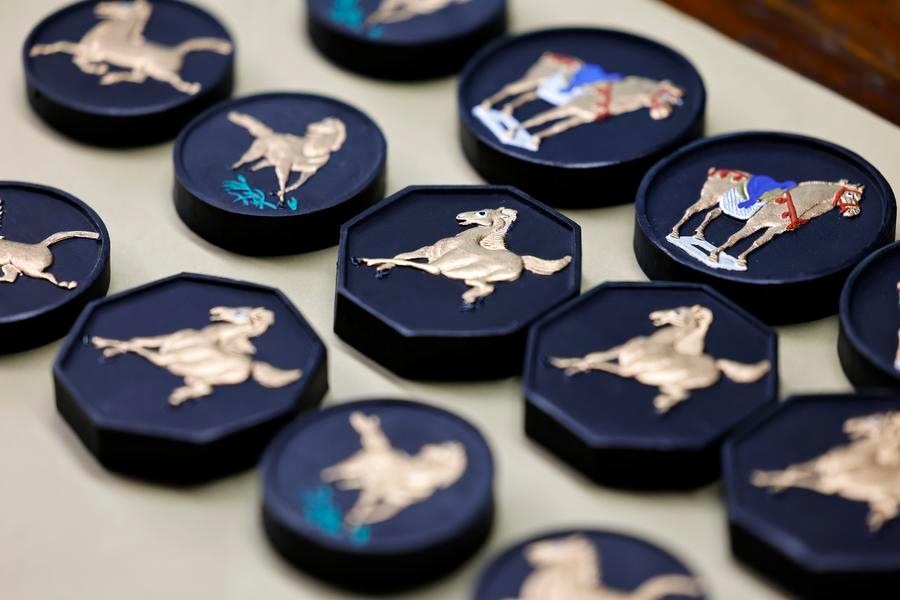
(Photo by Shi Yalei/Xinhua)
In January, China’s AI sector witnessed a wave of new-generation large model releases from major players, such as Alibaba, Moonshot AI and DeepSeek. Rather than simply scaling up parameters, these companies are now focused on building AI agent capabilities into their large models, which indicates that AI technology is evolving from “knowing how to chat” to “getting things done.”
Industry experts note that China’s AI development is advancing along two parallel paths: technology climbing upward to overcome cognitive and collaborative barriers, and applications reaching downward to tackle real-world challenges.
For example, Tencent has deployed its self-developed large models in more than 900 internal scenarios and applications, saying that the aim is to make AI a widely accessible, productive tool. Baidu founder Robin Li predicts that only a few foundational models will survive in the field, but that application-related opportunities will flourish, with more participants likely to succeed.
During the next five years, China will deepen AI integration across industry, culture, livelihoods and governance, empowering a broader range of sectors.
The once fierce AI model competition in the country has now transitioned from a sprint into an endurance race, focusing on real-world scenarios, industrial ecosystems and application value creation.
AT FULL GALLOP
Beyond AI, other emerging industries are progressing speedily. This can be illustrated by a Chinese proverb: “To spur on a swift horse.” This suggests accelerating speed further in pursuit of faster progress.
Via policy support, technological breakthroughs and rising market demand, sectors like embodied intelligence and low-altitude economy are “galloping ahead” in 2026.
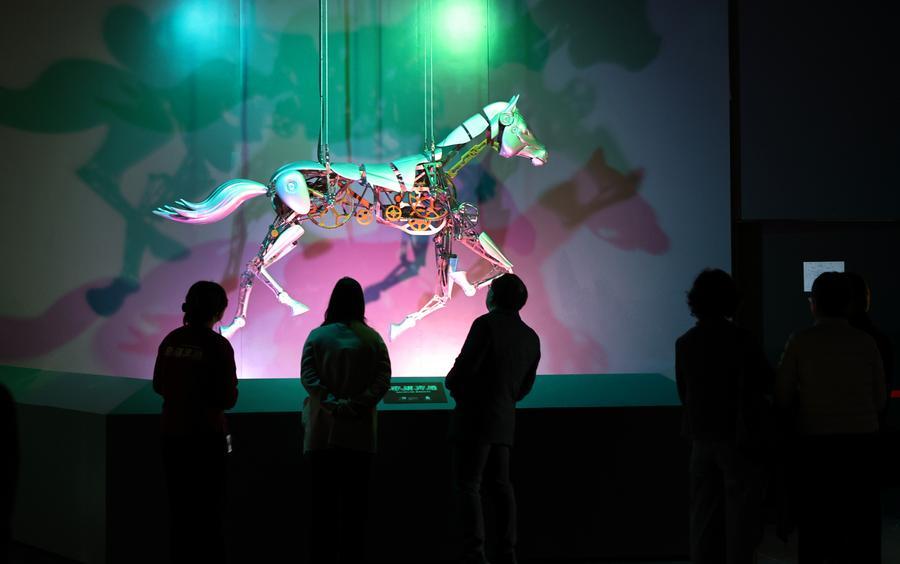
Major robotics firms have announced ambitious goals. UBTECH, based in Shenzhen in south China’s Guangdong Province, produced its 1,000th Walker S2 industrial humanoid robot by the end of 2025 and targets 10,000 units this year. AgiBot in east China’s Shanghai, meanwhile, disclosed that its 2025 shipments had exceeded 5,100 units and expects this figure to grow to tens of thousands in 2026.
Xiong Rong, chief scientist at the Zhejiang Humanoid Robot Innovation Center, located in east China, estimates that China’s humanoid robot output will reach between 100,000 and 200,000 units this year.
Many industry insiders have also noted a transition in robot applications: from undertaking hazardous and monotonous tasks, to general industrial and commercial services, and eventually entering households.
Similar fast growth can be seen in the low-altitude economy. XPENG AEROHT announced that its module flying car, named Land Aircraft Carrier, has entered the final stage before mass production. At full production capacity, the Chinese company is expected to produce one flying vehicle every 30 minutes.
China’s quest for accelerating the development of emerging industries, and the rapid expansions of embodied AI and the low-altitude economy, will become a new engine driving the country’s economic growth.
Competition will further heat up in 2026. Notably, it has become an industry consensus in China that focusing on customers and sustained innovation are the keys to staying ahead.
UNBRIDLED CREATIVITY
Another popular horse idiom in China is “celestial horse galloping through the sky,” which is used to describe thoughts or actions that are unrestrained, without limitations. This year, China’s space endeavors are set to embody this spirit of expansive exploration.
The country has scheduled the Chang’e-7 moon mission for launch in 2026, with the task of surveying the lunar south pole’s environment and water ice resources. The spacecraft will carry international payloads from countries like Egypt, Bahrain, Italy and Switzerland.
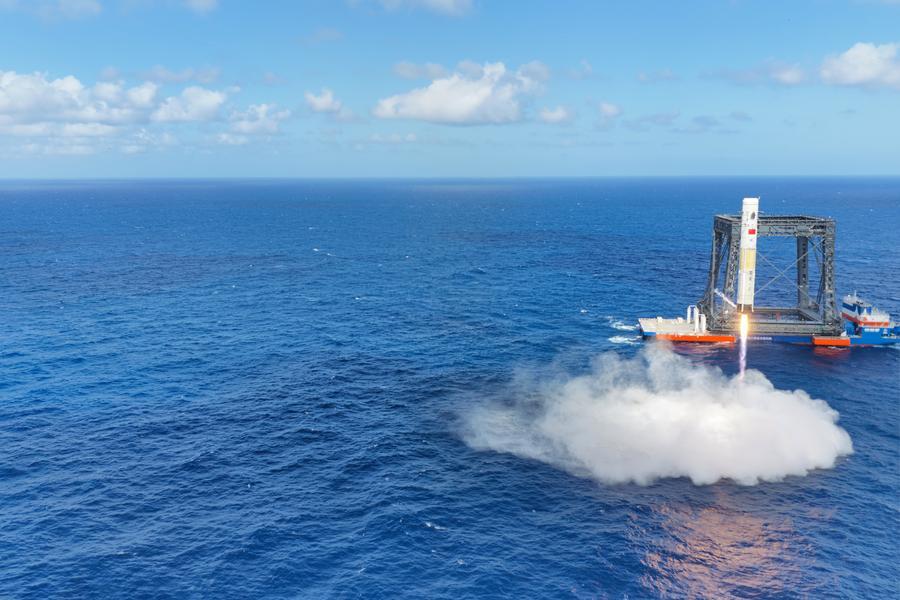
A major milestone was reached this past Wednesday, which saw successful flight tests of the Long March-10 rocket and Mengzhou spaceship. Both are designed for use in China’s crewed lunar landing mission, planned to take place before 2030.
These tests also featured a historic ocean recovery, which took place in the South China Sea. The spaceship’s return capsule, attached to a red-and-white parachute, featured in China’s first-ever splashdown of a spacecraft return capsule at sea. Meanwhile, the rocket’s first stage descended from an altitude of 105 km and hovered precisely five meters above the water, carving a circular ripple on the ocean surface.
It validated China’s rocket recovery design theories and methods, according to Zhou Jianping, chief designer of China’s manned space program.
Both the national program and private space enterprises will focus heavily on reuse. Chinese companies like Galactic Energy and Deep Blue Aerospace have already announced maiden flights of newly developed reusable launch vehicles this year.
Also, the orbiting Tiangong space station will welcome both the Shenzhou-23 and Shenzhou-24 crews this year. One of the taikonauts involved will undertake an orbital stay lasting over one year, during which more discoveries will no doubt be made at China’s “space home.”
These developments show that China has opted for “riding the fast lane to success,” as it pursues greater self-reliance and strength in science and technology, achieving considerable success and striving for even swifter progress in the Year of the Horse. ■
