


BNP wins 151 of 300 seats in Bangladesh parliament, securing a simple majority; Jamaat-e-Islami gets 42
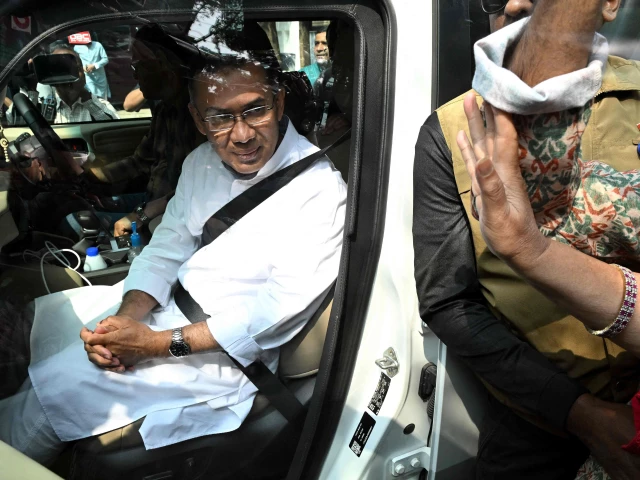
BNP chairman and election candidate Tarique Rahman greets his supporters as he leaves his residence in Dhaka on February 13, 2026 a day after Bangladesh’s general election. PHOTO: AFP
The Bangladesh Nationalist Party claimed a historic win on Friday in the first elections held since a deadly 2024 uprising, with leader Tarique Rahman poised to become prime minister.
However, final official results are yet to come, and the Bangladesh Nationalist Party(BNP)’s main rival, Jamaat-e-Islami, the largest Islamist party leading a wider coalition, said it had “serious questions about the integrity of the results process”.
Rahman told AFP two days before polling he was “confident” that his party, crushed during the 15-year autocratic rule of ousted prime minister Sheikh Hasina, would regain power in the South Asian nation of 170 million people.
The US embassy swiftly congratulated Rahman and the BNP for a “historic victory”, while neighbouring India praised his “decisive win” despite recent rocky relations with Dhaka. China and Pakistan, which both grew closer to Bangladesh since the uprising and the souring of ties with India, which has sheltered Hasina since her ouster, also congratulated the BNP.
Broadcasters projected that the BNP had secured a two-thirds majority with 212 seats in parliament, with Jamaat winning 76 — a huge leap from past results, but far short of the outright win it had campaigned for.
President Asif Ali Zardari and Prime Minister Shehbaz Sharif shared congratulatory messages, describing Tarique Rahman’s victory as “decisive” and “resounding”.
PTV News reported that President Zardari conveyed his best wishes to the government and the Bangladeshi people as over 127 million voters went ot the polls to elect their representatives.
President Extends Best Wishes to Bangladesh on National Elections
President Asif Ali Zardari has conveyed his best wishes to the government and people of Bangladesh as over 127 million voters head to the polls today to elect representatives to 300 seats in the National… pic.twitter.com/ZeQT7pYCGl
— PTV News (@PTVNewsOfficial) February 12, 2026
🇵🇰🇧🇩 President Asif Ali Zardari felicitates Tarique Rahman on BNP’s landslide victory and congratulates the people of Bangladesh on their successful, peaceful polls. Pakistan reaffirms strong support for democratic partnership and shared progress ahead. @trahmanbnp @bdbnp78
— The President of Pakistan (@PresOfPakistan) February 13, 2026
I extend my warmest felicitations to Mr. Tarique Rahman on leading the BNP to a resounding victory in the Parliamentary elections in Bangladesh. I also congratulate the people of Bangladesh on the successful conduct of the elections.
I look forward to working closely with the…
— Shehbaz Sharif (@CMShehbaz) February 13, 2026
“I extend the warmest felicitations to Mr Tarique Rahman on leading the BNP to a resounding victory in the Parliamentary elections in Bangladesh. I also congratulate the people of Bangladesh on the successful conduct of the elections,” PM Shehbaz said in a post on X.
Deputy Prime Minister and Foreign Minister Ishaq Dar also said that Pakistan will “remain committed to elevating bilateral cooperation on the basis of sovereign equality and mutual respect.”
Warm felicitations to Mr. Tariq Rahman on leading the elections in Bangladesh. I am confident that, under your able stewardship, Bangladesh will continue its journey towards peace, progress, and prosperity. Pakistan remains committed to elevating our bilateral cooperation on the…
— Ishaq Dar (@MIshaqDar50) February 13, 2026
“Mounting challenges”
Jamaat chief Shafiqur Rahman, 67, had mounted a disciplined grassroots campaign on a platform of justice and ending corruption. His party said it was “not satisfied with the process surrounding the election results”, claiming it had logged “repeated inconsistencies and fabrications in unofficial result announcements”, but without giving further details.
The Election Commission, which said that turnout was 59%, is expected to release final results later on Friday for a total of the 299 constituencies of 300 in which voting took place. Another 50 seats in parliament reserved for women will be named from party lists.
Senior BNP leader Ruhul Kabir Rizvi claimed a resounding win, calling for followers to give thanks in prayer rather than celebrate on the streets.
“There will be no victory rally despite the BNP’s sweeping victory,” Rizvi said in a statement. “We will hold special prayers.”
Peaceful polls
Party workers spent the whole night in front of the BNP offices. “We will join the nation-building effort led by Tarique Rahman,” Md Fazlur Rahman, 45, told AFP. “Over the last 17 years, we have suffered a lot.”
Heavy deployments of security forces are posted countrywide, and UN experts warned ahead of the voting of “growing intolerance, threats and attacks”, and a “tsunami of disinformation”.
Political clashes killed five people and injured more than 600 during campaigning, police records show. But polling day was largely peaceful, according to the Election Commission, which reported only “a few minor disruptions”.
“Ended the nightmare”
Interim leader Muhammad Yunus, who will step down once the new government takes power, has urged all to stay calm. “We may have differences of opinion, but we must remain united in the greater national interest,” he said.
The 85-year-old Nobel Peace Prize winner has led Bangladesh since Hasina’s rule ended with her ouster in August 2024. His administration barred her Awami League party from contesting the polls. Yunus said the election had “ended the nightmare and begun a new dream”.
75-year-old Hasina, sentenced to death in absentia for crimes against humanity, issued a statement decrying an “illegal and unconstitutional election”.
Yunus has championed a sweeping democratic reform charter to overhaul what he called a “completely broken” system of government and to prevent a return to one-party rule.
Voters also took part in a referendum on the proposals for prime ministerial term limits, a new upper house of parliament, stronger presidential powers and greater judicial independence. Television projections suggested 65% of voters had endorsed the charter.
