


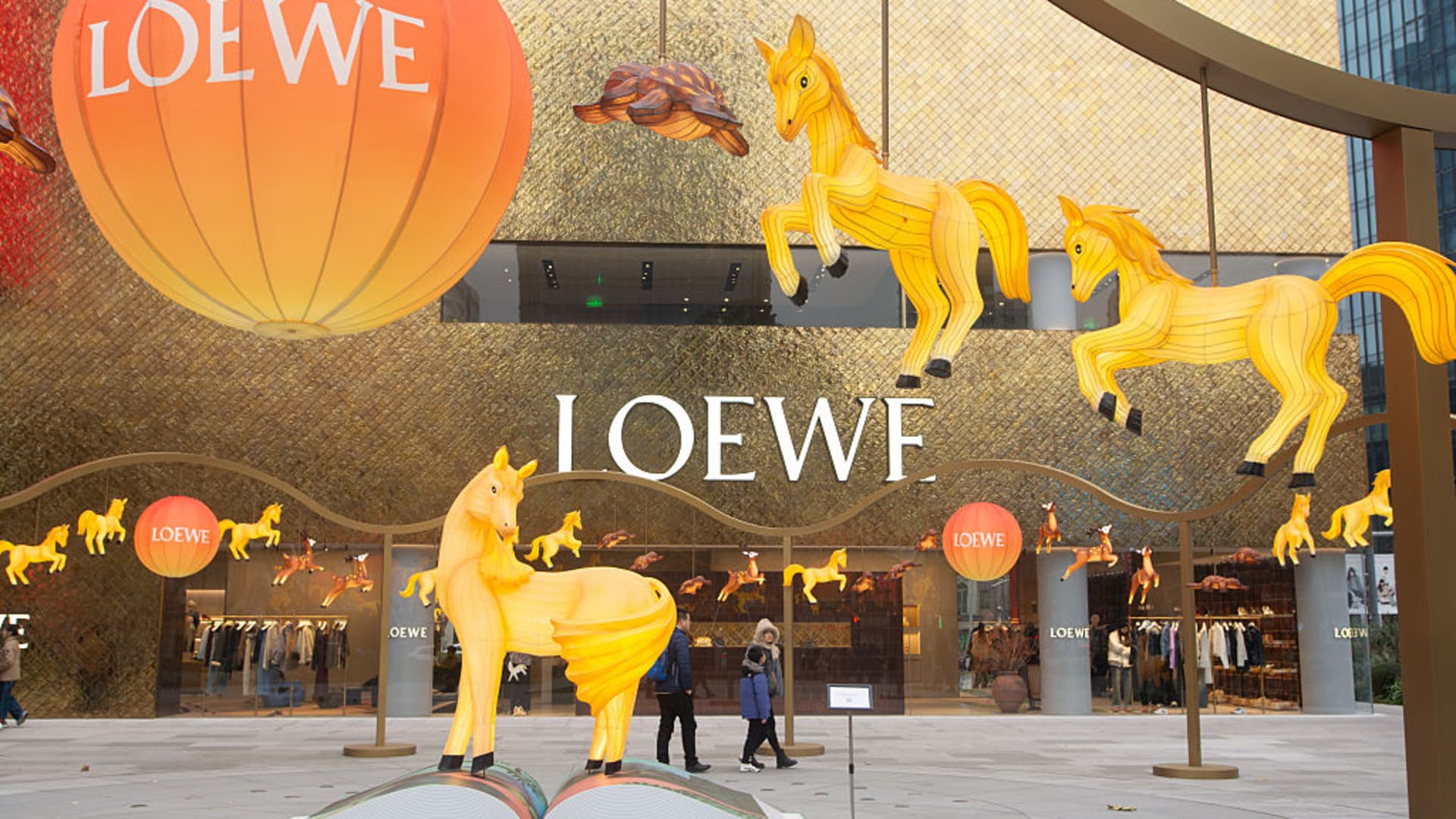

Luxury brands from Harry Winston to Loewe are going all in on Lunar New Year collections in a bid to attract Chinese customers.
Ahead of the Year of the Horse, which starts on Tuesday, Harry Winston unveiled a limited-edition, $81,500 rose gold watch with diamond bezels and a red lacquer horse. High-end fashion brand Chloé released a capsule collection, ranging from $250 silk scarves to a $5,300 snakeskin and leather shoulder bag with a horse head and tail linked by a horsebit chain. A slew of other brands, including Loewe, Gucci and Loro Piana, have introduced new bag charms with horse motifs.
The Year of the Horse arrives at a time of cautious optimism for designer brands and could mark the start of a China’s luxury market comeback.
Chinese consumers were once the primary driver for the global luxury sector but have cut back sharply in recent years, weighed down by the country’s slowing economy and depressed housing values.
The Chinese luxury market stood at about 350 billion RMB in 2024, or about $50 billion, according to estimates from Bain. While the consultancy estimates that market contracted by 3% to 5% in 2025, Bain analysts noted that the sector started showing signs of recovery in the second half of 2025 on the back of stronger stock market performance and consumer confidence.
Loewe celebrated Year of the Horse with storefront installation in Shanghai, China.
Ying Tang/NurPhoto via Getty Images
Bernstein senior analyst Luca Solca said he predicts Chinese luxury spending will stabilize, forecasting mid-single-digit percentage growth in 2026. However, the market is still far more competitive than at its peak, he said.
Before the Covid pandemic, Chinese consumers accounted for about one-third of the global luxury goods market, according to Solca. That percentage has since dipped to about 23%, he said.
The luxury market’s fortunes do not solely rest on Lunar New Year, but it is an opportunity for Western brands to show respect for Chinese culture, he said.
The annual holiday is associated with the colors red and gold, which symbolize good luck and fortune in Chinese culture. Each Lunar New Year is represented by one of 12 Chinese zodiac animals. Last year’s animal was the snake.
But Solca said in order to best capture the Chinese luxury consumer, brands need to go beyond the expected motifs.
“The Chinese are no longer in awe of anything that comes from the West,” Solca said. “A perfunctory interpretation of CNY is not going to go far.”
Veronique Yang, who leads BCG’s consumer practice in Greater China, said literal interpretations can come across as lazy or even disrespectful to Chinese consumers. Younger shoppers are also looking for fresher takes, she said.
“Chinese young people, they respect the old Chinese culture, but to be honest, a lot of parts of it they don’t understand, or they want it to be reinterpreted in a modern way,” she said. “It’s important to weave a narrative that connects the heritage with a contemporary vision.”
Lunar New Year collections date back to the early 2010s, as Western brands were eager to tap into the rapidly growing Chinese luxury consumer market, according to Daniel Langer, professor of luxury strategy at Pepperdine University. At the time, newly wealthy Chinese consumers were eager to spend on designer goods, especially when they traveled abroad, he said, as there were few luxury boutiques in China outside major cities like Shanghai and Beijing.
Now, with broader access and more choice, brands have to work harder to bring in new clients.
And in the 12 years since the last Year of the Horse, Chinese high-income consumers have become more discerning, Langer said.
“They’ve been to the best places in the world. They’ve dined in the best restaurants in the world. They’ve shopped in the best shops in the world. Their expectations towards brands are significantly higher,” he said. “China has completely changed from a country where there was pent up demand for luxury goods to a country of the highest sophistication.”
Burberry’s Lunar New Year products.
Courtesy of Burberry
They also have grown accustomed to spending less on Western brands between pandemic travel restrictions and the rise of domestic high-end labels, according to Langer.
Before the pandemic, Chinese consumers did most of their luxury shopping abroad. Pandemic travel restrictions permanently changed that dynamic. According to Bain, two-thirds of Chinese luxury goods spending was done abroad in 2019. Last year, overseas spending made up only a third.
The Year of the Horse provides a natural opportunity for a sizable number of Western brands to connect to the holiday. Langer said he preferred brands who take a less literal approach, such as Loewe, which adorned its signature Puzzle bags with fringes and tassels for a cowboy aesthetic.
Yang noted, however, that the year’s zodiac animal is a good luck symbol only for people who were born in that year, which makes playing too much into horse imagery a risk.
Instead, she said, brands can use immersive experiences to connect to Chinese customers, especially younger ones, in a more authentic way.
Valentino, for instance, held a three-day lantern festival in January at Tianhou Palace, a historic temple along the Suzhou Creek in Shanghai. Burberry launched an extensive Lunar New Year campaign in mid-December, with Chinese brand ambassadors and a pop-up boutique and ice rink in Beijing.
“There’s a lot of different cultural elements that you can integrate and build a narrative around,” Yang said. “It’s not only about animals.”
