



PUBLISHED
February 15, 2026
In recent months, the streets of several US cities have been transformed into theatres of enforcement, where masked federal agents conduct raids in homes, workplaces, schools, and hospitals, and where the distinction between policing and spectacle has grown increasingly thin. The immigration crackdown unfolding under the banner of national security is not simply a matter of border control or administrative excess; it is a contemporary expression of how power continues to organise bodies, space, and visibility long after the formal end of empire. The migrant body—racialised, surveilled, and rendered perpetually suspect—has once again become the site where sovereignty is staged, and anxiety is managed. That this is occurring within a liberal democratic order should give pause, not because it marks a historical aberration, but because it reveals how unfinished the work of decolonisation remains.
Decolonisation has never been merely a historical event. It is not exhausted by the lowering of flags or the reconfiguration of state sovereignty, nor can it be adequately understood as the moral rectification of past injustice. At its most profound, decolonisation names a disturbance in the organisation of the modern subject: a reworking of perception, desire, embodiment, and authority. Colonialism did not simply conquer territory; it installed a regime of sense, a grammar through which bodies were apprehended, valued, feared, and governed. Its afterlives persist not because history has failed to move on, but because colonial power was always more psychological than juridical.
The enduring difficulty of thinking about decolonisation lies precisely here. Political independence has proven far easier to imagine than psychic dis-alienation. Modern institutions—law, medicine, education, psychology—continue to function as if colonial difference were an external aberration rather than a constitutive condition. The contemporary subject is thus caught between formal equality and lived asymmetry, between the rhetoric of post-racial universality and the visceral persistence of racialised fear, shame, and desire. Decolonial thought, if it is to remain intellectually serious, must confront this disjunction without recourse to nostalgia or moral reassurance.
It is in this space—between history and interiority, between violence and fantasy—that the figure of Frantz Fanon continues to exert an unsettling pressure. Fanon’s enduring relevance does not lie in the slogans occasionally extracted from his work, nor in the myth of revolutionary catharsis that has sometimes attached itself to his name. It lies instead in his refusal to separate politics from psychology, structure from affect, or domination from desire. Fanon insists that colonialism survives precisely because it takes hold of the mind as much as the world. Any serious engagement with decolonisation today must therefore return to the question Fanon never abandoned: what does colonial power do to the subject, and why does it continue to do so long after the empire’s formal demise?
Re-centring the psychological question
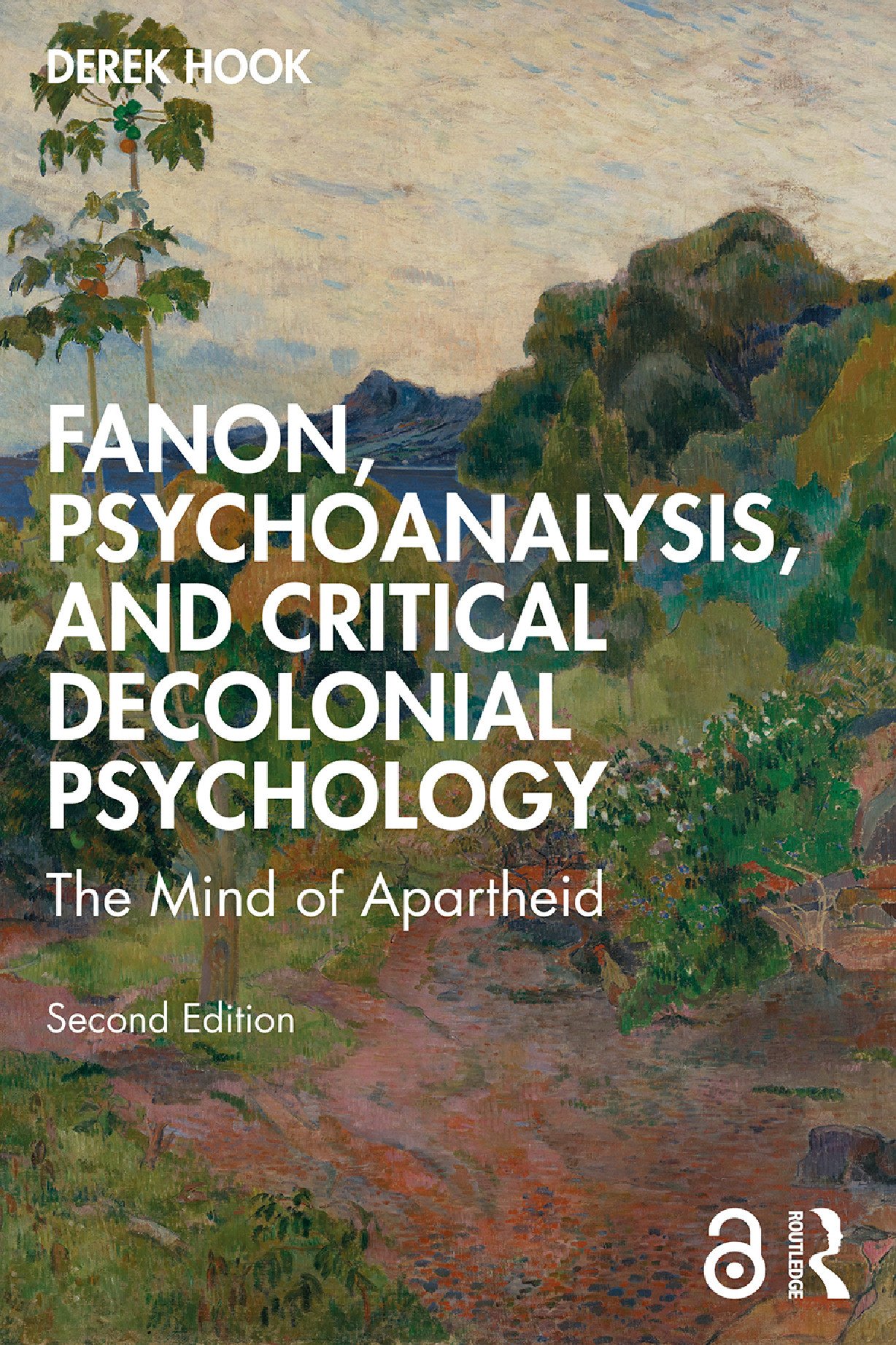
One of the most significant achievements of Derek Hook’s Fanon, Psychoanalysis, and Critical Decolonial Psychology is its insistence that decolonial critique cannot dispense with psychology without impoverishing itself. Much contemporary decolonial discourse has been rightly sceptical of psychology, seeing in it a discipline historically complicit with racial classification, normativity, and colonial governance. Hook does not dispute this history. Rather, he argues that abandoning psychology altogether cedes too much ground. If colonialism operated through the production of racialised subjectivities, then the work of undoing it must reckon with the psychic mechanisms through which domination was—and remains—sustained.
The book’s central wager is that Fanon offers precisely the resources needed for such a reckoning. Not Fanon as revolutionary icon or postcolonial theorist avant la lettre, but Fanon as clinician, diagnostician, and analyst of colonial affect. Hook reads Fanon not against psychoanalysis but through it, showing how Fanon appropriated, transformed, and radicalised psychoanalytic concepts to confront racism as a lived, embodied, and libidinal phenomenon. Racism, in this account, is not merely an ideology imposed from above; it is a structure of feeling, sustained by fantasy, anxiety, and unconscious investment.
This reorientation has significant consequences. It displaces the assumption that racism persists primarily because of ignorance or false belief. Instead, racism appears as something actively enjoyed, defended, and reproduced at the level of affect. The persistence of racial hierarchy cannot be explained by cognitive error alone; it must be understood as a psychic economy in which fear and desire are mutually entangled. Hook’s sustained engagement with Fanon allows this uncomfortable insight to be developed with theoretical precision rather than rhetorical flourish.
Apartheid as psychic regime
Although the book is deeply engaged with South Africa’s history, apartheid functions here less as a regional case study than as an extreme clarification of colonial logic. Apartheid appears not merely as a system of legal segregation but as an all-encompassing psychic regime, one that sought to regulate proximity, visibility, intimacy, and bodily meaning. What distinguishes Hook’s analysis is his refusal to treat apartheid as a historical anomaly. Instead, it becomes a laboratory for understanding how racial domination embeds itself in everyday perception and affect.
The analysis of racialised embodiment is particularly compelling. Drawing on Fanon’s insistence that the Black body is fixed under the white gaze, Hook shows how racism operates through a continual return to the body—its imagined excess, threat, or opacity. Racism never fully abstracts itself into discourse; it repeatedly reanchors itself in flesh. The body becomes the site where difference is made to appear self-evident, natural, and incontestable.
This emphasis allows Hook to illuminate the sexual and visceral dimensions of racism that liberal discourse routinely disavows. Racism is shown to be animated by fantasies of contamination and control, proximity and repulsion. The colonial order, far from repressing desire, organises it. What apartheid enforced was not only separation but a particular choreography of longing and fear, in which the racial other became the necessary object through which white subjectivity secured itself.
Psychoanalysis under decolonial pressure
One of the book’s most intellectually productive tensions lies in its relationship to psychoanalysis itself. Psychoanalysis, after all, is hardly innocent. Its universalising assumptions, Eurocentric norms, and historical blindness to colonial violence have long been subjects of critique. Hook does not attempt to rehabilitate psychoanalysis wholesale. Instead, he subjects it to decolonial pressure, using Fanon as a figure who exposes both its limitations and its unrealised potential.
Fanon’s engagement with psychoanalysis was always strategic. He refused its tendency to pathologise the colonised subject while remaining sharply attentive to its insights into desire, fantasy, and identification. Hook’s reading makes clear that Fanon did not reject psychoanalysis because it was psychological, but because it was insufficiently historical. Colonialism, Fanon insisted, was not an individual trauma to be cured but a social condition that structured psychic life itself.
This insight enables Hook to articulate what he calls a critical decolonial psychology: a mode of analysis that neither psychologises oppression nor reduces subjectivity to structure. Such an approach insists that political domination works precisely because it becomes internalised, because it recruits the unconscious, because it installs forms of enjoyment that bind subjects to their own subjection. The value of this framework is its refusal of easy moralism. It demands that we ask not only how oppression harms, but how it is sustained.
Fanon beyond sanctification
The contemporary revival of interest in Fanon has not always served his thought well. Too often, Fanon is invoked as a symbol rather than read as a theorist, his work reduced to a set of militant aphorisms divorced from their clinical and historical context. Both Derek Hook and Azzedine Haddour resist this tendency, albeit in different ways.
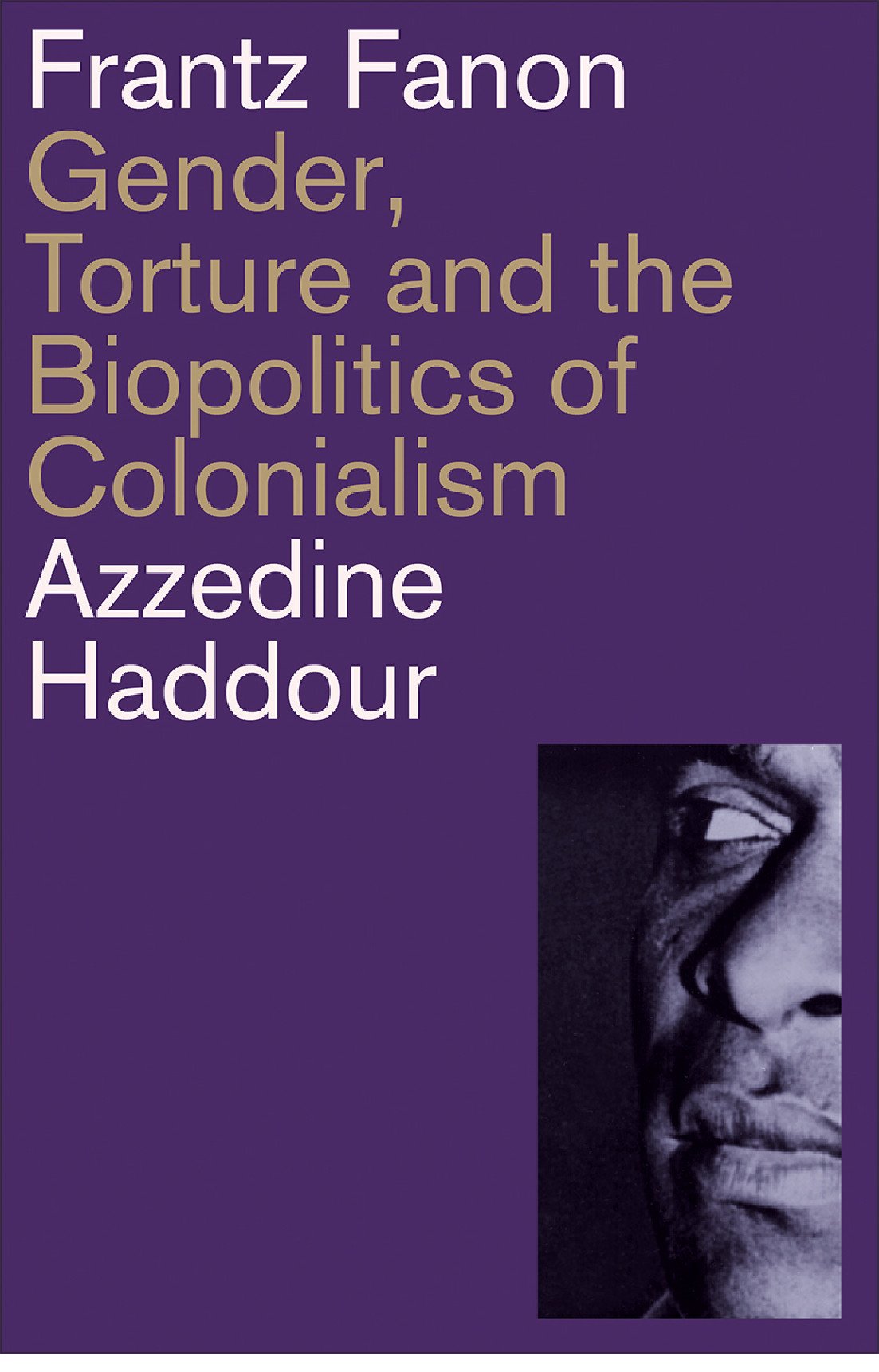
Haddour’s Frantz Fanon: Gender, Torture and the Biopolitics of Colonialism complements Hook’s project by returning attention to Fanon’s most historically specific and least celebrated writings. By foregrounding torture, medicine, gender, and family, Haddour restores Fanon to the material conditions of the Algerian war, insisting that his insights emerged not from abstraction but from proximity to extreme violence. Fanon appears here not as a prophet but as a witness.
This emphasis is crucial for understanding Fanon’s contemporary relevance. Fanon’s thought does not offer a general theory of oppression applicable in all contexts; it offers a method for analysing how power takes hold of bodies under particular historical conditions. Torture, in Fanon’s work, is not merely an instrument of information extraction but a technique for producing colonial truth. It is through torture that the colonial state asserts its absolute authority over the colonised body, transforming pain into political pedagogy.
Haddour’s attention to gender further complicates any simplistic appropriation of Fanon. Fanon’s writings on women and the family have often been dismissed as dated or instrumental. Haddour demonstrates instead that they are central to Fanon’s analysis of colonial biopolitics. Colonial power, Fanon understood, targeted women not incidentally but strategically, recognising that the family was both a site of resistance and a vector of control. Gender, in this account, is not secondary to colonial domination but constitutive of it.
The biopolitics of care and control
One of the most unsettling aspects of Fanon’s legacy, brought into sharp relief by Haddour’s work, is his critique of colonial medicine. Medicine, often imagined as a neutral or benevolent institution, emerges as a key instrument of colonial governance. Health, hygiene, and care functioned not simply to alleviate suffering but to manage populations, regulate movement, and stabilise settler dominance.
This analysis resonates powerfully with contemporary debates about humanitarianism, surveillance, and global health. The language of care continues to mask relations of power, particularly in contexts marked by racial and geopolitical inequality. Fanon’s insistence that colonialism governs through both violence and benevolence remains disturbingly relevant to the present moment. The biopolitical management of life—who is protected, who is exposed, who is deemed expendable—continues to structure global inequalities in ways that Fanon anticipated with remarkable clarity.
Fanon in the present tense
What, then, is Fanon’s relevance today? Not, as is sometimes claimed, because the world has returned to a colonial past, but because colonial power was never fully dismantled. Its logics have been redistributed, rearticulated, and normalised within ostensibly postcolonial institutions. Borders, policing, surveillance, and migration regimes reproduce distinctions between valued and devalued lives with chilling efficiency. The psychic dimensions of these processes—fear, resentment, disavowal—remain largely unaddressed.
Fanon’s enduring contribution lies in his insistence that liberation must be psychic as well as political. He offers no comfort in this regard. Fanon does not promise reconciliation without conflict or healing without rupture. What he demands instead is clarity: an unflinching recognition of how deeply colonial power has shaped modern subjectivity. To read Fanon seriously today is not to seek affirmation, but to accept discomfort.
Thinking without consolation
Derek Hook’s Fanon, Psychoanalysis, and Critical Decolonial Psychology is a demanding and rigorous work, one that refuses the shortcuts of slogans and sanctification. By returning Fanon to psychology—without domesticating him within it—Hook reopens questions that much contemporary theory has been too eager to close. In dialogue with complementary scholarship such as Haddour’s, the book demonstrates that Fanon’s relevance lies not in his capacity to confirm present certainties, but in his power to unsettle them.
Fanon remains indispensable not because he offers solutions, but because he teaches us how to read moments like our own without illusion. The contemporary management of migration—through raids, detention, deportation, and the quiet normalisation of fear—echoes the colonial grammar Fanon diagnosed so precisely: the division of space, the policing of movement, the reduction of certain lives to permanent exposure. In a world increasingly adept at administering inequality while denying its violence, Fanon’s thought continues to disturb, diagnose, and demand. It reminds us that what presents itself as security is often a rehearsal of domination, and that the unfinished work of decolonisation persists wherever the state governs through the psychic capture of vulnerable bodies.
Fanon, Psychoanalysis, and Critical Decolonial Psychology: The Mind of Apartheid
By Derek Hook
Published by Routledge (Taylor & Francis Group), 2025
Frantz Fanon: Gender, Torture and the Biopolitics of Colonialism
By Azzedine Haddour
Published by Pluto Press, 2025
The writer is a Pakistan-born and Austria-based poet in Urdu and English. He teaches South Asian literature and culture at Vienna University
