


SHANGHAI, Feb. 24 (Xinhua) — Sitting in a classroom at an art school in Florence, Italy, a retired teacher from Shanghai surnamed Wang began his first systematic lesson in sketching. This was a scene he had envisioned for over half a century.
At the age of 28, he encountered a book of Raphael’s paintings at a second-hand bookstall. From then on, the interplay of light and shadow of the Renaissance and the name “Florence” planted a seed of longing in his heart.
Now, with the help of a club specifically serving the “mature-age” learners, he completed language preparation and interviews, embarking on a weeks-long dream-fulfilling journey.
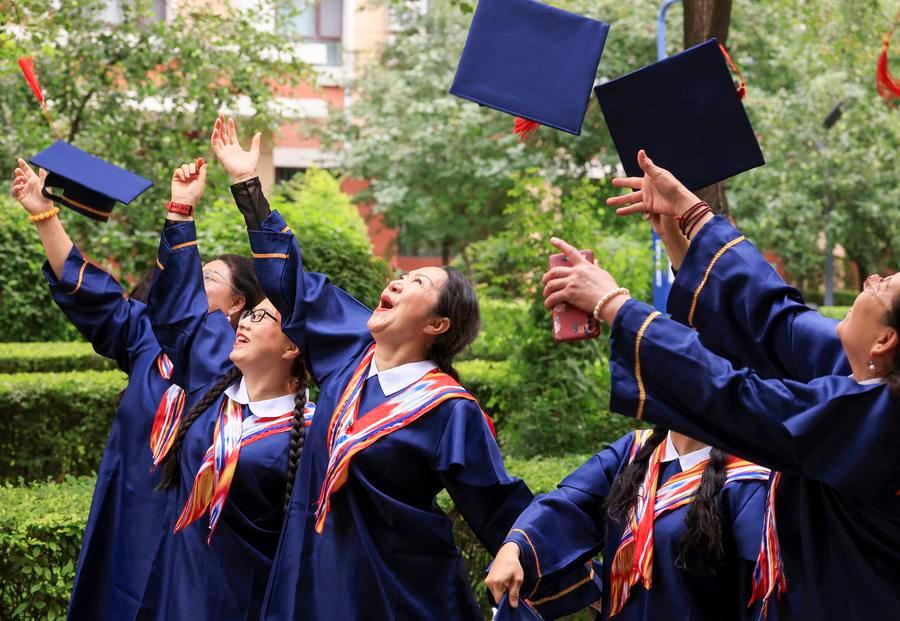
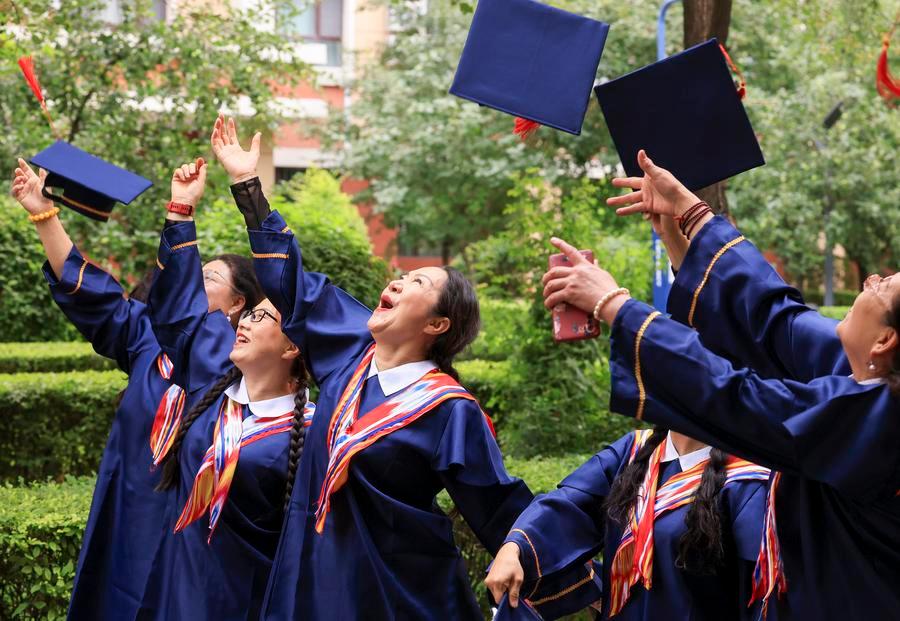
Wang’s story is not an isolated case. A growing number of Chinese retirees, primarily those born in the 1960s and 1970s, are redefining their “golden years.” No longer satisfied with traditional retirement lifestyles involving doting on grandchildren or community leisure activities, they choose to carry their schoolbags and go overseas to restart their lives as students.
This trend reflects the intense pursuit of spiritual fulfillment and self-actualization among the increasingly large “new elderly” demographic. It also poses new challenges to existing social perceptions, market services and public policies.
“The moment I retired was a big shock. My body and mind didn’t feel old, but the familiar rhythm of society suddenly came to a halt, creating a strong sense of a ‘value vacuum’,” admitted Zi Wenli, 56.
After retiring, this former senior media professional and founder of an international education institution found that “the choices available for our generation, the 1960s and 1970s cohort, are too limited.” Zi visited numerous universities for the elderly in China and discovered that the course content often stuck to the basics, focusing on rote imitation rather than inspiring creativity.
“For example, they might teach you how to paint a big peach, a symbol of longevity, but not why it’s painted that way. After learning, you still can’t paint anything else,” she said.
In her view, this is a significant disconnect from the intrinsic needs of her generation, people who “changed their destinies through knowledge” and crave deep learning and intellectual renewal. “We don’t just need to kill time; we want to regain a sense of value, even explore the possibilities of second careers.”
A turning point occurred on Christmas Eve in 2024. Zi shared her thoughts on retirees applying to study abroad on a short-video platform. To her surprise, it went viral.
During a subsequent live stream, two to three thousand peers joined, eagerly asking, “How to get there?” Zi suddenly realized that her decades of experience and resources in international education could perfectly meet this vast, silent demand. “I suddenly felt I had found the second direction of my life.”
Thus, the “Teacher Zi’s Retiree Study Abroad Club” (later renamed the “Mature-Age Learning Club”) was born. Zi positioned herself as a “sharer” and “guide,” connecting people primarily born between 1955 and 1979 with domestic and international educational resources.
The pathfinding process was not smooth at the beginning. Initially, she tried to find opportunities domestically, only to find that formal continuing education or degree programs for those over 50 were almost nonexistent.
Consequently, she had to look overseas. Although many foreign universities have no explicit age limits, receiving an organized cohort of senior students from China was unprecedented. Both sides needed repeated exchanges on details like course difficulty, language support, visa facilitation, and even accommodation standards.
Zi concluded: “Perhaps the biggest obstacle is the conceptual gap. Society is accustomed to lumping people aged 50 to 85 together as ‘the elderly’ and providing undifferentiated services. This broad-brush categorization completely ignores the vast differences in psychological state, learning ability, and life aspirations among the ‘younger elderly’.”
Since securing its first partner institution in March 2025, her club has served tens of thousands of members and organized over 10 overseas study programs, with the oldest participant being 83 years old.
As the demand for “mature-age studying abroad” becomes increasingly apparent, the market has begun to respond.
Industry insiders note that this generation seeking overseas study often shares common characteristics. They are financially secure and possess broad life experience, but their foreign language skills may be rusty. Their learning goals are specific and diverse — some prepare for future overseas visits to family or reunions, some seek immersive cultural experiences beyond superficial tourism, while others view learning as a form of “knowledge-based travel” that is both deep and accompanied.
In response to these new demands, market adjustments have already begun. Some language schools and educational institutions have started offering classes at a more relaxed pace, designing workshops and visit activities integrated with local culture, and paying more attention to comfort and convenience in logistical arrangements, such as accommodation. Although these attempts are preliminary, they signal a shift in service mentality from “undifferentiated” to “age-appropriate” and “personalized.”
Peng Xizhe, director of the Fudan Institute on Ageing, noted that the main force of “active seniors” currently entering retirement is the “baby boomer” generation, who grew up alongside China’s reform and opening up. They are more financially secure, better educated and hold more diverse views on life than previous generations.
“As life expectancy steadily increases, and there might be 20 or 30 years of healthy life after retirement, the traditional three-stage life planning model of ‘learning, working and retiring’ indeed needs to be re-examined and restructured,” Peng said. ■
