


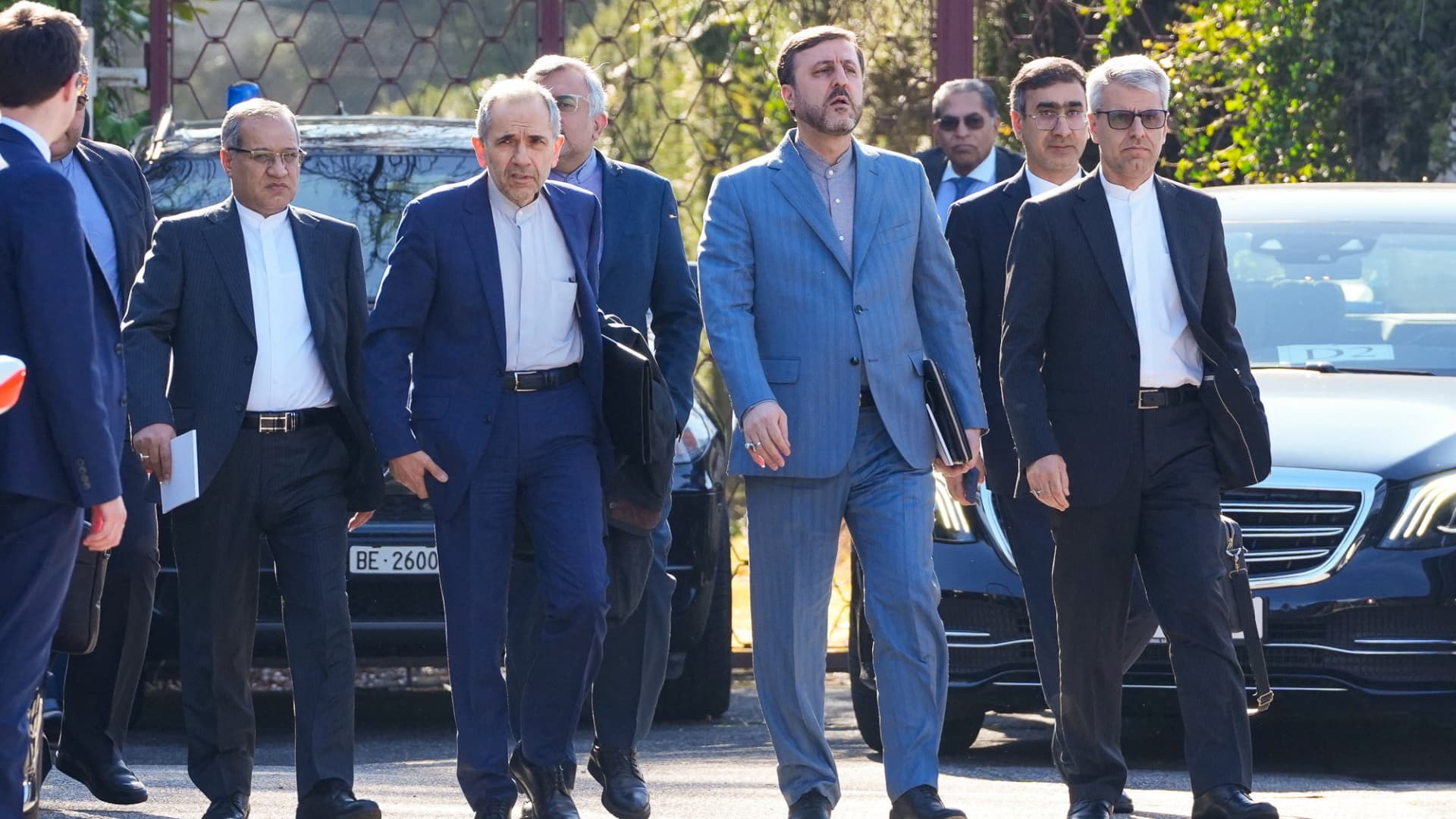
Iranian negotiating delegation departs for the site of the talks with U.S., in Geneva, Switzerland, Feb. 26, 2026.
Iranian Foreign Ministry | WANA | Via Reuters
The latest round of U.S.-Iran talks did not lead to a breakthrough, with both sides agreeing to extend negotiations, Iranian Foreign Minister Seyed Abbas Araghchi said, describing the discussions as the “most intense so far.”
“Further progress has been made in our diplomatic engagement with the United States,” said Araghchi, adding that both sides planned to engage in a more “detailed” manner on critical issues including termination of U.S. sanctions on Iran and “nuclear-related steps.”
The two sides made “significant progress” in the high-stakes talks in Geneva, Switzerland, and agreed to meet next week to discuss technical details in Vienna, according to Oman’s foreign minister Badr Albusaidi, the mediator of the talks.
Earlier this week, U.S. President Donald Trump said that Iran wants to make a “deal” more than the U.S. while Tehran’s refusal to commit to not developing nuclear weapons remains a key sticking point holding up the agreement.
In his State of the Union address earlier this week, Trump said that “They [Iran] want to make a deal, but we haven’t heard those secret words: We will never have a nuclear weapon.”
Tensions continued to run high as the U.S. has amassed a large military force in the Middle East with Trump last week warning that “bad things” would happen if Iran does not agree to a deal over the future of its nuclear program.
The third round of talks this week were led by U.S. special envoy Steve Witkoff and Trump’s son-in-law Jared Kushner, while Araghchi headed the Iranian delegation.
The Wall Street Journal reported earlier Friday that the U.S. team had tough demands for the Iranians, including that they destroy the three main nuclear sites at Fordow, Natanz and Isfahan, and deliver all of its remaining enriched uranium to the U.S. Iranian officials have objected to these demands.
The team also requested any nuclear deal must last forever and not have so-called sunset clauses, the newspaper reported, citing unnamed U.S. officials.
From nuclear program to ballistic missiles
Iran’s nuclear program has been at the crux of the negotiations, with the U.S. pressuring Tehran to curb its ballistic-missile development program as well. But Tehran has insisted on its right to carry out the enrichment of uranium in the country, saying it’s needed for energy production.
Right before the latest talks in Switzerland, U.S. Secretary of State Marco Rubio said that Iran’s reluctance to discuss its development of intercontinental ballistic missiles was a significant stumbling block.
The Trump administration has also demanded Tehran to stop supporting regional armed groups and cease its repression of domestic protestors.
Analysts have warned of risks of a military clash in the region should the two sides fail to reach any meaningful breakthrough, which could unleash turmoil in the wider Middle East and for oil markets.
“Absent a diplomatic breakthrough in the coming days, the U.S. risks entering into a military clash with significant escalatory potential,” said Michael Hanna, director at International Crisis Group, a Brussels-based think tank.
Hanna also pointed out that Washington’s priorities remain unclear as it presses a wide-ranging list of demands for Tehran: “It is unclear if the administration itself has a fixed idea about its desired end point.”
Among Tehran’s priorities in the talks is the lifting of sanctions that have hobbled its economy and fueled a currency crisis, sparking widespread protests against the Islamic Republic in December.
Outcome of this week’s indirect talks will be key to the direction of oil prices as traders weigh potential supply concerns if hostilities escalate.
WTI futures were down 35 cents, or 0.24%, on Friday at $64.97 per barrel. Brent crude futures lost 38 cents, or 0.30%, to $70.54 per barrel.
“The market may hold off on a full reaction until the scale of potential U.S. action against Iran becomes clearer,” said Warren Patterson, head of commodities strategy at ING Bank, forecasting that any “targeted and brief” strikes that avoid energy infrastructure — like those seen in June last year — with limited retaliation from Iran may lead to a short-lived spike in oil prices.
But in the event of longer-term action from Washington coupled with more aggressive retaliation from Tehran, oil prices will likely stay elevated on supply risks.
Traders will also watch the OPEC+ decision on oil output for April this weekend.
“If we are to see de-escalation between the U.S. and Iran, it should allow weaker fundamentals to feed through to a lower flat price — particularly if OPEC+ resumes supply increases from April, which we believe they will agree to this weekend,” Patterson said.

