



The Trump administration has rolled out a series of measures to attempt to blunt the blow of the Iran-driven oil-price hike, and yet prices remain stubbornly high.
As the war rolls on, it is becoming clear there isn’t much the U.S. or any other government can do to provide relief from higher oil prices short of ending the conflict.
It will take a military breakthrough to get oil flowing and reduce energy prices. That means this episode is sharply different from past market crises that President Donald Trump has muddled through. A pattern of escalating political tensions followed by fast economic relief that has held through Trump’s second presidency may finally be breaking.
This is a problem Trump can’t solve through economic policy.
The economic math is uncompromising. The war will cut the global supply of oil by about 8 million barrels a day in March, the International Energy Agency estimated Thursday. That accounts for the near-closure of the Strait of Hormuz, the narrow waterway bordered by Iran that carries as much as 20 million barrels a day in normal times, as well as the oil industry’s attempts to route around the problem and production increases elsewhere.
The Trump administration and other governments are trying to get more oil onto the market, most substantially by releasing some 400 million barrels from strategic reserves. But it won’t come all at once. The U.S. portion will amount to about 1.4 million barrels a day over roughly four months, based on plans from the Department of Energy. All told, the global release will amount to perhaps 3 million barrels a day, according to estimates by Goldman Sachs shared with clients.
These figures are rough estimates made quickly during wartime and should be taken with a grain of salt. But the overall result is clear: Government reserves probably can’t make up even half of the daily shortfall driven by the war.
The administration has several other plans in motion. Treasury Secretary Scott Bessent said on Thursday the administration would to ease some sanctions on Russian oil. The U.S. International Development Finance Corporation is working on a plan to backstop insurance for ships in the region.
Oil prices rose Friday despite those measures. A gallon of regular costs $0.69 more Friday than it did a month ago, according to AAA. That is a 23% increase. A barrel of oil on the U.S. market would have cost about $63 in mid-February. It was $97 at midday Friday.
The White House is well-aware of Americans’ concerns. The president has said the short-term cost of higher prices is necessary to end the threat of the Iranian nuclear program.
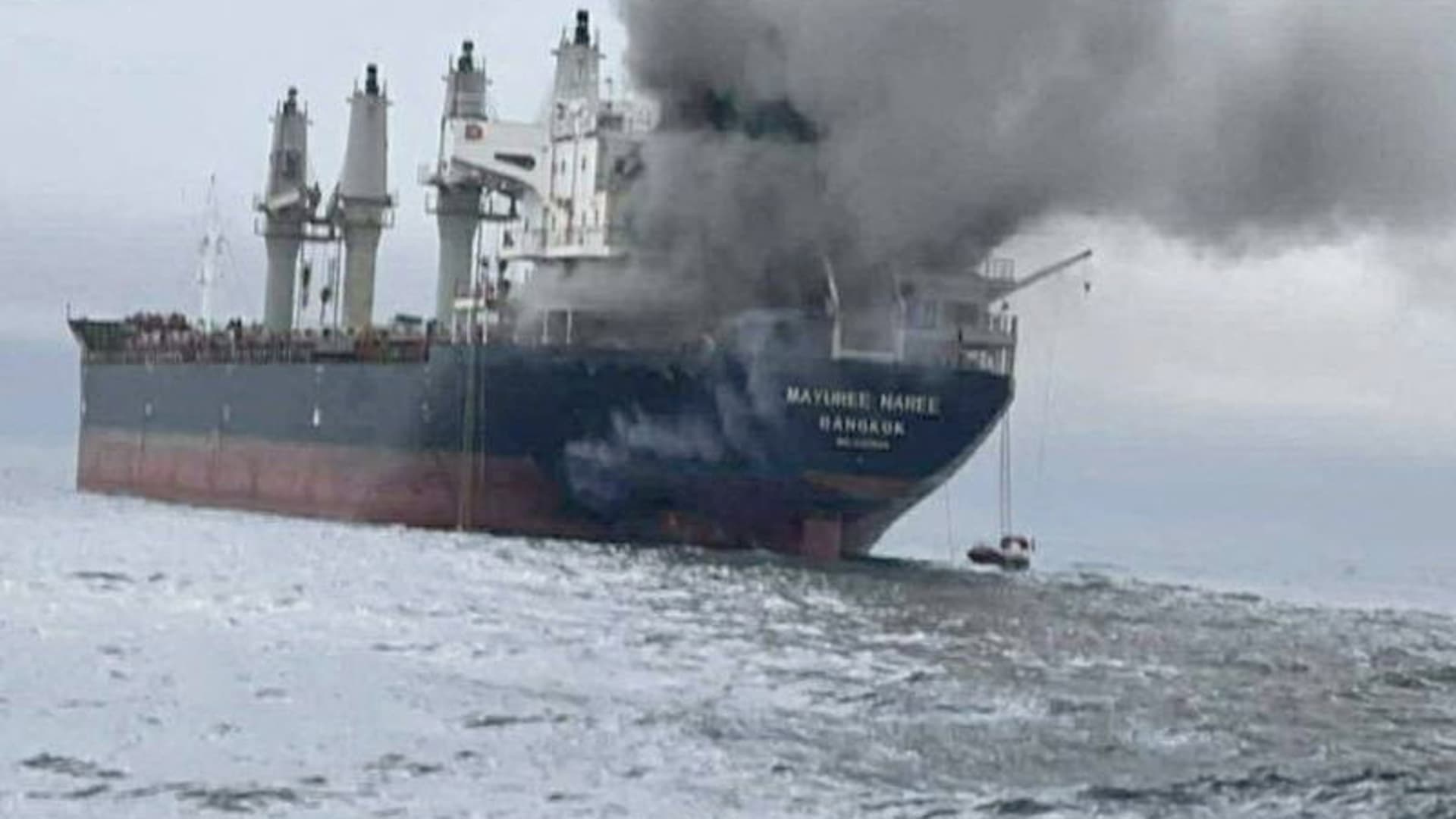
The Thailand-flagged cargo ship Mayuree Naree engulfed in black smoke in the Strait of Hormuz, March 11, 2026.
Reuters
“We expect these prices to come down significantly back down again” once the war is complete, a White House official told CNBC, speaking on condition of anonymity to discuss the administration’s strategy.
While Trump and Defense Secretary Pete Hegseth have been predicting a short war since it began nearly two weeks ago, they have shifted what the end goal is, naming removal of the Iranian regime and security for commerce in the region as well as nuclear concerns.
The oil market was well-supplied before the war. “The evidence that the bottom can keep falling out is at best highly speculative,” the official said.
Still, it is unusual for this president to power through an economic disruption. Trump normally listens closely to the market. The most famous episode was last April, when sticker shock over the size of his tariff program sent stocks plummeting and nearly broke the Treasury market. The administration backed off its most extreme plans. The market learned a lesson embodied in the derisive acronym TACO: Trump Always Chickens Out.
It was never really true that Trump would lose his nerve. Rather, he would take large risks for uncertain gains and then shift policy and rhetoric when the risks started to materialize.
But in Iran, Trump can’t pivot like that, because the driver of prices isn’t economic policy that can be easily changed.
Iran is a military problem. “The only thing prohibiting transit in the straits is Iran shooting at shipping,” Defense Secretary Pete Hegseth said at a briefing Friday.
The U.S. wants the Strait of Hormuz open. Iran doesn’t. And 13 days into the war, despite the incredible firepower the U.S. and Israel are raining down on Iran, it isn’t clear when that might change.
The U.S. Navy may be able to escort tankers through the strait, but at best that might start by the end of the month, Energy Secretary Christopher Wright told CNBC Thursday. Without military assistance, ship captains aren’t likely to budge, even if the U.S. government helps them find more insurance. Even then oil traffic probably won’t look like normal.
The expanding war effort has uncomfortable echoes of the Iraq War. Tens of thousands of U.S. troops on the ground weren’t enough to end the violence, and the conflict dragged on for nearly nine years.
That said, no one in power is talking openly about sending troops into Iran. And the U.S. and global economies may be able to pull through the Iran war, even if oil prices remain high. The U.S. economic expansion that began after Covid survived $120-a-barrel oil when Russia invaded Ukraine in 2022. Gas prices were higher than than they are now as recently as fall 2023.
The U.S. military, meanwhile, remains the most powerful in the world. Tehran has prepared for this moment, but so has the Pentagon. Other governments want the Strait of Hormuz open, too. Iran likely can’t hold out forever.
But until Iran caves or the U.S. military prevails, markets and the economy will remain vulnerable.
