


PUBLISHED
March 15, 2026
Art in Pakistan is shifting. No longer is it about dusty galleries and oil portraits; it’s the time for glowing screens, a generation that knows how to blend the old with the new. They are building their own platforms, launching startups, and finding their way into a wider conversation.
One of the emerging names on the scene is someone who appears to be wearing many hats at once. Awais Shaukat, 21, is a multitalented, award-nominated visual artist who started his journey as a child by making cartoons on paper using a lead pencil. At 14 years of age, he was already doing digital illustrations, when not many Pakistanis knew about it.
Born in the small town of Bhawana, he later moved to Lahore to study at the National College of Arts, still an undergraduate. Outside of his studies, Awais co-founded Awartsy, a film studio behind “Under the Blaze” with Rafhan Shaukat. He also established PakistaniArt, the country’s first independent art magazine, to provide a platform for local artists, which has been freshly nominated for the Global Startup Awards 2026.

Also, Awais is the first Pakistani who ranked in the top 50 on Crunchbase, a business directory, in September 2024.
His bio makes it clear that for him this is more than a hobby. But to understand his work, you have to look at his experiences carefully. There’s always been a friendly battle between traditional painters and digital artists who use a stylus. I asked him which side he’s on. What does he love more, painting and digital art?
“Traditional work always has a different type of feel; every stroke puts my emotions on canvas,” says Awais. “Painting is something that I just chose last year, and I feel a certain peace in it. Also, for me, the experience of seeing traditional work with my naked eyes is more satisfying.
But now that I’ve been doing digital art for six to seven years, it is one of the things I’m doing most.”
To Awais, painting on canvas feels is basically therapeutic. But digital art? That’s for the hustle. That’s where the money is at.
Right now, digital illustration is blowing up in Pakistan. Just check Instagram or Behance, and you’ll see tons of young people doing it. It makes sense because it’s cheaper in the long run, as you don’t have to keep buying pricey paints and canvases. But for most of them, it’s not just about drawing still pictures; they want to get into animation. That’s the real dream.

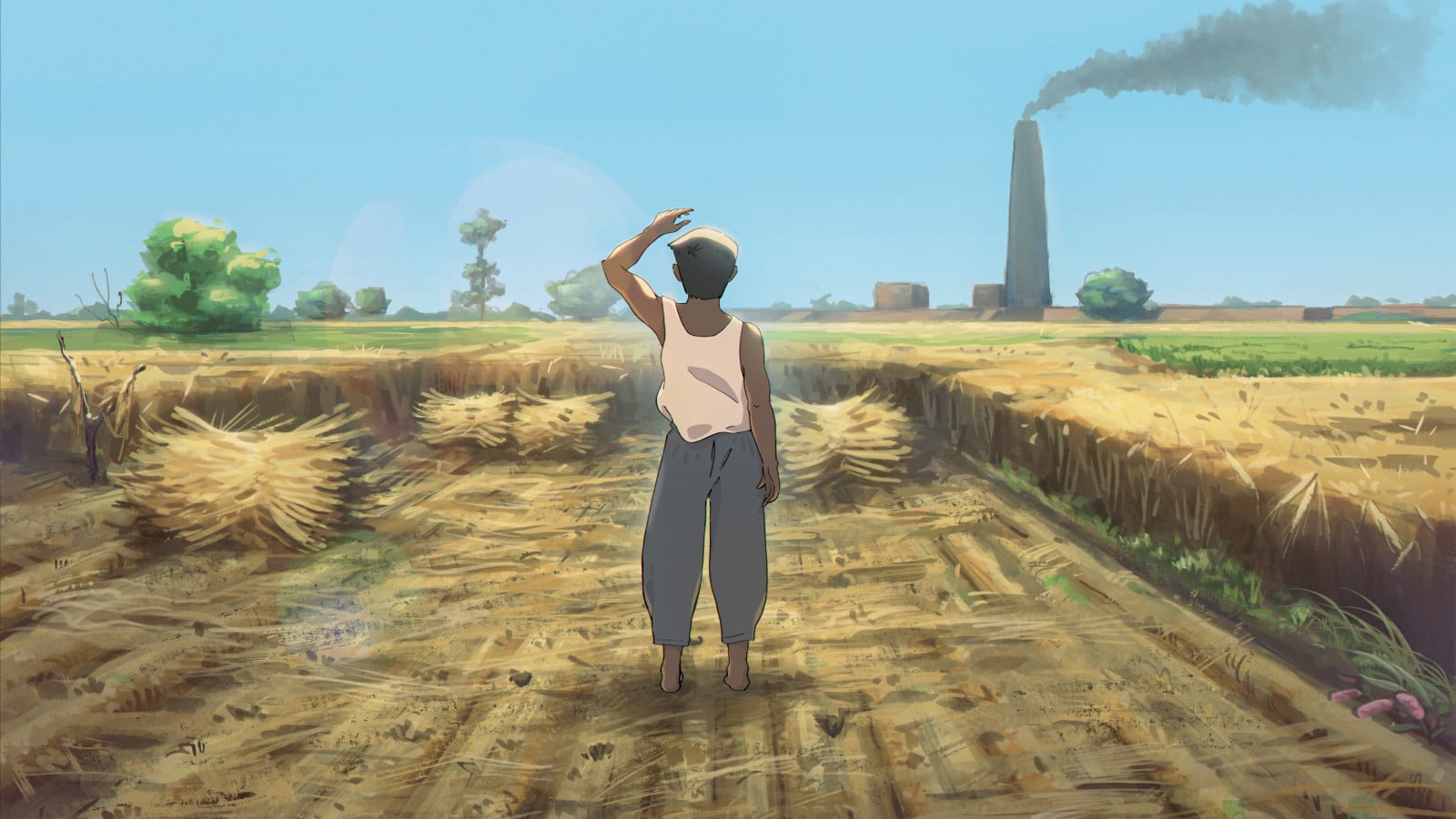
Awais has been working in animation too. “I have a lot of updates on the film [Under the Blaze] that I’d love to share in the future, but I want to clarify that the film is now on pause. I have so many things on the side to do, especially a full-time college routine, and budget issues that have kept me stuck on and off, so I’ve just given it a little break.”
Financial constraints present challenges for artists in our country. Unlike in the West, there is no availability of grants or easy funding for painters and indie filmmakers yet. Even with those hurdles, artists don’t stop but continue to work to find their own path. No wonder they say that artists are a different breed.
The art coming out of Pakistan right now is a fusion of sorts. We can see the influence of the West blending with our own deep desi roots.
At this point, Awais feels his style is still evolving. “As I’m still in the learning stages yet, there may be some development after some time has passed,” he says. “My digital work reflects a bit of Japanese style, I think, because I love it but along with some local impact. But in my traditional work like painting and drawing, I have a good feel for visible strokes and material impression. I love to portray the local side in my work.”
This idea of Japanese style art blended with local influences actually came to light in Pakistan when the 2024 release of the Ghibli-inspired film, The Glassworker, hit theaters.
“When I drew cartoons as a child, I dreamt of becoming a comic book artist and animator. I always felt like digital art was a good fit for me” says Awais. “I never thought I would be connected with the Fine Arts, but a time came when I realised that I could learn better through the traditional way of working, as it is important to know the basics. So I joined the NCA for a bachelor’s in fine arts, and that turned out to be the best decision that I could take.”

How does he manage his time?
“Learning everything is something I love to do,” says Awais. “I have no specific routine, but I’m really stretched thin across many, many things and that includes full-time college routine, doing painting stuff there. “I like to make illustrations to post on social media. All this does not leave too much time for my main film project, so I just paused that area for a bit.
Awais is also working on developing an art magazine online. “The magazine which will be called PakistaniArt will be a digital launch, and its website is under construction with the CEO of Bluelinks Agency, and other team members. We plan to make it a digital space to showcase local hidden gems as well as international artists.”
Digital illustration is rapidly gaining ground in Pakistan. A decade ago, “graphic design” was largely confined to event posters, wedding invitations, and basic logo work. Today, it has evolved into a dynamic, expansive industry with growing creative and commercial reach.

Fields like character design and app interfaces are growing incredibly fast.
Websites such as Fiverr and Upwork have changed everything, making Pakistan a trustworthy workplace. Because of this “gig economy,” our youth can earn money in dollars without ever leaving their bedrooms.
While freelancing is common, creating original art is a newer but trending practice. Brands are hiring artists to create unique packaging instead of using boring and repeatedly used stock photos.
However, this is where things get a bit complicated. When you compare Pakistan to the world’s biggest names, we are in a very different position.
The Big Players (the US, Japan, France) have had their industries for a long time. For instance, in Tokyo, Awais’s “Japanese style” would fit right into a huge world of manga editors and anime studios. In Los Angeles, he could even get a government grant to make his film.
India is ahead of us in animation. For years, they have been working for Disney and Sony and have massive studios that employ thousands of people.
You could call Pakistani artists the “rising underdogs.” On an individual level, the talent is undeniable. Artists based here are contributing to global giants like Marvel and DC, as well as leading video game studios — often working remotely from their own homes.

What we have not yet built, however, is a sustained studio culture. There is no local equivalent of Pixar — no large-scale institutional ecosystem that nurtures, funds, and amplifies this talent under one roof.
In essence, Pakistan possesses world-class artists. What it lacks, for now, is infrastructure, and long-term systems that can fully support and showcase them at scale.
To dabble in digital art, all you really need is a laptop and a drawing tablet or even an iPad to get going. The whole world is your market. You can live in Lahore and sell your work to someone in New York. Because of the internet, it does not matter where you are physically. Like Awais who works on cartoons, fine art, and films, you can do many things. Once you learn digital art, it is easy to switch between different jobs. You can design a character for a video game one day and a movie poster the next.
What we lack is the middle layer of the industry. At one end, there is no shortage of talented students just entering the field. At the other, there are a handful of highly skilled professionals operating at the top of their game. But between these two extremes lies a gap — a dearth of stable jobs, funding bodies, agencies, and representatives who can connect artists to consistent opportunities.
There is also no standardisation. Rates vary wildly. One artist may charge $50 for a logo, while another charges $500 for similar work. Without benchmarks or industry guidelines, both artists and clients are left navigating an uneven marketplace.
Another challenge is creative ownership. We have become exceptionally good at executing other people’s ideas — contributing to international franchises and outsourced projects — but we have invested far less in developing our own characters, comics, and animated worlds.
That is why the work of artists like Awais Shaukat matters. He is not just producing art; he is attempting to build intellectual property rooted in our own stories and imagination — something that truly belongs to us.
Hafsah Mazhar is a writer and teaches at Lahore Grammar School
All facts and information are the sole responsibility of the writer
