


PUBLISHED
March 22, 2026
An animal kept in a cage is entirely dependent on its captors for its survival. Whether for hunger, thirst, boredom, or just a breath of fresh air, the captive creature must master the art of imploring its owner to unbolt the door and fulfil its needs. Yet, fearing abandonment or punishment, the animal cannot afford to upset the captor and ultimately chooses submission. Without an income of their own, such is the lived reality of millions of women across the country, systemically trapped in the money cage.
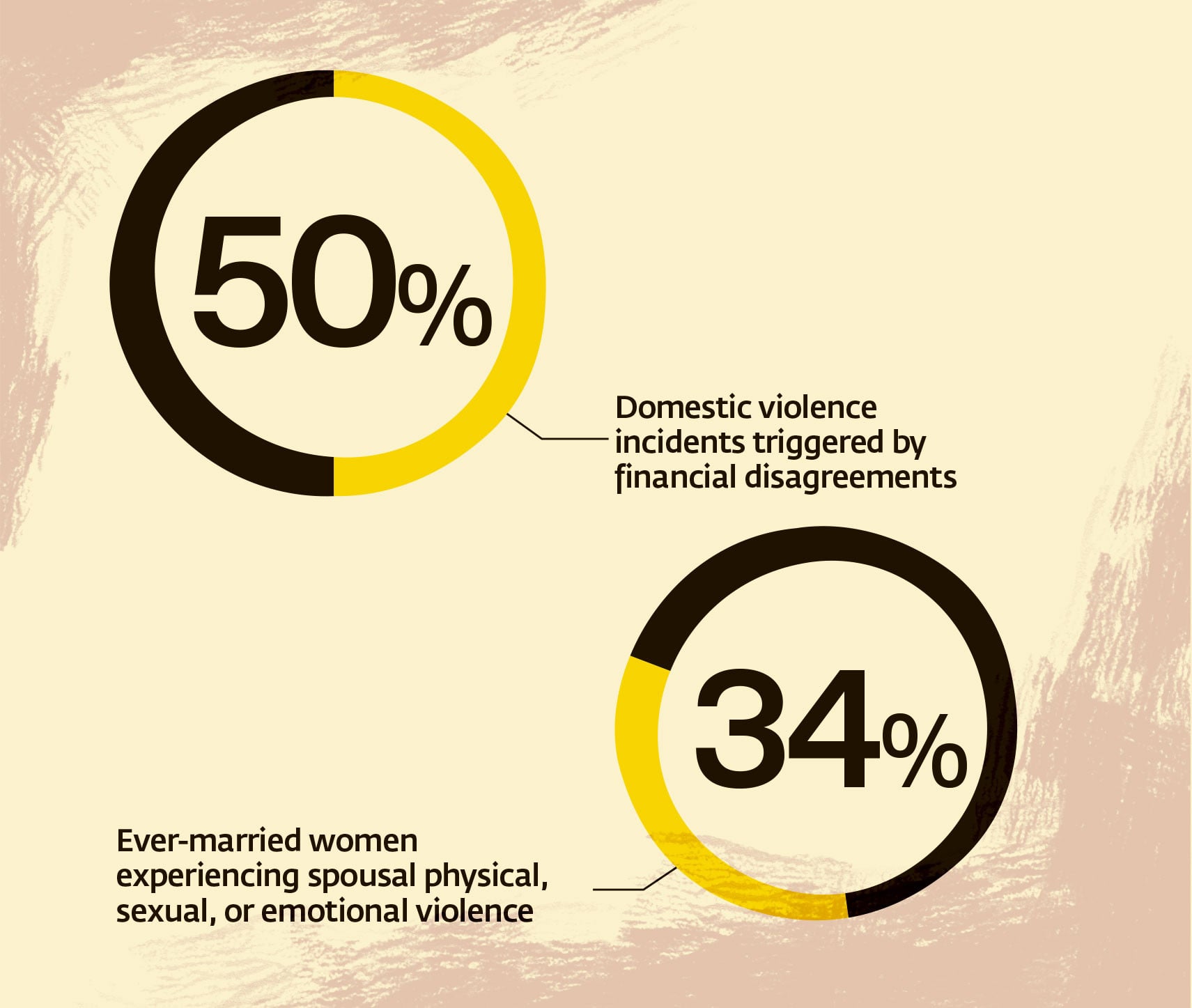
Despite the gradual rise in female literacy and emphasis on women empowerment, the state of women’s financial dependence on men is such that even today, newspapers are filled with harrowing accounts of women being brutally beaten to death by their husbands or in-laws over demands for clothes, money, and even sanitary pads. According to the UNFPA, 34 per cent of ever-married women have experienced spousal physical, sexual, or emotional violence, while local studies show that more than 50 per cent of domestic violence incidents are triggered by financial rifts between the husband and wife.
For the advocates of traditional gender roles, such figures might incite the clichéd “not all men” debate. But the reality is that when troubling finances, soaring inflation, and rampant unemployment reduce the purchasing power of the average household, the male provider model loses its romanticised charm and becomes an ugly breeding ground for misogyny and abuse. Even in cases where direct physical violence is absent, the psychological degradation of having to persuade another person for each and every need or desire gradually erodes women’s self-esteem. Over time, many housewives simply become immune to their husbands shunning them for their spending habits and have no qualms about sneaking money.
In conversation with the Express Tribune, Mashal Khan, managing director retail, and chief marketing officer at a brokerage firm, believed that the idea that a woman moves from being her father’s responsibility to becoming her husband’s responsibility was an outdated narrative that limits women’s independence. “The gender imbalance exists largely because of cultural conditioning. Boys are taught that financial success is their primary responsibility, while girls are raised with the expectation that they will eventually marry into a ‘good family’. Yet modern economic realities make single-income households increasingly difficult to sustain, particularly in a country like Pakistan where rising energy costs, household expenses, education costs, and daily living expenses place significant pressure on families,” highlights Khan.
Although some might argue that times are changing and women are contributing towards household income, the ground reality among the masses can be gauged by a simple YouTube clip. While answering questions in their sermon, a renowned local religious figure, with millions of subscribers on his YouTube channel, outright condemned women for “stealing” money from their husbands’ wallets. As expected, the comment section was flooded with desperate wives describing the peculiarity of their individual cases and the utter despondence which forced them to commit the misdeed. But the question remains: if women were encouraged to earn money of their own, would they still be stuck in this cycle of beg, borrow, steal?
Ambreen Ajaib, executive director at an Islamabad-based NGO, highlighted the deep-rooted social, cultural, and institutional barriers that continued to limit women’s financial independence. “Patriarchal norms keep women on the margins, limiting where they can go, the decisions they can make, and the income they can control,” says Ajaib. “Early marriage, unpaid care work, unsafe workplaces, and scarce opportunities to gain marketable skills further block their path to economic independence, while weak enforcement of inheritance rights and the lack of basic identification documents like CNICs often prevent women from opening bank accounts or accessing credit. For women with disabilities and those from religious or ethnic minorities, these barriers stack even higher, compounding exclusion and deepening economic vulnerability.”
Gaps in wealth
While women across the world continue to prove their mettle in every field, millions in Pakistan remain shut out of the formal financial system due to structural barriers, restrictive social norms, and unequal access to resources. Trapped in a cycle of financial dependence, many women cannot even afford the quiet pride of holding a debit card in their own name, let alone the thrill of participating in the stock market and building a financial future.
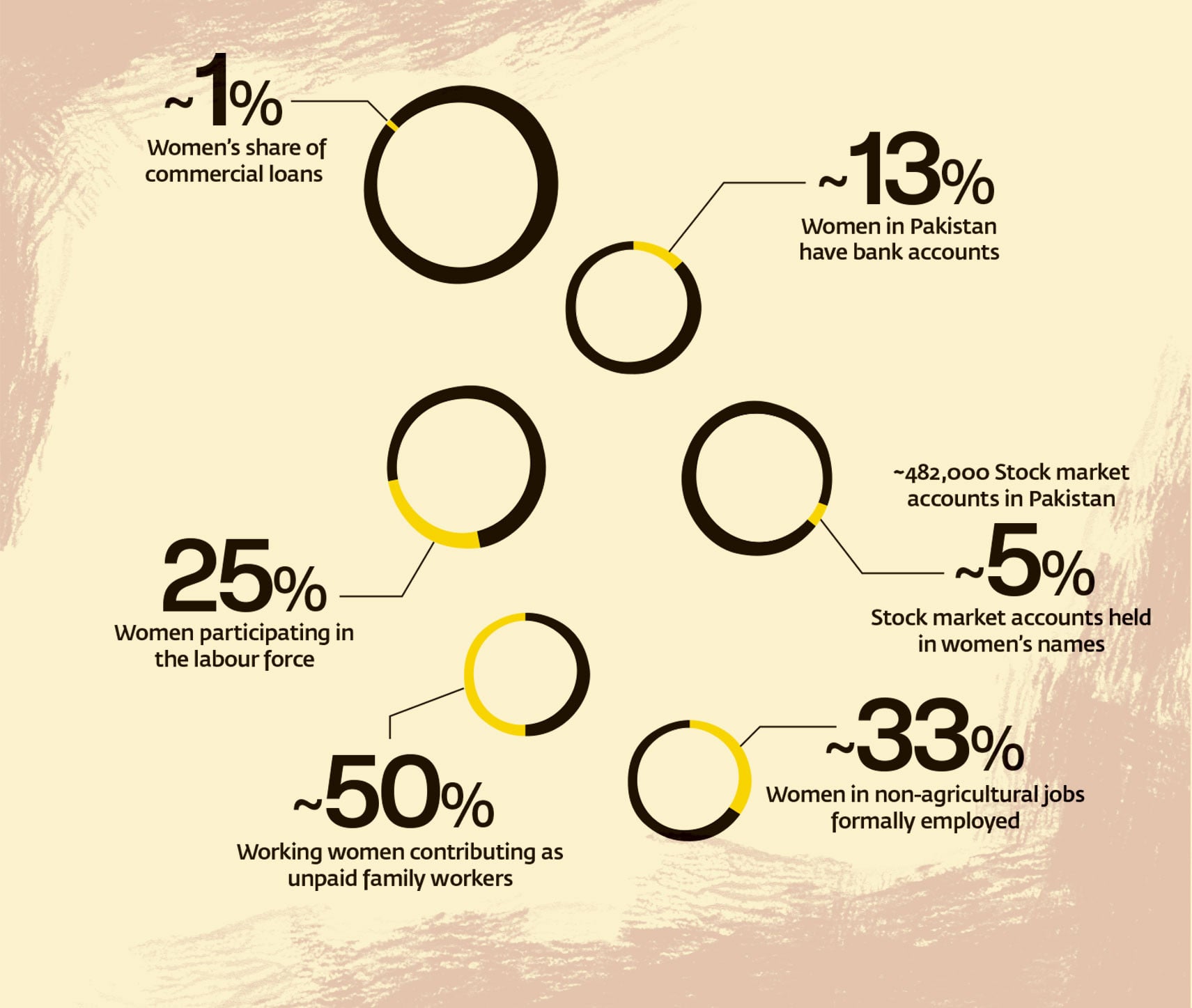
According to Khan, the gap in women’s financial participation in Pakistan is stark, since there is a deeply ingrained assumption that men are naturally better at managing money or financial matters. “Despite women constituting a significant portion of the population, only around 13 per cent of women have bank accounts,” she says. “The disparity becomes even more severe in more advanced financial participation. At present, there are around 482,000 stock market accounts in the country, and only about 5 per cent of them are held in women’s names. When it comes to access to commercial loans, women account for just about one per cent.”
Commenting on the participation gap in financial markets, Khan explained that finance was often perceived as a dry or technical field, and there was a stereotype that women naturally gravitate towards creative fields instead. “However, research repeatedly shows that women perform just as well—if not better—in areas involving numbers, mathematics, and financial management,” she claims. “In fact, global studies on portfolio management have shown that women often make strong fund managers because they tend to approach risk differently, cut losses earlier, and avoid making decisions based on ego.”
Dr Rakhshinda Parveen, a Gender Equality, Disability and Social Inclusion (GEDSI) expert and founder of an entrepreneurship enabler, noted that only about 25 per cent of women participate in the labour force. “Among those who do work, only around one-third of women in non-agricultural jobs are formally employed, while most remain in informal, unpaid, or family-based work,” she shares. “Nearly half of working women contribute as unpaid family workers, performing household or agricultural labour without pay or protection. This shows that the challenge is not simply getting women into work but ensuring they have secure, recognised, and empowering employment.”
Dr Parveen highlighted that although women had legal rights on paper—including inheritance, mehr (dower), and alimony—these rights were rarely enforced in practice. “Courts have declared customs that deprive women of inheritance to be un-Islamic and illegal,” she informs. “Some rulings have also called on the state to create mechanisms enabling women to claim property without fear. Yet cultural pressure, entrenched local customs, and weak enforcement mean most women never receive their rightful share. The issue extends beyond inheritance. Mehr is often unpaid, alimony remains fragile, and women frequently face obstacles when attempting to sign leases or start businesses without male guarantors.”
Khan believes these gaps in wealth did not emerge suddenly, since they begin at home and are reinforced by social norms. “The belief that men are better with money is not even consciously expressed—it is simply embedded in how children are raised,” she emphasises. “When children go out, parents often hand the money to the son while telling the daughter her brother will buy her treats. In a patriarchal system, the idea of protecting women has often been confused with limiting their independence and ability to manage their own affairs.”
“A lack of safety for women is frequently used as justification to restrict them, when in reality the issue should be addressed by improving safety and accountability rather than limiting women’s opportunities,” urges Khan. “Conversations about financial independence, money management, and investment should start at home, continue in classrooms, and become part of everyday discussions among peers. Only when these ideas become normalised within families, schools, and social circles can the cycle of financial exclusion begin to break.”
Shackles of dependency
For many girls writing “housewife” as their mother’s occupation on their school application forms, the shackles of dependency begin to take shape early. While women’s unpaid domestic labour sustains the smooth functioning of patriarchal families, it often comes at the cost of their own economic autonomy. As children absorb these cues, many grow up internalising the idea that marriage—not personal ambition or financial independence—is the ultimate milestone for a woman.
This perception is reinforced by how society frames marriage itself. As Khan noted, marriage is treated almost like a career alternative for women. “When a woman leaves her job, the explanation offered is sometimes simply, ‘she got married,’ as though marriage naturally replaces a professional path,” she explains. “In reality, marriage and career are separate aspects of life, and one should not cancel out the other. Rather than being treated as an achievement or endpoint, marriage should ideally function as companionship—a partnership between two individuals who have already built their own identities.”
Yet cultural expectations continue to undermine that ideal. “During marriage negotiations, women are often expected to ask whether they will be ‘allowed’ to continue working,” she adds. “The existence of such a question reveals a deeper problem. No individual should require permission to pursue their ambitions or profession. As long as a person respects their partner, harms no one, and acts within the bounds of the law, their life choices should remain their own.”
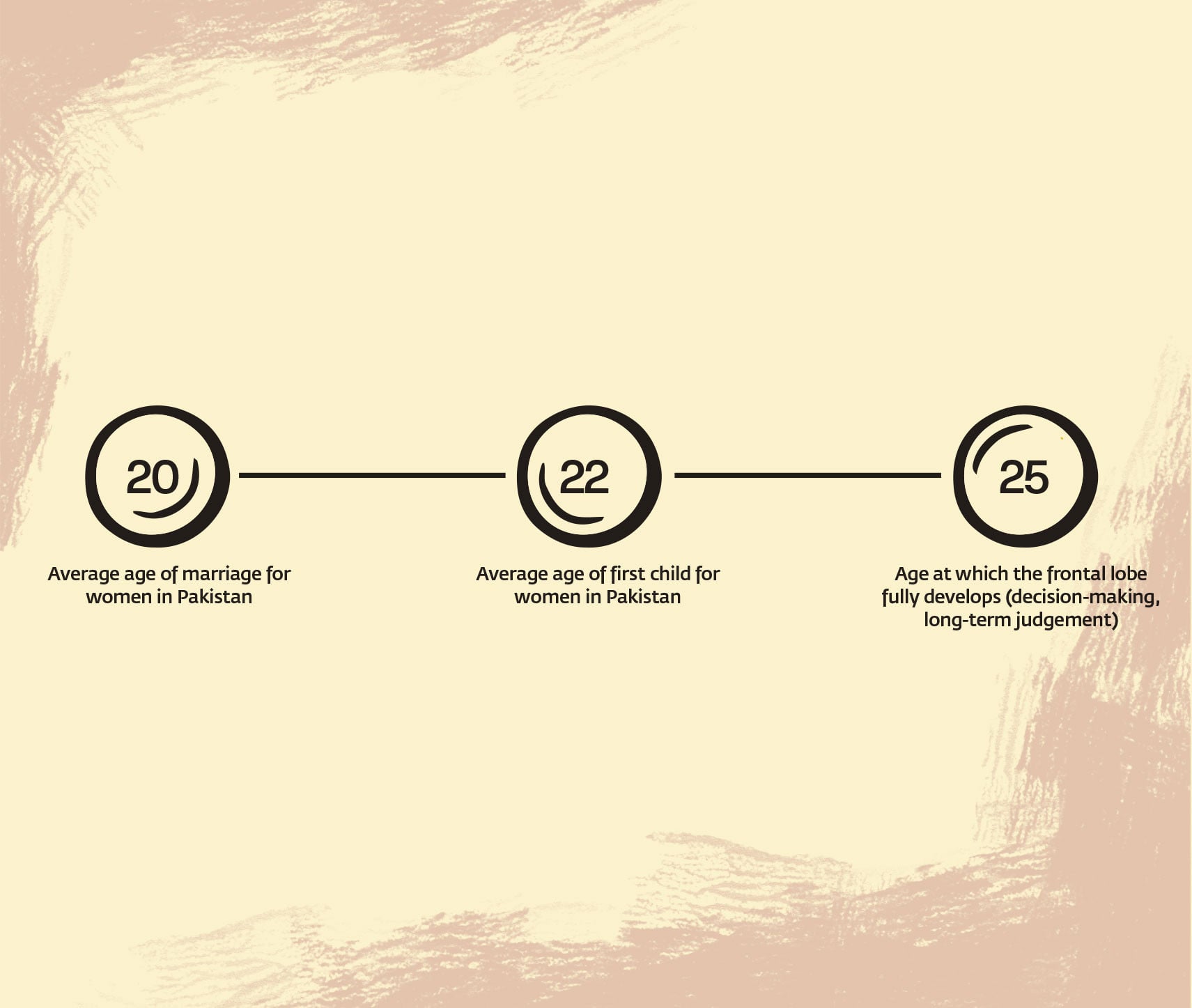
Yet, millions of girls are denied agency, and forced into early marriages that strip them of life choices. In Pakistan, the average age of marriage for women is around 20, and by 22 many have already had their first child, leaving little time to pursue education, build careers, or establish financial independence. Khan points out that the frontal lobe of the human brain — the region responsible for decision-making and long-term judgement—fully develops around the age of 25. “Many people recognise that their priorities and identities shift significantly after this stage,” shares Khan, raising important questions about the cultural pressure for early marriage in countries like Pakistan.
Social media has also fuelled the cycle of dependency by projecting unrealistic lifestyles and romanticised ideas of damsels in distress being spoiled by rich men in shining automobiles. “I would blame online narratives for glamorising financial comfort through relationships. Through the ‘sugar-baby culture’, female influencers create distorted expectations about wealth and independence. Such portrayals can quietly reinforce the notion that security will arrive through someone else rather than through personal agency,” highlights Khan.
As glittery as a partner-funded lifestyle may be, its true consequences become forbidding when the relationship either turns abusive or heads towards failure. Incapable of affording the lifestyle provided by their husbands, many women continue to compromise in marriages, where neither their spirit nor their flesh is safe from harm. For instance, Zara, a 24-year-old, found herself trapped in an abusive marriage. “When I told my father my husband had hit me, he brushed it aside—saying it was no big deal as long as my husband apologised, bought me a new iPhone, or took me on a trip to the Maldives,” shares Zara.
“Whenever people talk about women stuck in abusive marriages, the first question many ask is: where will she go? For many women, returning to their parents’ home after marriage is still burdened with stigma and shame. Yet countless tragic cases reveal that women are sometimes driven to death in abusive environments simply because they feel they have no safe alternative. Families often say in hindsight that they would have preferred their daughters return home, but the lack of reliable support systems and financial independence keeps many women trapped in dangerous situations,” notes Khan.
According to Dr Parveen, these chains of dependency leave many women feeling as though they belong nowhere. “Women first grow up under the close supervision of their families and later find themselves under the authority of husbands and in-laws. Financial independence matters deeply, but giving women an emergency wallet or more shelters is not enough to make them feel safe or free,” implores Dr Parveen. Something as simple as a single woman trying to rent a home in Islamabad can quickly become a moral judgement rather than a practical arrangement.”
Until women’s financial and residential rights are guaranteed as basic entitlements—rather than privileges subject to family or societal approval—true security will remain elusive. As Dr Parveen stressed, the barriers are real and structural, and even educated and employed women often remain constrained not by lack of ability but by lack of control. What women ultimately need is not only financial independence but agency, ownership, and enforceable rights that allow them to shape their own lives.
Unleashing dignity
Financial exclusion does more than limit opportunity—it limits choices, safety, and dignity. For millions of women, economic dependence becomes a silent cage, restricting the ability to leave abusive situations, make independent decisions, or build secure futures. Breaking that cycle requires more than goodwill; it demands financial knowledge, institutional support, and the confidence to claim economic space.
“For young women entering their 20s, financial independence should be treated as a non-negotiable life goal. Ideally, before marriage, a young woman should have her own bank account, personal savings covering six to twelve months of expenses, and a marketable skill or qualification that ensures employability. Dowry should never be mistaken for financial security. Instead, women must assert their legal right to inheritance and assets in their own name,” stresses Ajaib.
Cultivating financial awareness early can make a transformative difference. As Khan explained, even modest habits—such as setting aside a portion of a student allowance instead of spending it entirely on coffee, food, or entertainment—can build long-term financial discipline. “Such savings are not merely about wealth; they are about resilience. Financial security protects individuals against life’s uncertainties—from abusive relationships, medical emergencies, and economic downturns to political instability, natural disasters, or global crises,” notes Khan. Having investments to rely on ensures that one’s quality of life does not collapse during difficult times.” She believes building this culture requires early exposure to financial knowledge. Schools, universities, and government campaigns can play a key role in normalising conversations about money, savings, and investment. Young women interested in investing can begin by following brokerage houses on professional platforms such as LinkedIn, where firms often publish strategy reports, sector analyses, and stock research. Opening a brokerage account and subscribing to research mailing lists can also provide valuable insights.
“For beginners, mutual funds provide a low-barrier entry, with professional managers handling investments for a modest fee,” shares Khan. “Over time, individuals can begin investing directly. Learning also comes from observing everyday products, studying resilient industries like food, energy, and internet services, and engaging with finance books, podcasts, or experts like Warren Buffett and Charlie Munger. Though initially intimidating, consistent learning over six to twelve months makes investing increasingly accessible.”
As critical as it might be, financial knowledge alone cannot dismantle entrenched inequalities. “Breaking these barriers requires structural reform and grassroots awareness,” emphasised Ajaib. “Access to financial services must be simple, inclusive, and physically accessible, while the media can showcase diverse women role models to normalise economic independence. Strong enforcement of inheritance laws and anti-discrimination protections is also critical to secure women’s equal economic rights.”
As Dr Parveen cautioned, meaningful change requires deeper structural transformation. “Real change will demand serious legal reform, widespread awareness, and sustained commitment. Unfortunately, empathetic engagement is often missing from lawmakers, bureaucracies, and even donor agencies,” she regrets.
Until institutions guarantee women equal access to financial systems, property rights, and safe living arrangements, economic freedom will remain fragile. But when women save, invest, inherit, and make independent decisions—the possibilities expand. Building long-term financial independence is not about filling wallets and financing luxury; it is about setting a powerful precedent for the future generation of young women. A roof over their head, food on their plate, and change in their wallet should never come at the cost of their dignity, safety, and respect.
All facts and information are the sole responsibility of the writer
