


Both countries emphasise primacy of the UN Charter, urging international community to support efforts for peace
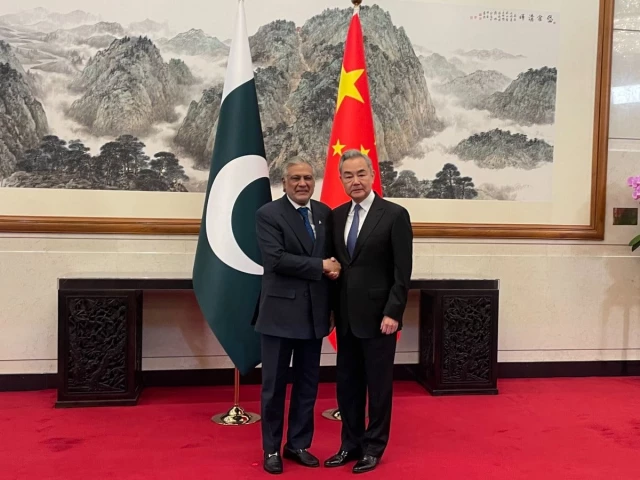
Chinese Foreign Minister Wang Yi met with Deputy Prime Minister and Foreign Minister Ishaq Dar in Beijing on March 31, 2026. Courtesy: CGTN
Pakistan and China on Tuesday jointly proposed a five-point initiative aimed at restoring peace and stability in the Gulf and broader Middle East, calling for an immediate ceasefire, protection of civilians, and urgent diplomatic engagement to prevent further escalation.
According to a statement issued by the Foreign Office on X, the initiative was put forward during a meeting between China’s Foreign Minister Wang Yi and Deputy Prime Minister and Foreign Minister Ishaq Dar in Beijing.
The two sides stressed the need for an immediate cessation of hostilities, urging all parties to prevent the conflict from spreading and to ensure unhindered humanitarian access to war-affected areas.
🔊PR No.8️⃣5️⃣/2️⃣0️⃣2️⃣6️⃣
Five-Point Initiative of China and Pakistan for Restoring Peace and Stability in the Gulf and Middle East Region (Beijing, March 31,2026)
🔗⬇️ pic.twitter.com/E3qOU2VhjC
— Ministry of Foreign Affairs – Pakistan (@ForeignOfficePk) March 31, 2026
They also called for the early resumption of peace talks, underlining that dialogue and diplomacy remained the only viable path to resolving disputes.
The statement emphasised the importance of safeguarding the sovereignty, territorial integrity, and security of Iran and Gulf states, while urging all sides to refrain from the use or threat of force during negotiations.
Highlighting concerns over civilian safety, Pakistan and China underscored the protection of non-military targets, calling on all parties to strictly adhere to international humanitarian law and halt attacks on civilians and critical infrastructure, including energy facilities, desalination plants, and peaceful nuclear installations.
The two countries also voiced concern over disruptions to global trade, stressing the need to ensure the security of shipping lanes, particularly in the Strait of Hormuz. They called for the safe passage of commercial vessels and the restoration of normal maritime traffic at the earliest.
Reaffirming their commitment to multilateralism, Pakistan and China emphasised the primacy of the United Nations Charter, urging the international community to support efforts aimed at achieving a comprehensive and lasting peace framework in line with international law.
The FO said the initiative reflects a shared commitment by Islamabad and Beijing to promote de-escalation and stability in a region facing heightened tensions.
Read More: Pakistan signals Iran-US talks in ‘coming days’
Upon arrival in Beijing, FM Dar was welcomed by Ambassador Yue Xiaoyong and Pakistan’s Ambassador to China, Khalil Hashmi. He was later received by Wang Yi at the Diaoyutai State Guest House for their bilateral discussions.
Earlier in the day, during a regular press conference, Chinese Foreign Ministry spokesperson Mao Ning, in response to a question about Dar’s second visit to China in three months, stated, “China and Pakistan are all-weather strategic cooperative partners with mutual trust and support. The two countries share similar positions and maintain close communication on key international and regional issues.”
She further explained that it was believed that the two foreign ministers would enhance strategic communication and coordination regarding the situation in Iran, as well as other international and regional matters of mutual concern, jointly advocating for peace, justice, and making fresh efforts to end the conflict and restore peace and stability in the region.
Tensions in the Middle East escalated sharply after US and Israeli air strikes last month assassinated Iran’s Supreme Leader Ayatollah Ali Khamenei and several senior officials, triggering a wave of retaliation from Tehran and widening the conflict across the region. In response to the strikes, Iran launched retaliatory attacks on US military bases in several Gulf countries, significantly expanding the scope of the confrontation.
Pakistan has since ramped up its diplomatic efforts to play its part in easing the tensions and emerged as a key mediator between the US and Iran in their ongoing conflict, which had spread across the Gulf region.
On Sunday, Pakistan hosted a quadrilateral foreign ministers’ meeting with representatives from Turkiye, Saudi Arabia and Egypt in Islamabad, focused on defusing tensions between the US and Iran.
After the four-way talks, in a televised statement, Dar announced that Islamabad could host high-stakes talks between Iran and the US “in the coming days”. “I briefed the visiting brother foreign ministers about the prospects of potential US-Iran talks in Islamabad. The visiting foreign ministers expressed their fullest support for this initiative,” he said.
Also Read: Pakistan signals Iran-US talks in ‘coming days’
The foreign minister said, “Pakistan will be honoured to host and facilitate meaningful talks between the two sides for a comprehensive and lasting settlement,” adding that both Tehran and Washington had expressed confidence in Islamabad’s role as a neutral facilitator.
