


Aurangzeb says domestic oil and gas prices are under review, while reassuring that country’s reserves remain stable
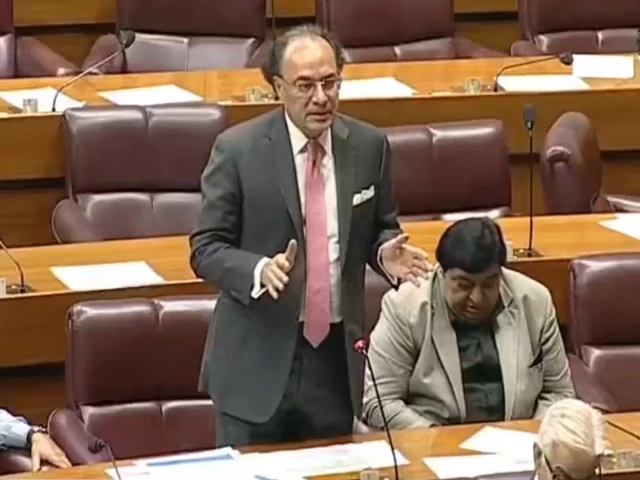
Finance Minister Muhammad Aurangzeb addresses a National Assembly session on April 7, 2026. SCREENGRAB
ISLAMABAD:
Finance Minister Muhammad Aurangzeb on Tuesday said domestic oil and gas prices are under review, while reassuring that the country’s reserves remain stable. “So far, there has been no impact on foreign exchange reserves,” he said, confirming that a $1.4 billion Eurobond repayment is due this week.
Addressing the National Assembly, he also noted that remittances, particularly from Gulf Cooperation Council (GCC) countries, are being closely monitored given their importance for external stability, adding that no decrease has been observed to date.
“The government is pursuing a holistic strategy that balances fiscal responsibility, subsidy management, energy security, and structural reforms, ensuring Pakistan’s macroeconomic stability in challenging times. With unity and informed decision-making, Pakistan can navigate these external shocks and continue its journey towards economic stability and sustainable growth,” he said.
Aurangzeb said that from March 14 to April 4, fuel price transmission was temporarily halted, and a blanket subsidy was provided to prevent further increases. “The total subsidy amounts to Rs129–130 billion. This was not left to mere discretion or speculation—it was carefully funded and monitored by the Finance Division,” he added.
He explained that austerity measures were enforced systematically, with around 60% of government vehicles grounded and other controls applied under ministerial oversight. A third-party audit of the subsidy is currently underway to ensure transparency.
His remarks came after lawmakers raised concerns over rising fuel prices and the government’s fiscal measures. Last week, Prime Minister Shehbaz Sharif announced a Rs80 per litre reduction in the petroleum levy on petrol, a day after prices were raised by Rs137 per litre, saying the move would bring the petrol price down to Rs378 per litre.
The announcement came a day after the government raised the petrol price by Rs137 per litre, taking it to a record high of Rs458.4. PM Shehbaz had decided to increase the petroleum levy on petrol to Rs160.61 per litre, marking the highest level in history. With a single notification, the premier raised the levy from Rs106 to Rs161 per litre, an increase of Rs55 in taxes.
The government also pushed the price of high-speed diesel to a record Rs520.35 per litre, an increase of Rs185 per litre, or 55 per cent. However, the prime minister abolished the petroleum levy on high-speed diesel, retaining only a Rs2.5 per litre carbon levy in addition to all import duties.
Read More: 2,800 Sindh residents have received motorcycle fuel subsidy: Sharjeel Memon
Addressing claims that certain sectors were neglected, the minister said, “Targeted subsidies were announced for deserving groups, including two-wheelers, trucks, large vehicles, mini-vans, and public transport buses. Small farmers and provincial mechanisms were also considered, with Punjab having 850,000 beneficiaries and Sindh using the Card system.”
He added that the government coordinated closely with relevant ministries, the State Bank, and banking officials to ensure proper distribution. “Subsidy disbursements are already underway, and every measure has been reinforced to protect the public interest,” he maintained.
Aurangzeb also provided an update on Pakistan’s fuel subsidy programme and its alignment with regional trends, emphasising that all deserving groups will begin receiving benefits soon.
He said the Ministry of Petroleum has been coordinating daily to monitor fuel policies across South and Southeast Asia, including the UAE, Bangladesh, Sri Lanka, India, the Philippines, and Cambodia.
“For instance, in the UAE, petrol prices have increased by 30% and diesel by 70%. Many countries have already started rationing. We are observing these developments closely to ensure our subsidy policy remains effective,” he added.
The minister stressed that Pakistan is implementing a carefully planned strategy, with continuous monitoring of the macroeconomic impact. “We are tracking increases in oil and gas bills, insurance and freight costs, and implications for exports, particularly to GCC countries. Remittances remain stable so far, which is encouraging,” he added.
Aurangzeb further said the government is monitoring the impact of subsidies on inflation, the balance of payments, and the current account, particularly concerning GCC countries. “We are closely tracking external financing needs, including the upcoming Eurobond repayment this week, alongside other obligations,” he noted.
He stressed that austerity measures and cost-cutting proposals are being implemented without compromising public welfare.
Read More: Five police personnel injured in IED attack on patrol in K-P’s Lakki Marwat
The finance minister highlighted structural reforms, including the privatisation of 26 state-owned enterprises, such as Pakistan International Airlines and the Women’s Bank. “Some entities that were unviable, like certain PWD operations, were closed to eliminate corruption and mismanagement, ensuring subsidies reach their intended purpose,” he added.
On energy, Aurangzeb said daily monitoring is being conducted for petroleum, diesel, aviation fuel, LPG, and crude oil, along with the assessment of strategic reserves in other countries.
He emphasised lessons learned from international markets, particularly China. Regarding renewable energy, he said Pakistan currently has around 8,000 megawatts of solar capacity, and the Prime Minister has formed a committee to plan the energy transition over the next 8–10 years to reduce fossil fuel dependency.
The minister stressed the importance of building strategic reserves alongside commercial stocks to better manage future energy shocks, adding that daily monitoring mechanisms have been implemented in coordination with the Petroleum Division.
Earlier in the session, Pakistan Peoples Party lawmaker Sharmila Farooqi criticised the increases, saying Pakistan had raised petroleum prices ahead of regional peers and that official briefings had been unsatisfactory.
Also Read: Heavy rains in K-P swell rivers, trigger power outages, disrupt daily life
She added that petrol still carried heavy taxation and urged the government to reduce margins for petroleum companies and develop a comprehensive pricing policy. “People ask us how they will manage their livelihoods. Even we hesitate while arranging petrol,” she said.
NA member Noor Alam Khan also criticised the finance minister. “By raising prices, you have benefited petroleum companies,” he said, adding that the rise in diesel costs has made all goods more expensive. “Now even wheat harvesting has become unaffordable,” he added.
He questioned why petrol prices rose despite Saudi Arabia supplying oil and Iran providing passage. “If Saudi Arabia were supplying oil and Iran was providing passage, then why did petrol prices still rise?”
MNA Alia Kamran submitted an attention notice highlighting tax revenue shortfalls, reporting a Rs430 billion deficit last year, and accused the government of attempting to reduce the shortfall by raising petroleum prices.
The federal government missed the International Monetary Fund (IMF)-dictated tax target by a wide margin of Rs610 billion, marking the third consecutive quarter the FBR has failed to meet its target. The government is offsetting the shortfall with increased petroleum levy rates and reduced development spending.
PPP MNA Mirza Akhtar Baig also criticised the petrol price hike, asking how much profit companies gained after the price was raised by Rs55 overnight.
“Global prices may rise, and increases may be necessary, but they should not be so high that life becomes impossible for ordinary citizens,” he said. He also questioned the finance minister on savings and criticised the federal government’s unjustified expenditures.
Also Read: FBR misses tax target by Rs610b
Meanwhile, Defence Minister Khawaja Asif defended the government’s revised solar energy policy, saying authorities were constrained by long-standing agreements with independent power producers (IPPs) and must balance the interests of solar users and conventional electricity consumers.
Asif said that while shifting to solar energy was desirable, capacity payment obligations limited policy flexibility. “So, this is the way forward—go solar. What can we do? Capacity payments have to be made; our hands are tied,” he said.
The debate followed a “calling attention notice” moved by Syed Naveed Qamar, who raised concerns over the imposition of tax on solar panels.
Minister of State Shazra Mansab Ali Khan Kharal said the tax had been reduced from 18% to 10% and would apply only to new consumers. She said the policy was based on multiple considerations.
The National Electric Power Regulatory Authority, in February, revised the terms for net-metered solar consumers to manage rising solar adoption and protect the financially strained grid.
The changes abolished the exchange of electricity units under net metering and proposed cutting the buyback rate for excess solar power from Rs25.9 per unit to Rs11 per unit. Contract durations were also reduced from seven to five years. The amendments took effect on February 9 and do not apply to existing consumers until their current agreements expire.
Opposition lawmakers criticised the move, saying it discouraged renewable energy adoption. Qamar questioned why green energy was being penalised when electricity remained expensive and largely generated from polluting fuels.
Responding to criticism, Asif said past agreements with IPPs—signed two to three decades ago under successive governments, including those of the PPP—continued to bind the current administration. “Discussions were held with IPPs some time ago, but little progress was made,” he said.
Under these agreements, the government must pay power producers in US dollars based on installed capacity, regardless of actual electricity purchases. Over time, revised contracts increased per-unit costs and capacity payments, contributing to a circular debt exceeding Rs2.3 trillion.
Gulfstream jet
MNA Atif Khan raised concerns over the Punjab government’s acquisition of a new Gulfstream jet, urging that Punjab Chief Minister Maryam Nawaz should refrain from using it until petrol prices are reduced. “Only then can we know if they are serious,” he said.
The aircraft in question, a Gulfstream G500 bearing registration N144S, arrived in Lahore from North America in December 2025 and began local flight operations on February 6. The 19-seater VIP jet, valued at approximately Rs11.7 billion, operates under the call sign “Punjab 2,” which is typically used when the chief minister is on board.
Responding to widespread criticism, Pakistan Muslim League-Nawaz Senator Abid Sher Ali said the aircraft belongs to the Punjab government and that its replacement was justified, given that the previous jet was over 25 years old.
The defence minister also defended the move, stating that all four provincial chief ministers use aircraft and that only Maryam Nawaz is being singled out. “This kind of political posturing is inappropriate,” he said, adding that the prime minister continues to use an older aircraft.
In response, MNA Junaid Akbar said that while all four chief ministers may have aircraft, the other three continue to use older planes.
Opposition member Zain Qureshi added that the Khyber-Pakhtunkhwa chief minister does not have a plane, questioning the purchase of the Rs11 billion aircraft. “Why did she sabotage herself with this decision?” he said.
Balochistan and Tirah
Opposition leader Mahmood Khan Achakzai called for political dialogue and unity, warning of unrest in Balochistan and urging greater space for civilian leadership.
“We will have to agree on some key points. We need to tell the military to give us some space. Countries cannot function without their armed forces,” he said. He added that if PM Shehbaz was present, he would go and personally speak to him. “This country can only progress through collective wisdom,” he added.
Separately, lawmaker Engineer Hamid Hussain highlighted the displacement of residents from the Tirah Valley in Khyber-Pakhtunkhwa, saying more than 26,000 families had been registered in Bara amid ongoing operations and were facing severe hardships.
Since the beginning of the year, there have been ongoing large-scale displacements from the Tirah Valley. More than 26,000 families have been registered in Bara as part of what officials describe as a major humanitarian and administrative operation in the border region.
National Assembly Speaker Ayaz Sadiq directed authorities to provide details of affected individuals and said the matter would be taken up with provincial officials, including K-P inspector general of police.
The National Assembly session was adjourned until 5pm on Wednesday.
With additional input from APP.
