


* The backdrop to Washington’s fury is a near-unanimous refusal by European NATO members to be drawn into a war they had no role in starting.
* Analysts said the standoff illustrated a wider gap in political and strategic thinking across the Atlantic.
* The latest dispute has also revived debate in Europe over whether the alliance can endure only if its European members take on a much larger share of the burden.
BRUSSELS, April 8 (Xinhua) — NATO Secretary General Mark Rutte is scheduled to arrive in Washington on Wednesday for talks with U.S. President Donald Trump and senior U.S. officials, as divisions over the U.S.-Israeli war against Iran have sharpened tensions within the 77-year-old military alliance.
The visit, slated for April 8 to 12, comes as Trump has, over the past two weeks, repeatedly threatened to pull the United States out of NATO, branding the alliance a “paper tiger” and accusing European member states of “cowardice and betrayal” for declining to join — or provide military support for — Washington’s military campaign against Iran.
As tensions across the Atlantic intensify, Rutte’s trip to the White House is widely regarded as an effort to stem a crisis that some analysts say may already have caused lasting damage.
TRUMP TURNS UP HEAT
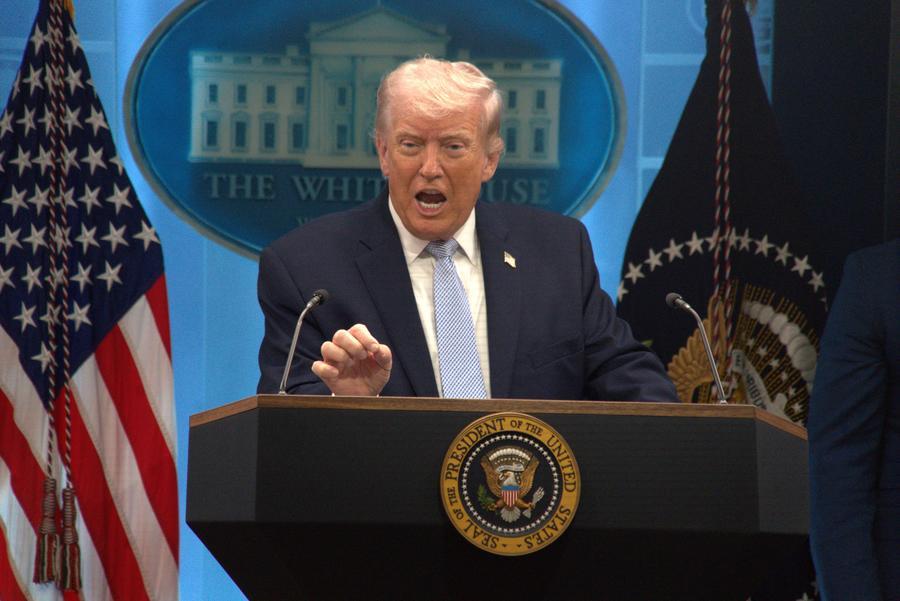
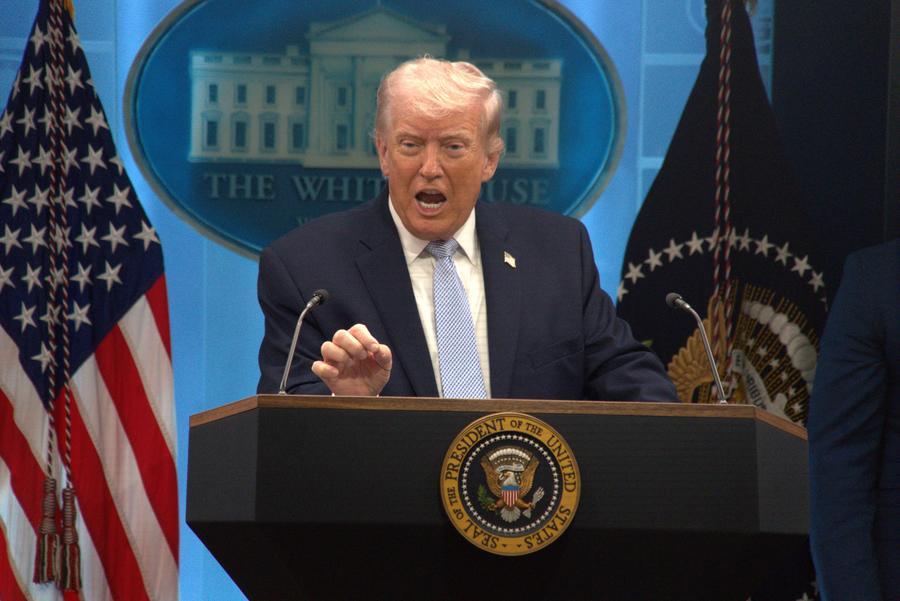
Trump on Monday sharpened his criticism of NATO, telling a White House press conference that some allies had gone “out of their way not to help” the United States in its war against Iran and once again describing the alliance as a “paper tiger.”
“I think it’s a mark on NATO that will never disappear,” he said, adding he was “very disappointed” by the lack of support after several countries, including Spain, refused to provide access to their bases or airspace, while European governments declined to send naval assets to help secure the Strait of Hormuz.
The comments followed a series of remarks that had already unsettled allied capitals. In an interview with Britain’s The Telegraph published on April 1, Trump said the U.S. membership in NATO was “beyond reconsideration” and that he had “never been swayed by NATO.” In an interview with Reuters the same day, he said he was “absolutely” considering an attempt to withdraw the United States from the alliance.
The criticism was echoed by senior U.S. officials.
U.S. Secretary of State Marco Rubio said in a television interview that once the Iran conflict was over, Washington would have to “re-examine” its relationship with NATO. Referring to U.S. military bases in Europe, he said that if they could not be used “to defend America’s interests,” NATO would become “a one-way street.”
U.S. Ambassador to NATO Matthew Whitaker said Trump was “reevaluating everything, whether that’s our involvement in NATO or our support for European efforts in Ukraine,” and said the alliance had to be a “two-way street.”
U.S. Defense Secretary Pete Hegseth declined to reaffirm Washington’s commitment to NATO’s collective defense clause, calling it “a decision that will be left to the president.” U.S. requests for “additional assistance or simple access, basing and overflight,” he added, had met “questions or roadblocks or hesitations.”
EUROPE RESISTS ALIGNMENT
The backdrop to Washington’s fury is a near-unanimous refusal by European NATO members to be drawn into a war they had no role in starting. Rob de Wijk, a professor of international relations at Leiden University in the Netherlands, said Trump had shown that “morality has left the White House” and that “the transatlantic community of values is over.”
Spain has been among the most outspoken countries. Madrid closed its airspace to U.S. aircraft involved in the Iran war after earlier denying Washington use of military bases for the campaign. Italy also pushed back, with authorities denying permission for U.S. military aircraft bound for the Middle East to stop at Sigonella air base in Sicily.
Britain, while stopping short of a blanket refusal, limited its support. London initially resisted broader U.S. military use of British facilities and later allowed only what it described as “defensive operations,” a distinction Downing Street has continued to stress amid growing domestic pressure.
France made clear that NATO should not be drawn into coercive action in the Gulf. French Minister Delegate for the Armed Forces Alice Rufo said on April 1 that NATO is an alliance focused on Euro-Atlantic security and “is not designed to carry out operations in the Strait of Hormuz,” warning that such action would breach international law.
French President Emmanuel Macron later said using force to “free” the strait was unrealistic and accused Trump of draining substance from NATO by sowing daily doubt about U.S. commitment.
Analysts said the standoff illustrated a wider gap in political and strategic thinking across the Atlantic.
Sven Biscop, director of the Europe in the World program at the Egmont Institute in Brussels, argued that European governments reacted with less shock to Trump’s belligerent remarks on allies and with greater resolve to resist pressure to support a war they do not back. Trump added pressure on NATO and his threats to leave the alliance had become more explicit than ever, but European leaders remained firm in their refusal to be drawn into the Iran war.
He Zhigao, an associate professor at the Institute of European Studies, Chinese Academy of Social Sciences, said the transatlantic relationship has long been anchored “in a shared commitment to a liberal and rules-based international order.”
Trump’s rejection of that framework as contrary to U.S. interests, he said, has widened the transatlantic divide in worldview, shaken European confidence in NATO as a “community of values,” and intensified a hollowing-out trend in the alliance.
TOWARD A EUROPEAN NATO?
The latest dispute has also revived debate in Europe over whether the alliance can endure only if its European members take on a much larger share of the burden.
“There’s definitely a growing awareness that, at some level, there is already a structural change at NATO,” Biscop said. “European militaries will have to provide Europe’s first line of defense.”
This argument is gaining traction in European policy debate. Pierre Haski, a columnist for the Italian magazine Internazionale, has urged that “it is time to reinvent NATO.” Europeans, he wrote, are not yet ready to see NATO disappear, but they know the Atlantic alliance is “essentially dead.” He called for a “revolution” in mentality and culture to imagine a new NATO in which the European pillar becomes predominant.
In Finland, the debate has shifted from the theoretical to the operational. The idea of a more European-led NATO was raised during a telephone conversation last week between Finnish President Alexander Stubb and Trump.
Henri Vogt, a professor of international politics at the University of Turku, said the central issue was not whether Europe had sufficient capabilities, but how to coordinate them effectively.
Henri Vanhanen, a Finnish researcher and nonresident fellow at the Atlantic Council, said Europe was moving toward stronger collective defense on a more European foundation, even if the division of responsibilities remained unsettled.
(Video reporters: Zhang Zhaoqing, Zhu Haochen, Zhang Xinwen, Shao Haijun, Sun Yi, Zhang Xuan, Shan Weiyi, Kang Yi; Video editors: Hong Yan, Roger Lott, Zhang Yuhong, Cao Ying)■
