




* Advancing the high-quality, efficient development of the service sector is vital to building a modern industrial system, a key strategic priority for the country over the next five years.
* Fostering a stronger and more efficient service sector is crucial to boosting domestic demand, improving people’s quality of life and creating jobs.
* China is making the service sector a key focus in expanding high-standard opening up, attracting high-quality global service providers to deepen their presence in the domestic market and sharing development opportunities with countries worldwide.
BEIJING, April 9 (Xinhua) — China is moving to foster more “China Services” brands and promote high-quality development across its service sector, as policymakers seek to empower manufacturing, expand domestic demand and create jobs.
It has been stressed that more efforts will be made to advance producer services toward greater specialization and the higher end of the value chain, and foster high-quality, diverse and accessible consumer services.
The added value of the service sector has accounted for half of the national economy for 11 consecutive years. The sector is projected to exceed 100 trillion yuan (about 14.56 trillion U.S. dollars) during the 15th Five-Year Plan period (2026-2030), according to official estimates. Beyond underpinning stable growth at home, its expansion is also expected to create fresh opportunities for global businesses.
China’s new five-year blueprint calls for improving the sector’s quality, efficiency and competitiveness, underscoring its role in supporting industrial upgrading, meeting people’s livelihood needs and driving job growth.
The service sector performed strongly in 2025, with its added value exceeding 80 trillion yuan for the first time and accounting for 57.7 percent of China’s gross domestic product. It contributed 61.4 percent of economic growth last year, up 3.7 percentage points from the previous year.
SUPPORTING INDUSTRIAL UPGRADING
At a humanoid robot data training center in Beijing’s Shijingshan District, more than 100 employees work in close coordination across roles ranging from trainers and data input reviewers to robot maintenance engineers, helping robots grow smarter through repeated, data-intensive training.

The scene underscores how producer services are increasingly embedded in advanced manufacturing, accelerating the integration of modern services with high-end industry and providing sustained momentum for China’s industrial upgrading.
Experts say that advancing the high-quality, efficient development of the service sector is vital to building a modern industrial system, a key strategic priority for the country over the next five years.
Industry analysts estimate that the software and information services sector will maintain average annual growth of around 12 percent over the next five years, while the market size of AI-powered application services is expected to exceed 800 billion yuan.
China’s government work report this year, for the first time, highlighted the need to enhance the capacity and quality of the service sector, explicitly calling for the development of producer services such as finance, information technology, modern logistics, intellectual property and inspection and testing.
From central authorities to local governments, China is stepping up efforts to explore concrete pathways for unlocking the service sector’s role in fostering new quality productive forces.
The Ministry of Industry and Information Technology is advancing innovation in service-oriented manufacturing, while the Ministry of Human Resources and Social Security has launched pilot programs to promote closer integration between human resources services and the manufacturing sector.

At the local level, south China’s Guangdong Province is accelerating the integration of sci-tech and finance to support innovation-driven enterprises, while Shanghai has introduced the country’s first guideline list for producer services in industrial parks.
TAPPING DEMAND, CREATING JOBS
The recent Formula One Chinese Grand Prix in Shanghai drew more than 230,000 spectators across three days and generated 190 million yuan in ticket revenue, a 35 percent year-on-year increase, offering a vivid glimpse into the rapid growth of consumer service spending.

According to experts, fostering a stronger and more efficient service sector is crucial to boosting domestic demand, improving people’s quality of life and creating jobs.
Rising incomes and demographic shifts are fueling faster growth in consumer-oriented sectors such as tourism, culture, sports, healthcare, elderly care and education, experts have noted.
In the first two months of this year, China’s retail sales of services rose 5.6 percent year on year, significantly outpacing growth in the retail sales of consumer goods. In 2025, service consumption accounted for 46.1 percent of per capita consumption expenditure of urban and rural residents, making it an important engine for expanding domestic demand.
Despite rapid expansion, the sector faces structural bottlenecks. Tickets for popular performances are often sold out within minutes, shortages of skilled service professionals persist, and weaknesses remain in public service provision.
“China’s service sector still falls short in terms of quality and efficiency, and there remains significant potential to be tapped,” said Shen Danyang, director of the Research Office of the State Council.
This year’s government work report has pledged efforts to boost the quality, diversity and accessibility of consumer services.
The National Development and Reform Commission estimates that by 2030, per capita spending on services among urban and rural residents will exceed 18,000 yuan, with service spending potentially accounting for 55 to 60 percent of total household consumption.
New occupations are emerging rapidly as the service sector expands. From livestreaming hosts and delivery couriers to ride-hailing drivers and data analysts, service-related jobs have become part of everyday life. In 2025, the sector accounted for around 50 percent of total employment, underscoring its role as a key driver of job growth.
GLOBAL OPPORTUNITIES
China is making the service sector a key focus in expanding high-standard opening up, attracting high-quality global service providers to deepen their presence in the domestic market and sharing development opportunities with countries worldwide.
China’s service trade deficit reached 828.72 billion yuan in 2025, driven by steady imports of high-quality services to meet domestic demand, data from the Ministry of Commerce (MOFCOM) showed.
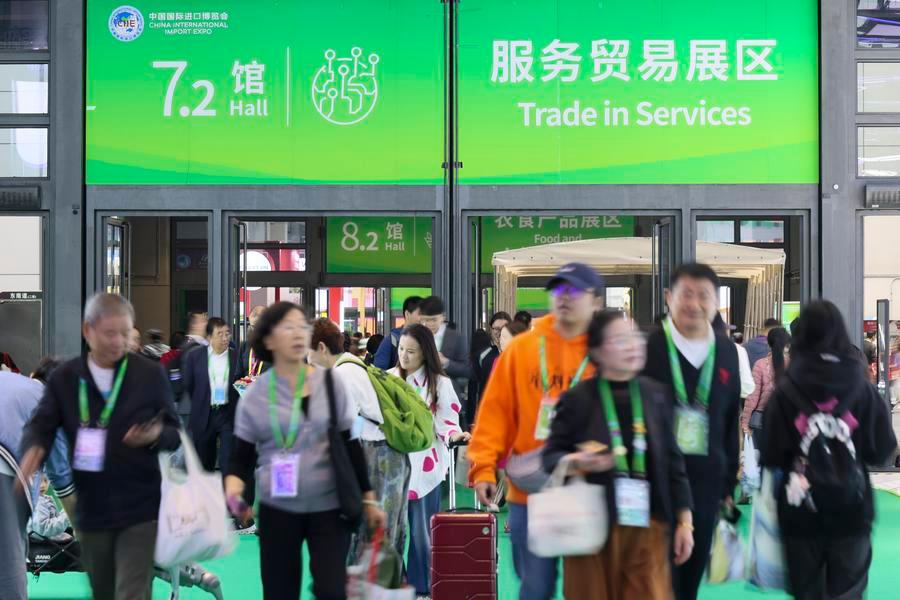
The country has continued to shorten the negative list for foreign investment, while advancing orderly opening up in sectors such as telecommunications, internet, education, culture and healthcare.
In May last year, DeltaHealth Hospital·Shanghai, a Swire-affiliated facility, was officially unveiled as China’s first wholly foreign-owned cardiovascular specialty hospital. The hospital recorded more than 80,000 outpatient and emergency visits over the year.
Jacqueline Jiang, chair of the Chinese mainland at John Swire & Sons, said the constant opening up in China’s service sector has brought new development opportunities for foreign-funded enterprises and boosted confidence in deepening engagement with the Chinese market.
Nie Pingxiang, a researcher with the think tank of the MOFCOM, said deeper opening up of the service sector would not only spur upgrades in manufacturing and growth in strategic emerging industries, but also create more room and opportunities for foreign investment in high value-added manufacturing. ■
