


The dust of the city coated everything – the flags, the crisp new doboks, the hopeful faces of fathers shepherding their children. After 18 years, this was Karachi’s welcome: not a red carpet, but a gritty testament.
The National Games had come home.
The city, in its quintessential fashion, demanded a pilgrimage.
For the first Games on its soil after 18 years, it offered an obstacle course of its own making – cranes standing like sentinels over diverted roads that formed labyrinths of progress. But through the grit and the detours, they came. A river of colour, athletes from every corner of the country in their distinct tracksuits, and locals converging on the National Stadium. They arrived not for a mere ceremony, but in spite of the journey.
“I am almost covered in this dust,” a father told Dawn, guiding his young son in a taekwondo dobok toward the gates. “But we are glad. We are here.”
That sentiment, gritty and determined, was the unspoken anthem.
An 18-year wait, borne of the nation’s tumultuous cycles, had culminated not in polished perfection, but in the magnificent, unruly spectacle that only Karachi – impatient, passionate, and perpetually under construction – would dare to stage.
In the cool December sunlight, the stadium slowly filled.
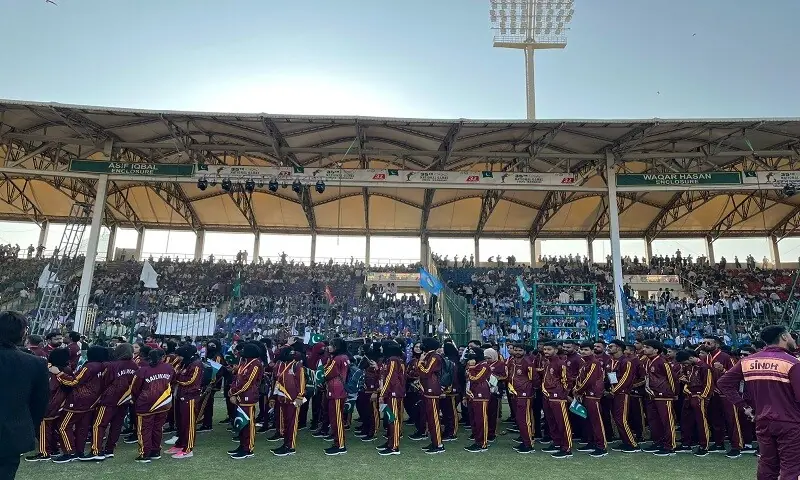
Nearly 2,500 athletes – a vanguard of the 11,000 competing – along with thousands of students transformed the stands into a living mosaic.
Pakistani flags fluttered. Girls in cultural dresses posed for pictures; athletes snapped selfies. The air buzzed with the screams of students tumbling off buses, their energy infectious.
Then, the city’s notorious inertia set in. An almost two-hour delay saw the early carnival buzz curdle under the sun.
The vibrant dances on the field began to feel like a loop.
“They brought us here just to bake?” an athlete muttered in the open ground, echoing a growing restlessness. The band’s drills became background noise to shared sighs.
A roar, rekindled
But when the chief guest, Chairman Pakistan Peoples Party Bilawal Bhutto-Zardari, and Sindh Chief Minister Murad Ali Shah finally arrived, the spark returned violently.
Fireworks blossomed against the evening sky. The ceremony opened with the recitation of the Quran, followed by the national anthem. As the last note faded, it was swallowed by a roaring, unified catharsis: “Pakistan Zindabad!”
What followed was a parade of pride and personality – the reason for all the chaos.
Fourteen contingents marched, each led by its stars. Defending champions, Army, moved with the gravity of expectation, led by judoka Shah Hussain Shah. The Air Force contingent followed in sharp lines. Then came a burst of raw energy as Azad Jammu and Kashmir’s athletes spilled from their vans, the fatigue of their long journey shed the moment their boots hit the Karachi tarmac.
One by one, they flowed past:
Higher Education Commission led by Shareef Tahir, Commonwealth silver medallist in wrestling and Maheesha Ali, the Asian gold medallist in taekwondo; flag bearers of Islamabad were boxers Mazhar Fayyaz and Summaiya followed by Balochistan, Gilgit-Baltistan, Khyber Pakhtunkhwa, Navy, Police.
An elderly coach from Balochistan paused, his eyes glistening, to salute a section of the crowd before hurrying to catch up. The hosts, Sindh, led by rugby player Areeba Noor, drew thunder from the stands. But the loudest cheers were reserved for the final entry: the Olympic champion.
The flame and the future
As the march ended, javelin gold medallist Arshad Nadeem – the nation’s brightest star – stood front and centre, holding the Pakistan flag aloft. The Navy band marched past with drums and flutes, a stirring prelude to the oath, taken by Mahoor Fatima and sprinter Mohammad Zubair Munir.
Then came the torch, carried on a journey that had begun in Karachi and travelled the nation. Passed from Olympian Qamar Ibrahim to athlete after athlete – Zameer Hussain, Anahita Fatima, Ayina Moeen, former sprinter Naseem Hameed, hockey legend Islahuddin – it finally reached Arshad.
He held it high, jogging a lap as every stand he passed erupted. From the Sindh contingent’s block, a chant rose: “Zindabad! Zindabad!” before melting into the stadium-wide roar.
With a final thrust, he lit the cauldron. Then, in a gesture that bridged ceremony and sport, he seized a javelin. With a familiar, powerful motion, he sent it arcing into the waiting net—a symbolic strike igniting the competitive spirit of the Games.
Bilawal formally declared the Games open. Fireworks flowered again in the sky.
On the field, little girls in colourful dresses waved handkerchiefs to the official song, while young karatekas in crisp gis showed off their kicks. The cold night had fully settled, but the stadium glowed with more than just flame.
It glowed with a promise. The journey that began in the dust was now alight. For Karachi, and for Pakistan’s athletes, the true test would come at dawn.
