


Islamabad should prepare for comprehensive trade deal with Brussels rather than relying on preferences alone
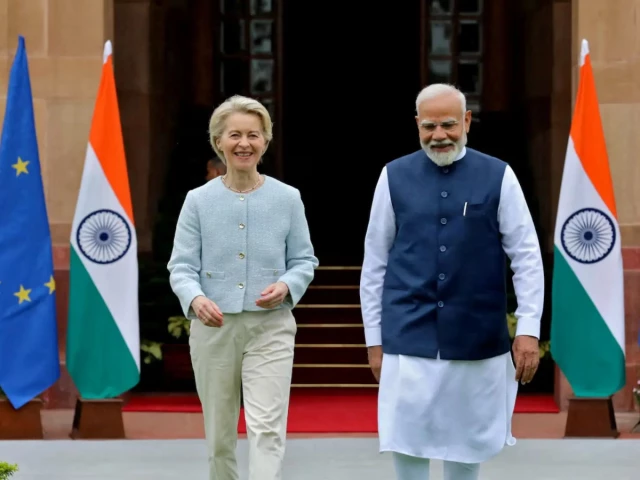
European Commission President Ursula von der Leyen and India’s Prime Minister Narendra Modi arrive for a photo opportunity ahead of their meeting at the Hyderabad House in New Delhi, India, on Feb 28, 2025. PHOTO: REUTERS
ISLAMABAD:
At a time when headlines are dominated by higher tariffs and economic nationalism, the proposed free trade agreement between the European Union and India sends a different signal. It suggests that global trade is not ending but changing shape. Countries still seek access to large markets, predictable rules, and reliable partners. The EU-India talks reflect this search for stability in an uncertain global economy.
Negotiations between the two sides have continued for nearly two decades, with long periods of slow progress. What finally created momentum was a shift in the global trade environment. The United States raised tariffs on several partners, with some affected more than others. Indian exports to the US, particularly textiles and clothing, faced an additional tariff of up to 50%. This disrupted orders and encouraged buyers to look for alternative suppliers.
The EU also faced new US tariffs of around 15% on products such as cars, machinery, pharmaceuticals, and luxury goods, many of which face high protection in India. As a result, both sides saw greater value in advancing their own agreement and reducing dependence on the US market. The economic base for such a deal is already substantial. Bilateral trade in goods stands at around $136 billion.
The EU is India’s largest trading partner, accounting for about 17% of India’s goods exports, valued at roughly $76 billion, while India imports around $60 billion from the EU. India’s exports to Europe are also diverse, spanning electronics, chemicals, fuels, machinery, iron and steel, pharmaceuticals, gems and jewellery, as well as textiles and clothing. This diversity gives India a strong platform to benefit from deeper market access.
For Pakistan, these developments naturally raise important questions. The EU is Pakistan’s largest export market, absorbing more than 27% of its exports, or about $8.8 billion in fiscal year 2025. Pakistan currently enjoys duty-free access on over 85% of its exports under the GSP Plus scheme, which is secured until at least December 2027 and is now under consideration for renewal.
Pakistan’s exports to Europe are, however, highly concentrated. Around 70% consists of knitted and woven garments and home textiles such as shirts, jeans, bed linen, and towels. In these products, Pakistan currently benefits from a preference margin of around 5-9%. If the EU grants India similar or better access under an FTA, this margin could narrow, intensifying competition. For most other industrial products, EU tariffs are already low, limiting the value of preferences.
There is also discussion around Basmati rice. Some fear that an EU-India agreement or changes to GSP Plus could hurt Pakistan’s rice exports. In practice, Pakistan’s main Basmati varieties already enter the EU at zero duty under the WTO commitments, and this is unlikely to change as a result of an EU-India deal. The more relevant concern relates to geographical indications. If India secures exclusive recognition for Basmati limited to its own varieties, Pakistan could face marketing and labelling challenges in Europe. This is primarily a legal and diplomatic issue, not a tariff one, and it requires active engagement.
The broader lesson lies in the changing nature of trade agreements. The EU-India deal is expected to cover over 95% of goods trade and extend into services, investment, and standards, aiming at deep and long-term integration. Pakistan’s agreements, by contrast, often cover less than 5% of tariff lines and rarely go beyond goods, limiting their economic impact. Even the agreement with China, Pakistan’s largest FTA, covers less than one-third of bilateral trade. India has also moved faster in building a network of trade agreements.
In recent years, it has concluded or advanced deals with partners such as the UAE, the UK, and the EFTA countries, alongside existing agreements with Japan, South Korea, Australia, and Asean. Pakistan, by comparison, lacks FTAs with most major economies and remains relatively less integrated into global trade networks.
Another lesson is the risk of relying too heavily on unilateral preference schemes. GSP-type arrangements are conditional and subject to monitoring. They can be suspended or withdrawn. Many countries, including Vietnam and India, have therefore shifted towards reciprocal FTAs to secure more stable market access and greater policy certainty.
The positive side is that Pakistan is now better placed to rethink its strategy. Gradual tariff reductions have lowered adjustment costs and made reciprocal agreements more feasible. This creates space to deepen existing agreements and pursue new ones with large markets such as the EU and the UK.
There is no immediate crisis. An EU-India agreement will still take time to enter into force, and tariff reductions will be phased in over several years. This provides Pakistan with some breathing room. That time should be used to improve export competitiveness by addressing practical constraints such as high energy costs, taxation, and access to finance. In the near term, safeguarding GSP Plus remains important.
At the same time, Pakistan should prepare seriously for a comprehensive trade agreement with the EU rather than relying on preferences alone. The global trading system is reorganising around deeper partnerships and clearer rules. As others move ahead, standing still is not a safe option. Pakistan must choose between shaping its place in the emerging trade landscape or adjusting to decisions made by others.
The writer is a member of the Steering Committee on the Implementation of National Tariff Policy 2025-30. He has previously served as Pakistan’s ambassador to the WTO
