


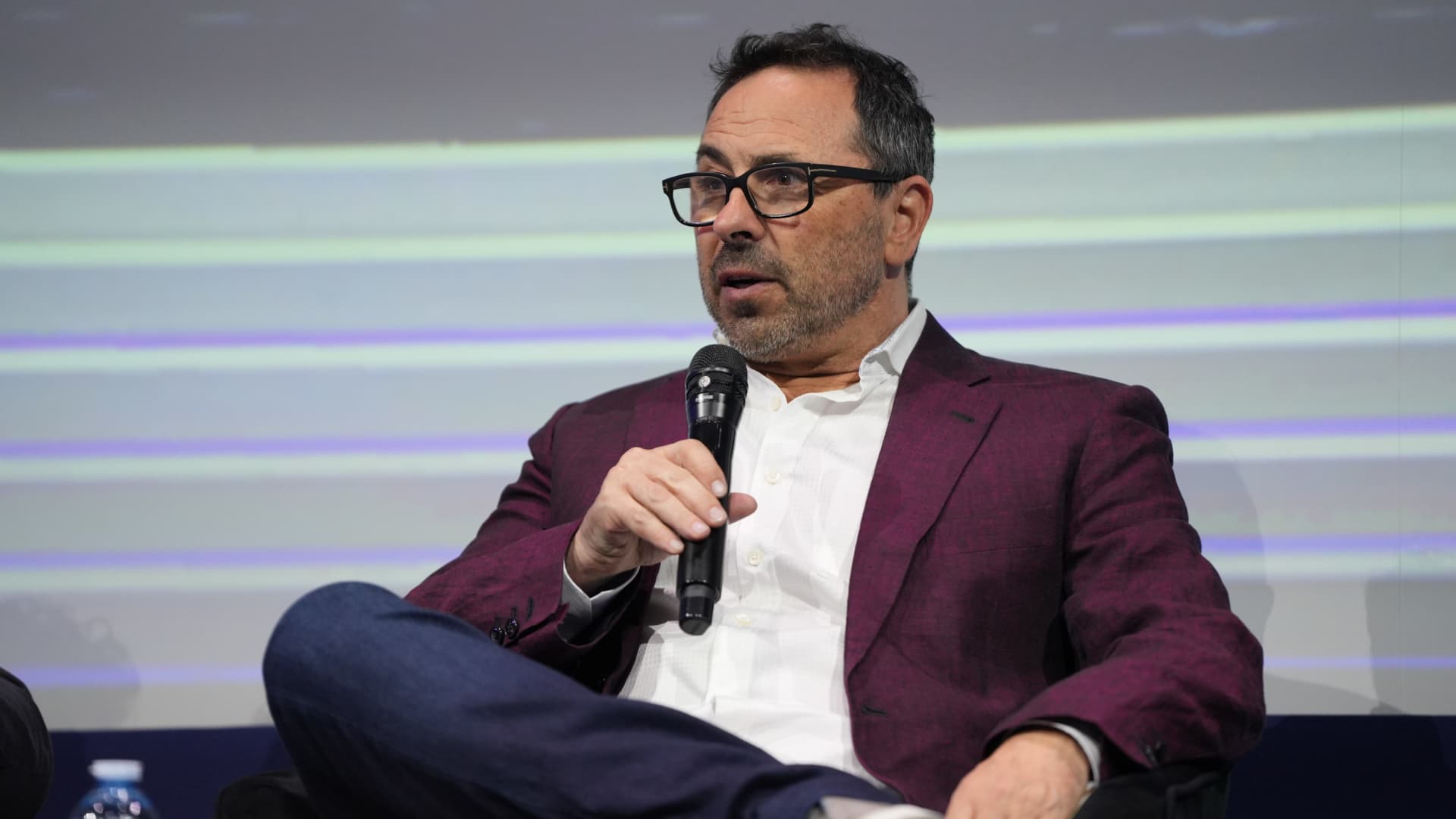
Andrew Feldman, co-founder and CEO of Cerebras Systems, speaks at the Raise summit in Paris on July 8, 2025. The annual conference gathers global leaders and key speakers in tech and AI.
Nathan Laine | Bloomberg | Getty Images
AI chipmaker Cerebras has signed a deal with OpenAI to deliver 750 megawatts of computing power through 2028, according to a blog post Wednesday by the maker of ChatGPT.
The arrangement is worth over $10 billion, according to people close to the company.
The deal will help diversify Cerebras away from the United Arab Emirates’ G42, which accounted for 87% of revenue in the first half of 2024.
“The way you have three very large customers is start with one very large customer, and you keep them happy, and then you win the second one,” Cerebras’ co-founder and CEO Andrew Feldman told CNBC in an interview.

Cerebras has built a large processor that can train and run generative artificial intelligence models. That makes it a challenger to Nvidia, which sells large quantities of its chips to cloud providers such as Amazon and Microsoft — those companies then rent the graphics cards to clients by the hour. Nvidia became the first company to reach a $5 trillion market capitalization in October, as investors sought to capitalize on further AI growth.
In December, Cerebras rival Groq said Nvidia had signed a nonexclusive licensing agreement that would result in some employees moving to Nvidia. Groq’s cloud service is not part of the deal, which CNBC reported is worth $20 billion in cash, making it Nvidia’s largest transaction to date.
“Cerebras adds a dedicated low-latency inference solution to our platform,” Sachin Katti, who works on compute infrastructure at OpenAI, wrote in the blog. “That means faster responses, more natural interactions, and a stronger foundation to scale real-time AI to many more people.”
The deal comes months after OpenAI worked with Cerebras to ensure that its gpt-oss open-weight models would work smoothly on Cerebras silicon, alongside chips from Nvidia and Advanced Micro Devices.
OpenAI’s gpt-oss collaboration led to technical conversations with Cerebras, and the two companies signed a term sheet just before Thanksgiving, Feldman said in a Wednesday interview with CNBC.
Cerebras has data centers full of its chips in the U.S. and abroad. Feldman said the company will continue to expand its footprint with the OpenAI commitment.
OpenAI evaluated Cerebras’ technology as early as 2017, according to emails that emerged as part of litigation between Sam Altman, OpenAI’s co-founder and CEO, and Tesla CEO Elon Musk, who also co-founded the ChatGPT maker. In 2018, Musk tried to buy Cerebras, Feldman said.
“We were under the impression he was trying to buy us in the context of Tesla,” Feldman said of Musk.
Cerebras filed for an initial public offering in September 2024, revealing that revenue in the second quarter of that year approached $70 million, up from about $6 million in the second quarter of 2023. The company’s net loss swelled to almost $51 million, from $26 million a year earlier.
Investment banks that typically participate in the top technology IPOs were missing from the prospectus, and the company used an auditor other than the so-called Big Four accounting firms.
Cerebras withdrew the paperwork in October, days after announcing a $1.1 billion round of funding that valued it at $8.1 billion. The company said it pulled the prospectus because details were out of date.
“Given that the business has improved in meaningful ways we decided to withdraw so that we can re-file with updated financials, strategy information including our approach to the rapidly changing AI landscape,” Feldman wrote in a LinkedIn post.
A revised filing will provide a better explanation of the business to potential investors, he wrote. On Wednesday he declined to talk about timing for a new filing.
Cerebras’ customer list includes Cognition, Hugging Face and IBM, and in March 2025, the company said the Committee on Foreign Investment in the United States had approved Cerebras’ request to sell shares to G42.
The Wall Street Journal reported on the deal earlier on Wednesday.
