


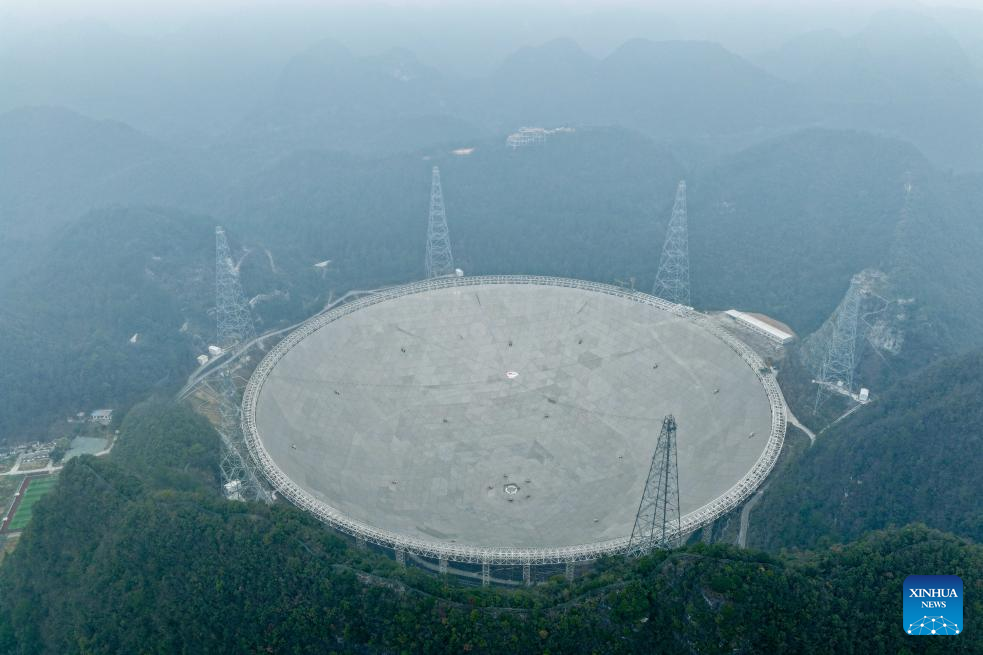
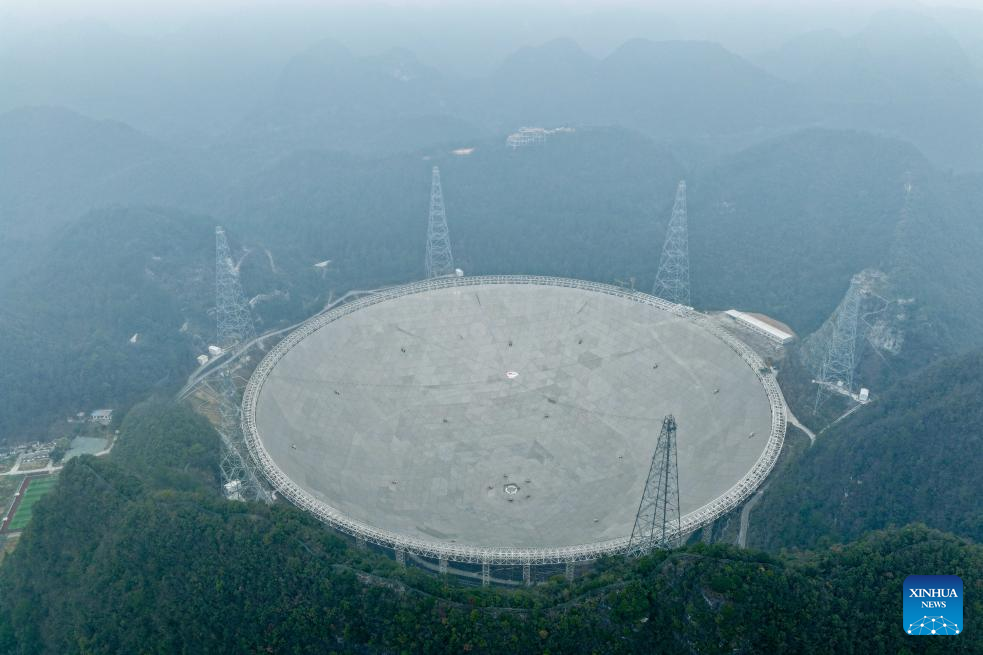
An aerial drone photo taken on Jan. 16, 2026 shows China’s Five-hundred-meter Aperture Spherical Radio Telescope (FAST) under maintenance in southwest China’s Guizhou Province. (Xinhua/Ou Dongqu)
GUIYANG, Jan. 16 (Xinhua) — Through studying the observation data of China’s gigantic radio telescope located in the country’s southwestern Guizhou Province, an international research team has uncovered compelling new evidence supporting a binary-system origin for at least some fast radio bursts (FRBs), one of the most enigmatic phenomena in modern astrophysics.
These findings, made by the research team led by astronomers from the Purple Mountain Observatory (PMO) of the Chinese Academy of Sciences (CAS), are based on observations using China’s Five-hundred-meter Aperture Spherical radio Telescope (FAST) and have been published online in the journal Science.
At a press conference held at the observation base of FAST on Friday, Wu Xuefeng, deputy director of the PMO, explained that FRBs are extremely bright, transient radio phenomena, lasting only milliseconds but releasing enormous amounts of energy, equivalent to the total radiation from the Sun over an entire week.
Since their discovery in 2007, astronomers have proposed a variety of models involving neutron stars and other compact objects. For repeating FRBs, periodic burst activity has hinted at a binary origin, though direct observational evidence has long been elusive.
To solve this puzzle, the research team leveraged FAST’s unparalleled sensitivity to conduct continuous monitoring of the repeating FRB 20220529, which is 2.9 billion light-years away, since June 2022.
In the study, scientists monitored a key parameter, the Faraday rotation measure (RM), which serves as a precise “cosmic magnetic environment probe.”
“This parameter probes the magnetized plasma properties along the propagation path of the FRB’s radio signals to Earth,” Wu said.
For the first 18 months of monitoring, the RM of FRB 20220529 showed only modest fluctuations. In December 2023, the team detected an extraordinary event: the RM suddenly surged to roughly 20 times its average variability, and then returned to its typical fluctuation range within two weeks.
This dramatic, rapid, and reversible change in the magnetic environment marks the first time such a record has been obtained in FRB research.
The researchers interpret this behavior as the result of a dense, magnetized plasma cloud passing through the line of sight between the source and Earth.
Existing theories cannot explain the observed phenomenon if FRB 20220529 originated from an isolated neutron star. In contrast, within a binary system, violent activities from a companion star or the special geometric structure of the binary orbit can naturally and reasonably produce the observed phenomenon, Wu said.
“It is a remarkable result,” said Duncan Lorimer, a professor of Physics and Astronomy at West Virginia University, adding that “the authors discuss a number of exciting applications that may help us understand how these repeating fast radio bursts operate and what type of sources they are.”
“It’s the testament to the power of the FAST radio telescope in China, to make these monitoring observations,” he added.
FRB 20220529 is an intrinsically faint source, and most of its bursts are challenging to detect with other facilities. The observation was made possible by FAST’s unprecedented sensitivity, combined with advanced data-processing techniques, said Sun Jinghai, deputy director of FAST Operations and Development Center.
Located in a naturally deep and round karst depression in Guizhou, FAST has a reception area equal to 30 standard football fields. As the world’s largest single-dish radio telescope, FAST started formal operations in January 2020 and was officially opened to the world in March 2021.
It has become a leading facility for studies of pulsars, FRBs, and the interstellar medium. The new results highlight FAST’s unique capability to probe the dynamic environments of cosmic radio sources and advance the understanding of the physical origins of FRBs, Sun said.
An upgrade plan for FAST is now underway: dozens of medium-aperture antennas will be deployed around the huge telescope to form a globally unique, FAST-centered giant synthetic aperture array, according to Sun.
This innovative design is expected to overcome the fundamental trade-off between sensitivity and resolution in single-dish telescopes, achieving a qualitative leap in comprehensive observational performance, turning FAST into a “super cosmic probe” and providing unprecedented support for scientists to delve deeper into solving a series of core astrophysical puzzles, Sun added.
Shi Shengcai, an academician of CAS and a researcher at the PMO, said that the new discovery represented a significant scientific advance and a pivotal step toward unraveling the origin of FRBs.
He added that to decipher the mystery of FRBs, his team is building a 15-meter submillimeter telescope in Delingha, northwest China’s Qinghai Province, and planning a terahertz telescope at the South Pole. These facilities will collaborate with FAST in observations at different frequency bands to unravel cosmic mysteries. ■

An aerial panoramic drone photo taken on Jan. 16, 2026 shows China’s Five-hundred-meter Aperture Spherical Radio Telescope (FAST) under maintenance in southwest China’s Guizhou Province. Through studying the observation data of China’s gigantic radio telescope located in the country’s southwestern Guizhou Province, an international research team has uncovered compelling new evidence supporting a binary-system origin for at least some fast radio bursts, one of the most enigmatic phenomena in modern astrophysics.
These findings made by the research team, led by astronomers from the Purple Mountain Observatory of the Chinese Academy of Sciences, are based on observations using FAST, and have been published online in the journal Science. (Xinhua/Ou Dongqu)

An aerial panoramic drone photo taken on Jan. 16, 2026 shows China’s Five-hundred-meter Aperture Spherical Radio Telescope (FAST) under maintenance in southwest China’s Guizhou Province. Through studying the observation data of China’s gigantic radio telescope located in the country’s southwestern Guizhou Province, an international research team has uncovered compelling new evidence supporting a binary-system origin for at least some fast radio bursts, one of the most enigmatic phenomena in modern astrophysics.
These findings made by the research team, led by astronomers from the Purple Mountain Observatory of the Chinese Academy of Sciences, are based on observations using FAST, and have been published online in the journal Science. (Xinhua/Ou Dongqu)

An aerial drone photo taken on Jan. 16, 2026 shows China’s Five-hundred-meter Aperture Spherical Radio Telescope (FAST) under maintenance in southwest China’s Guizhou Province. Through studying the observation data of China’s gigantic radio telescope located in the country’s southwestern Guizhou Province, an international research team has uncovered compelling new evidence supporting a binary-system origin for at least some fast radio bursts, one of the most enigmatic phenomena in modern astrophysics.
These findings made by the research team, led by astronomers from the Purple Mountain Observatory of the Chinese Academy of Sciences, are based on observations using FAST, and have been published online in the journal Science. (Xinhua/Ou Dongqu)

An aerial drone photo taken on Jan. 16, 2026 shows China’s Five-hundred-meter Aperture Spherical Radio Telescope (FAST) under maintenance in southwest China’s Guizhou Province. Through studying the observation data of China’s gigantic radio telescope located in the country’s southwestern Guizhou Province, an international research team has uncovered compelling new evidence supporting a binary-system origin for at least some fast radio bursts, one of the most enigmatic phenomena in modern astrophysics.
These findings made by the research team, led by astronomers from the Purple Mountain Observatory of the Chinese Academy of Sciences, are based on observations using FAST, and have been published online in the journal Science. (Xinhua/Ou Dongqu)
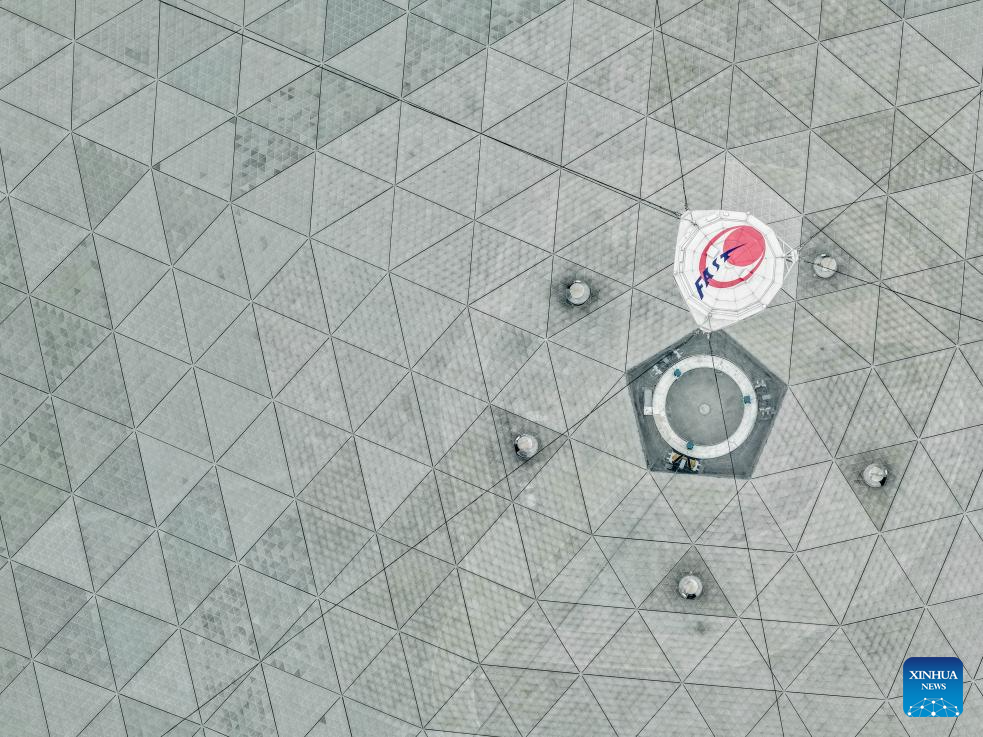
An aerial drone photo taken on Jan. 16, 2026 shows the feed cabin of China’s Five-hundred-meter Aperture Spherical Radio Telescope (FAST) under maintenance in southwest China’s Guizhou Province. Through studying the observation data of China’s gigantic radio telescope located in the country’s southwestern Guizhou Province, an international research team has uncovered compelling new evidence supporting a binary-system origin for at least some fast radio bursts, one of the most enigmatic phenomena in modern astrophysics.
These findings made by the research team, led by astronomers from the Purple Mountain Observatory of the Chinese Academy of Sciences, are based on observations using FAST, and have been published online in the journal Science. (Xinhua/Ou Dongqu)
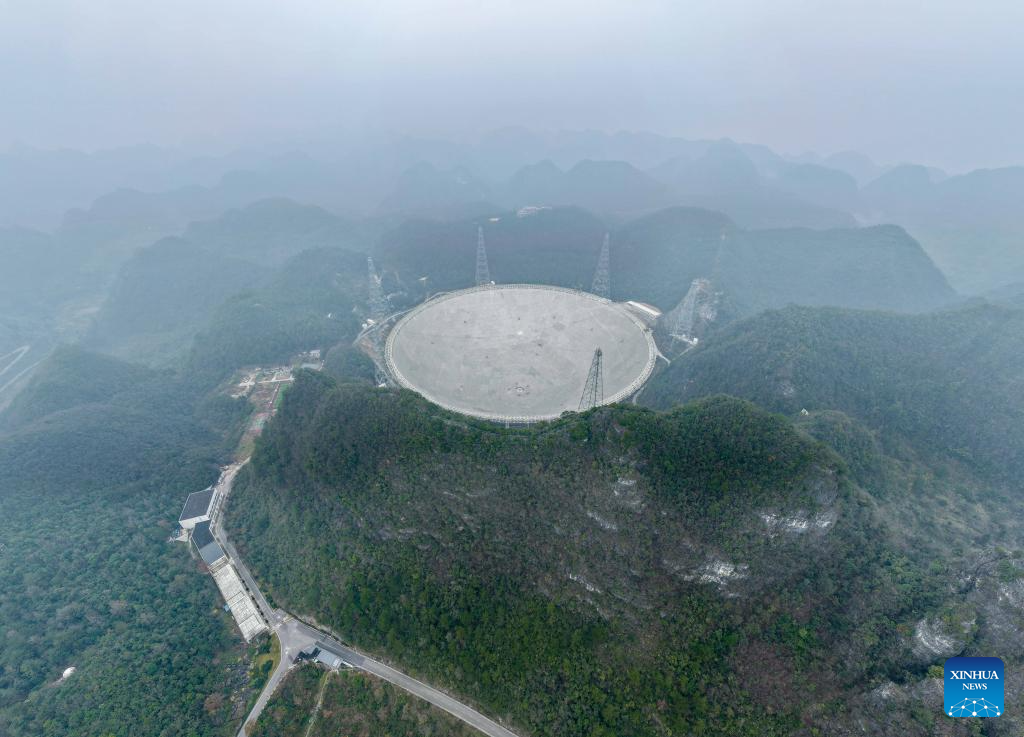
An aerial drone photo taken on Jan. 16, 2026 shows China’s Five-hundred-meter Aperture Spherical Radio Telescope (FAST) under maintenance in southwest China’s Guizhou Province. Through studying the observation data of China’s gigantic radio telescope located in the country’s southwestern Guizhou Province, an international research team has uncovered compelling new evidence supporting a binary-system origin for at least some fast radio bursts, one of the most enigmatic phenomena in modern astrophysics.
These findings made by the research team, led by astronomers from the Purple Mountain Observatory of the Chinese Academy of Sciences, are based on observations using FAST, and have been published online in the journal Science. (Xinhua/Ou Dongqu)
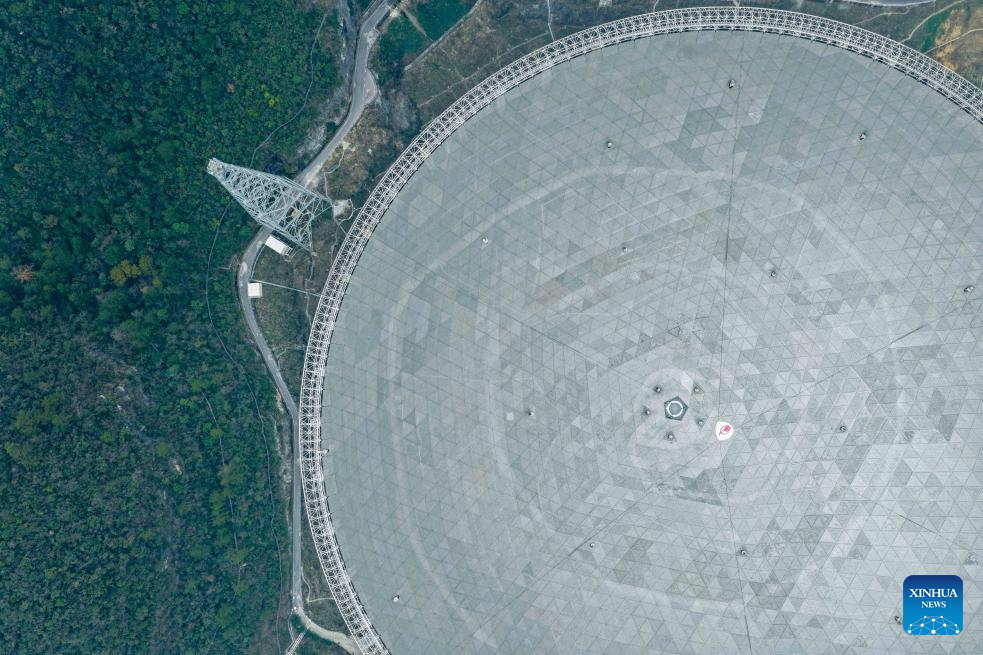
An aerial drone photo taken on Jan. 16, 2026 shows China’s Five-hundred-meter Aperture Spherical Radio Telescope (FAST) under maintenance in southwest China’s Guizhou Province. Through studying the observation data of China’s gigantic radio telescope located in the country’s southwestern Guizhou Province, an international research team has uncovered compelling new evidence supporting a binary-system origin for at least some fast radio bursts, one of the most enigmatic phenomena in modern astrophysics.
These findings made by the research team, led by astronomers from the Purple Mountain Observatory of the Chinese Academy of Sciences, are based on observations using FAST, and have been published online in the journal Science. (Xinhua/Ou Dongqu)

An aerial drone photo taken on Jan. 16, 2026 shows China’s Five-hundred-meter Aperture Spherical Radio Telescope (FAST) under maintenance in southwest China’s Guizhou Province. Through studying the observation data of China’s gigantic radio telescope located in the country’s southwestern Guizhou Province, an international research team has uncovered compelling new evidence supporting a binary-system origin for at least some fast radio bursts, one of the most enigmatic phenomena in modern astrophysics.
These findings made by the research team, led by astronomers from the Purple Mountain Observatory of the Chinese Academy of Sciences, are based on observations using FAST, and have been published online in the journal Science. (Xinhua/Ou Dongqu)
