


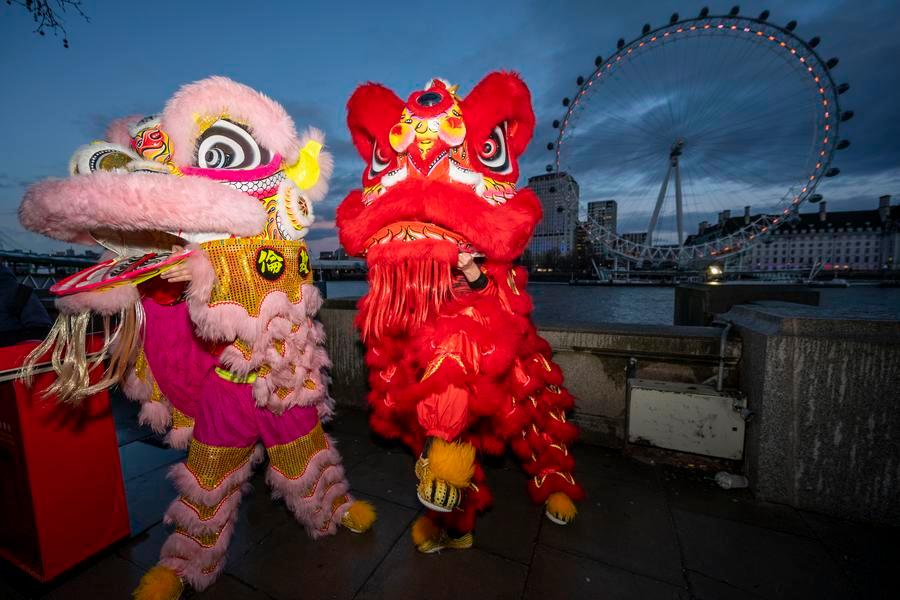
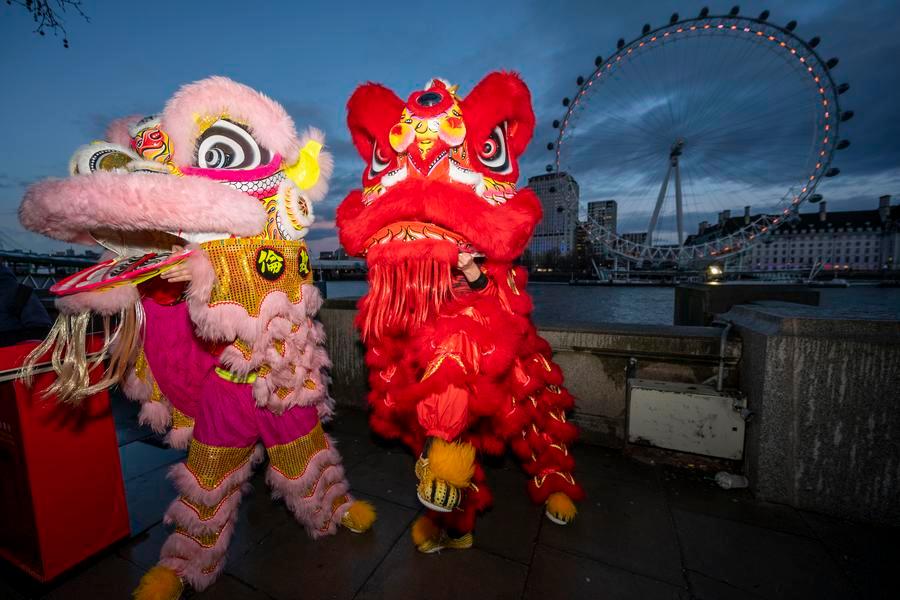
*Chinese tourists traveling abroad during the Lunar New Year, which fell on Feb. 17 this year, are finding Chinese traditions alive in destinations far from home.
*The expansion of mutual visa-free arrangements between China and several countries has made overseas travel more accessible for holidaymakers.
*Across continents, Spring Festival celebrations are becoming meaningful platforms for cultural exchanges.
BEIJING, Feb. 21 (Xinhua) — During this year’s Spring Festival, many Chinese chose to celebrate abroad, discovering that distance did little to dull the holiday’s joy — vibrant dragon dances, glowing lantern displays and lavish festive feasts proved that the spirit of the Chinese New Year transcends borders.
Across the globe, Spring Festival celebrations are creating memorable experiences for both tourists and locals, not only showcasing Chinese culture through performances and traditional events, but also fostering travel and cross-cultural exchanges.
CHINESE TRADITION DISPLAYED OVERSEAS
From festive parades in Europe and holiday fairs in South America, Chinese tourists traveling abroad during the Lunar New Year, which fell on Feb. 17 this year, are finding Chinese traditions alive in destinations far from home.
In central Türkiye’s Cappadocia region, an event celebrating the annual festival was launched on Feb. 14, bringing Chinese New Year elements to one of the country’s most visited tourist destinations.
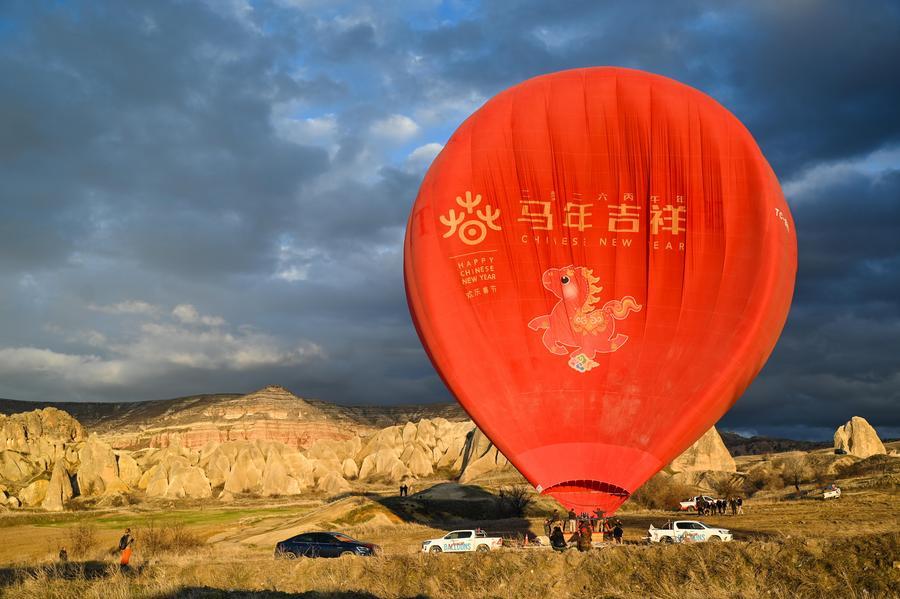
Best known for its dramatic rock formations and cave-dotted valleys shaped by volcanic activities, Cappadocia attracts visitors from around the world each year. During this year’s festivities, hot-air balloons bearing Chinese New Year greetings, including a horse-shaped balloon, became a popular attraction for tourists.
As night fell, drone formations lit up the sky with messages such as “Year of the Horse 2026” and “China-Türkiye Friendship,” creating a festive atmosphere visible across the landscape.
“It’s amazing!” Zhang Mengping, a tourist from China’s Chengdu, told Xinhua. Seeing elements of the Chinese Spring Festival in a foreign country is familiar and heartwarming, and highlights the growing global reach of Chinese culture, she said.
Like those visiting Türkiye, Chinese tourists traveling in France during the holiday have also encountered celebrations incorporating modern technology.
In Paris, a Chinese New Year parade led by robotic performers made its way along the Champs-Elysees to the beat of festive drums, bringing traditional celebrations to the landmark avenue for the fourth time.
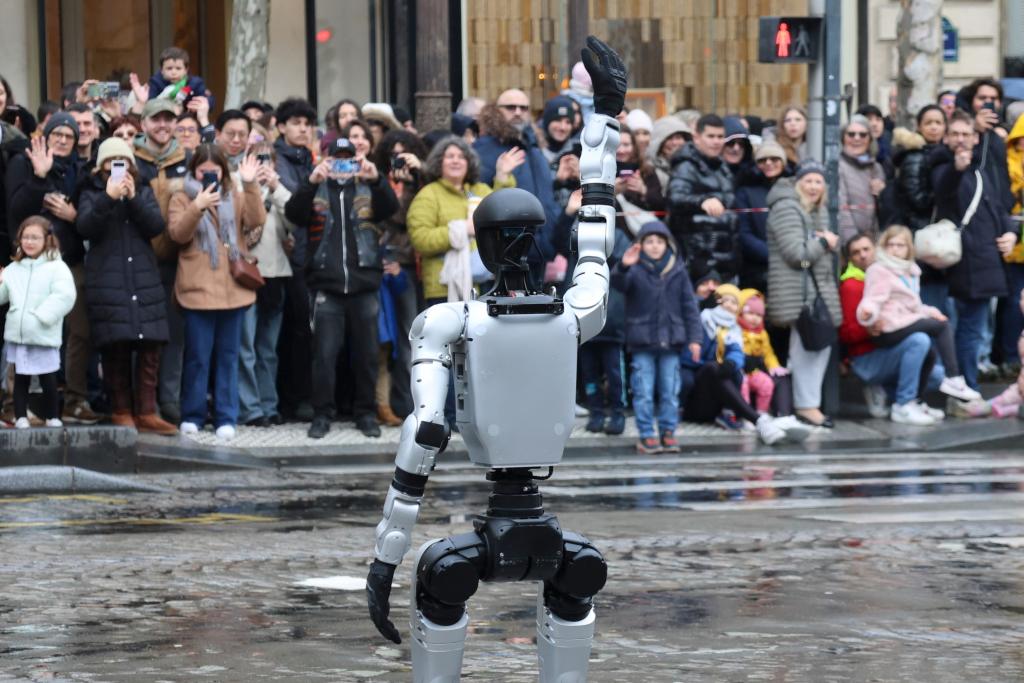
“Seeing traditional arts like the dragon and lion dance, Yingge dance, and Hanfu performances presented together overseas made me more intuitively feel the charm of Chinese civilization,” said Wu Yao, a tourist from northwest China’s Shaanxi Province, after watching the parade.
VISA-FREE POLICIES BOOST HOLIDAY TRAVEL
Data from China’s National Immigration Administration indicate that cross-border travel is expected to rise in both directions during this year’s Spring Festival holiday. Daily inbound and outbound passenger trips are projected to exceed 2.05 million, up 14.1 percent compared with the same period last year.
The expansion of mutual visa-free arrangements between China and several countries, including Russia and Brazil, has made overseas travel more accessible for holidaymakers.
On Monday, also the Chinese New Year’s Eve, the third “Happy Chinese New Year” event opened at Manezhnaya Square in Moscow. Despite temperatures dropping to minus 15 degrees Celsius and the day falling on a workday, residents and tourists gathered at the venue in falling snow to join the celebrations.
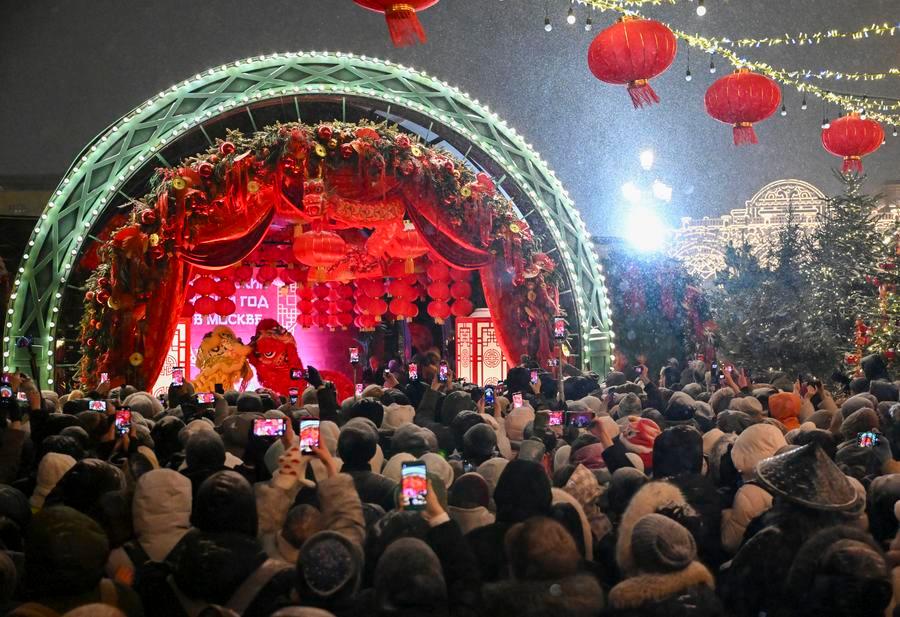
A tourist surnamed Wu from east China’s Zhejiang Province said his family chose to spend the holiday in Russia this year to experience a different Spring Festival abroad. They also traveled to Murmansk, a city in the Arctic Circle, where they viewed the aurora over the Arctic Ocean.
In January, Brazil announced visa-free entry for certain short-term categories of Chinese travelers in response to China’s visa-free policies for Brazilian nationals.
In contrast to Russia’s winter chill, Brazil is in the midst of summer. In Sao Paulo, the country’s largest city, Liberty Square has been adorned with decorations for the Chinese Spring Festival.
The annual holiday fair, now in its 21st edition, has attracted thousands of locals and visitors. Activities including calligraphy, traditional Chinese dance and acupuncture demonstrations have been highlighted as part of the celebrations.
A tourist surnamed Chen from south China’s Guangdong Province, who is traveling in South America during the holiday, said she was surprised to see the broad participation in overseas Spring Festival celebrations.
“With dragon and lion dances and people practicing Tai Chi, the Chinese New Year atmosphere in Brazil is truly rich,” said Chen. This year, the Spring Festival coincides with Brazil’s carnival season. “This kind of ‘double festivity’ that spans half the globe is truly unforgettable,” she said.
CELEBRATIONS FOSTER CROSS-CULTURAL CONNECTIONS
Across continents, Spring Festival celebrations are becoming meaningful platforms for cultural exchanges, bringing Chinese traditions into dialogue with local customs and creating shared festive experiences across borders.
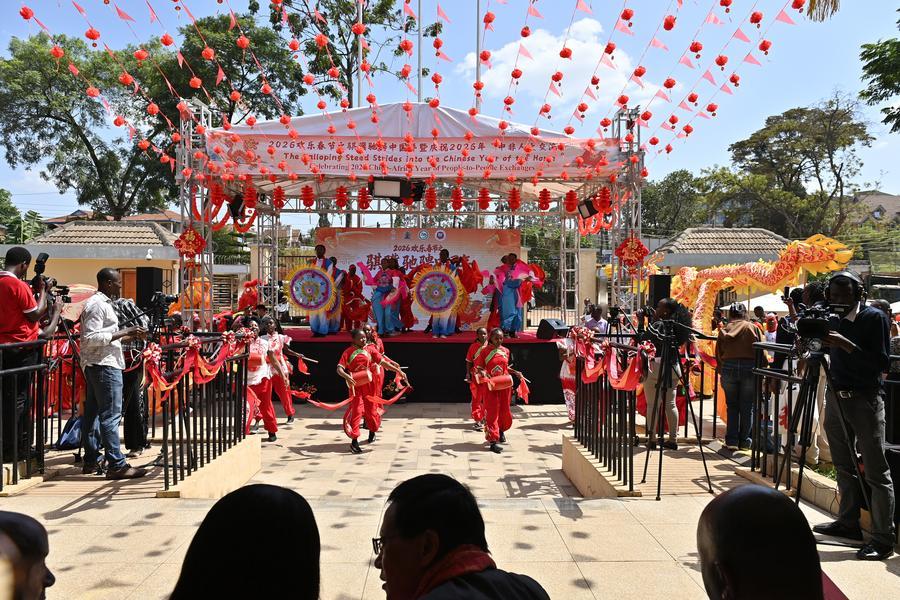
On Tanzania’s Zanzibar, an island in the Indian Ocean known as the “Spice Island,” Spring Festival festivities took on a unique local flavor. On Chinese New Year’s Eve, Wang Wenming, a Chinese tourist born in the 1990s, and his fiancee spent the festival at a seaside restaurant on the northern part of the island.
As the waves lapped against nearby rocks, a restaurant staff member, learning that the couple was celebrating the Chinese New Year, played the Chinese folk song Mo Li Hua (Jasmine Flower). The melody echoed across the terrace, drawing smiles and toasts from diners of different nationalities.
Wang said he was delighted to see locals becoming more familiar with Chinese traditional festivals.
“Through these exchanges, I introduced some Chinese cultural customs to local people, and the sense of fulfillment from this kind of interaction goes beyond simple tourism,” he said.
Efforts to showcase the cultural aspect of the Spring Festival extend to Indonesia, where the Confucius Institute at the University of Al-Azhar Indonesia organized celebrations under the guidance of its Chinese director, Wang Daxin.
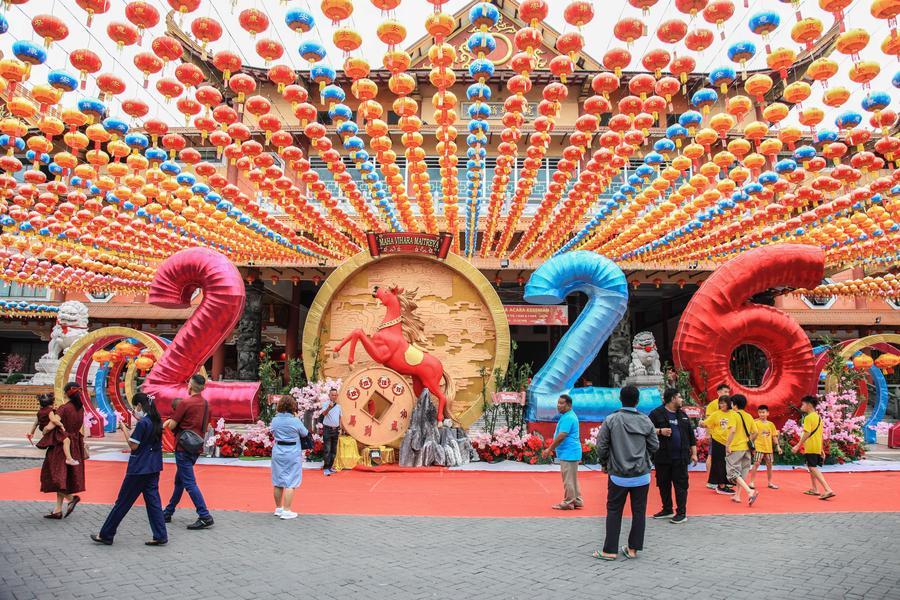
During the holiday, events combined park-style activities with stage performances. Visitors could watch lion dances, martial arts and traditional performances, while also participating in interactive experiences such as practicing calligraphy, crafting paper cuttings, learning tea ceremonies and making dumplings.
“We aim to help more Indonesians understand where the customs come from and what they mean, through guided explanations, demonstrations and hands-on activities,” Wang said.
Chen Jinxin, a tourist from south China’s Guangxi Province, attended a face-changing performance of Sichuan opera at the institute and was deeply moved.
“Seeing Chinese traditional arts appreciated overseas makes me truly proud,” he said. “It shows that different cultures can connect, and that understanding and respect are possible across borders.” ■
