


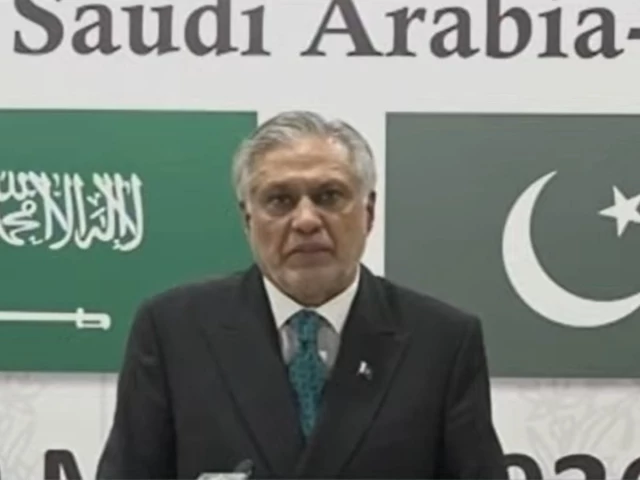
Calls for upholding principles of UN Charter, including respect for sovereignty and territorial integrity of all
Deputy Prime Minister and Foreign Minister Ishaq Dar said on Sunday that foreign ministers from Turkiye, Saudi Arabia, and Egypt have expressed full support for dialogue and diplomacy as the only viable path toward an “early and permanent end” of the US-Israel-Iran conflict.
Addressing a media briefing on the quadrilateral foreign ministers’ meeting, Dar described the gathering as a “very detailed and in-depth discussion” on the current situation in the Middle East.
He said the foreign ministers emphasized dialogue and diplomacy as the only way to prevent conflicts and promote regional peace and harmony. “We call for upholding the principles of the UN Charter, including respect for the sovereignty and territorial integrity of all,” he added.
The ministers also expressed concern over the devastating impact of the ongoing conflict on lives and livelihoods across the region. “We agreed that this war benefits no one and would only lead to death and destruction,” Dar said.
He briefed the visiting foreign ministers on the prospects of potential US-Iran talks in Islamabad. “The visiting ministers expressed their full support for this initiative and reaffirmed unity to contain the situation, reduce the risk of military escalation, and create conditions for structured negotiations between the relevant parties,” he said.
Dar further noted that the ministers discussed ways to strengthen mutual cooperation among the brotherly countries.
Under the leadership of Prime Minister Shehbaz Sharif, Pakistan has maintained regular engagement with regional and international partners. “We have remained actively involved in all efforts aimed at bringing this conflict to an end,” he said.
Calling Pakistan–US relations “very important,” Dar said Islamabad has remained in active dialogue with US leadership to help de-escalate the situation and find a peaceful resolution.
Read More: Iran’s president tells PM Shehbaz trust needed for talks to end Middle East conflict
“In this context, Pakistan is pleased that both Iran and the US have expressed confidence in Pakistan’s ability to facilitate talks. Pakistan will be honoured to host meaningful negotiations between the two sides in the coming days for a comprehensive and lasting settlement of the conflict,” he added.
He further said he had also held several telephone conversations with counterparts worldwide, all of whom expressed full support and confidence in Pakistan’s efforts. “There is strong appreciation and support among all our partners for Pakistan’s initiatives. We will continue our efforts with sincerity and commitment,” he said.
Dar noted a detailed telephonic discussion with Chinese Foreign Minister Wang Yi, who fully supports Pakistan’s initiative to host US-Iran talks, as well as a conversation with United Nations Secretary-General António Guterres, who also expressed support for the peace initiative.
The foreign minister stressed the importance of Muslim unity during these challenging times. “The unity of the Muslim Ummah in these circumstances is of utmost importance,” he said.
In his concluding remarks, Dar called on the international community for prayers and support to ensure the success of Pakistan’s efforts to achieve peace and bring a permanent end to the war.
Also Read: Pakistan, Turkiye, Saudi Arabia, Egypt conclude first round of talks on US-Israel-Iran war
According to Reuters, during the talks, initial discussions focused on proposals to reopen the Strait of Hormuz to shipping, sources familiar with the matter said.
Foreign ministers from the three regional powers landed in Islamabad for the talks as Iran warned the US against launching a ground attack and global oil prices surged amid continued fighting between Iran, the US and Israel.
The countries meeting in Pakistan have floated proposals to Washington tied to maritime traffic and reopening the Strait of Hormuz, five sources familiar with the matter told Reuters, as part of wider efforts to stabilise shipping flows.
The Strait of Hormuz was previously a conduit for about a fifth of global oil and liquefied natural gas supplies, but Iran has effectively halted shipping flows through it in response to the US and Israeli air strikes that began a month ago.
Proposals on reopening Hormuz
Pakistan, which, like Turkiye, borders Iran, has leveraged its close ties to both Tehran and Washington to emerge as a key diplomatic channel in the conflict, while Ankara and Cairo have also played a role.
A source from Pakistan said proposals, including from Egypt, had been forwarded to the White House by the countries before Sunday’s meeting and that they included Suez Canal-style fee structures.
Two other Pakistani sources said Turkiye, Egypt and Saudi Arabia could form a consortium to manage oil flows through the waterway, and had asked Pakistan to participate. The first Pakistani source said Islamabad had not been formally asked to join and maintains that it will not.
The proposal for a management consortium had been discussed with the US and Iran, the sources said.
A Turkish diplomatic source said Ankara’s priority was securing a ceasefire. “Ensuring the safe passage of ships could serve as an important confidence-building measure in this regard,” the person said, requesting anonymity.
