


Says 2025 saw record terrorist attacks, successful military operations with 2,597 militants killed
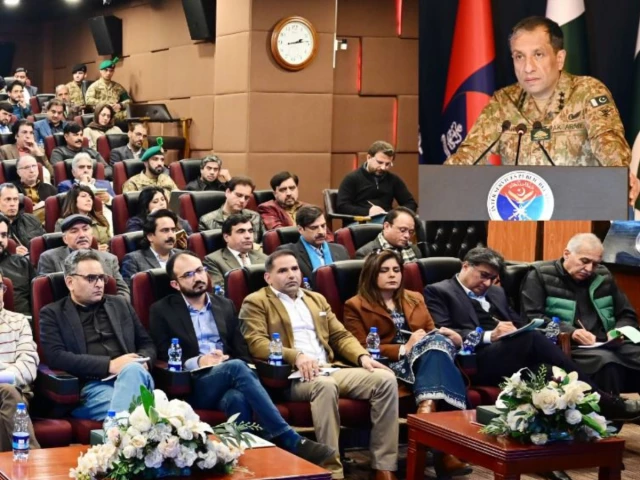
Director General Inter-Services Public Relations Lt Gen Ahmed Sharif Chaudhry addresses a press conference on Tuesday. Photo: ISPR
Director General of Inter-Services Public Relations Lt Gen Ahmed Sharif Chaudhry on Tuesday said that 80 per cent of all terrorist incidents in the country have occurred in Khyber-Pakhtunkhwa. He attributed the trend to what he described as a ‘politically permissive environment’ for militants and an emerging ‘nexus between political and militant elements’ in the province.
Addressing a press conference on Tuesday, the chief military spokesperson said the prevailing environment had enabled extremist groups to organise, build facilitation networks and repeatedly challenge the writ of the state, with implications for the country’s overall security situation.
During the briefing, the DG ISPR strongly criticised Pakistan Tehreek-e-Insaf (PTI) and its leadership over their stated positions on counterterrorism. He played video clips of senior PTI leaders, including the K-P Chief Minister Sohail Afridi, and displayed screenshots of statements attributed to PTI founder Imran Khan, questioning what he termed their narrative on the fight against terrorism.
Referring to international assessments, Lt Gen Chaudhry said the United Nations had acknowledged the presence of 20 international terrorist organisations operating in the region. “Ask Tajikistan — it says terrorism is emanating from here. Ask Uzbekistan — it says the same. Ask Iran — it says the same. Ask Pakistan — and it says the same,” he said, rejecting what he described as a ‘false narrative’ that portrayed Pakistan as the only country facing the problem. “Who exactly is satisfied with this situation, and who is saying that things are going well there?” he asked, alleging that misleading claims were being spread to confuse the public.
The DG ISPR also took exception to assertions that security personnel were sacrificing their lives for ‘minerals or dollars’, saying such claims insult the sacrifices of martyrs. He said Pakistan, including K-P, was rich in mineral resources but stressed that peace was essential for their responsible exploration. “We want these resources to benefit the people of K-P, their children and future generations — but without peace, it will not be possible,” he said, noting that young people from the province are among those being martyred.
Referring to a recently martyred army major Adeem, he asked whether the officer was not from Dera Ismail Khan and how many young men from the province had laid down their lives, questioning whether such statements honour or demean their sacrifices.
Responding to calls for the military’s withdrawal from certain areas, Lt Gen Chaudhry said the army was a federal force operating under federal directives, adding that safeguarding Pakistan’s territorial integrity and security was a constitutional and legal responsibility. “No one has the authority to allow their province or areas to be handed over to terrorists for the sake of politics or to serve undisclosed interests,” he said.
Recalling past developments, the DG ISPR warned that similar political rhetoric had led to the army’s withdrawal from Swat, with grave consequences. “What followed was not a small price — hundreds, even thousands of children and civilians as well as soldiers in Swat, Matta and across K-P paid with their lives,” he said, questioning whether there was now an attempt to once again oppose operations and allow militant control, thereby enabling the spread of a terrorism nexus across the region.
During the presser, the DG ISPR shared a screenshot of a post circulated from Imran Khan’s social media handle, which stated that a similar period in the past had been used to render the Awami National Party (ANP) unpopular in K-P. Responding to this, Lt Gen Chaudhry said the ANP, along with several ‘principled and patriotic’ political parties and leaders in the province, had stood firmly against terrorism. “They are saying, they are not prepared to die, so that they will not stand up and will instead align with them. “Why have these Fitna al-Khwarij, these terrorists, never attacked them?” he questioned.
He said the Khwarij had targeted workers and leaders of every political party, including the ANP, Jamiat Ulema-e-Islam, Pakistan Peoples Party and Pakistan Muslim League-Nawaz. “Attacks have taken place — so why not on them?” he asked, adding that they themselves had said they did not want to become unpopular. “Among whom do they seek popularity — with Fitna al-Khwarij? Whose approval are they seeking — that of Fitna al-Khwarij?” he remarked.
The DG ISPR also criticised calls seeking Afghanistan’s help, questioning what kind of appeasement policy was being pursued by appealing to Kabul for security guarantees. He said such appeals were being made to a regime that was hosting, and controlled by, global terrorist organisations.
Questioning the PTI’s narrative opposing military operations, he said thousands of terrorist incidents had already occurred in the province. “And this is what you are talking about? There is neither reason nor logic — it is merely political rhetoric,” he said.
He asked what alternative was being proposed if military operations were ruled out. “If there is to be no military operation, then what is the alternative? Are we to sit at the feet of terrorists? Should Noor Wali Mehsud be made the chief minister of the province? Should allegiance be pledged to him? Will Haibatullah decide what happens in Charsadda? Should girls in K-P — 50 per cent of the population — be removed from schools and confined to their homes? What exactly is the plan?” he asked, adding that there was no answer to these questions.
Addressing the issue of militancy, the DG ISPR said there was no distinction among terrorist groups, regardless of their labels or affiliations. “Whether the terrorist is from Daesh, Al Qaeda or TTP — they are all terrorists. They have no religion or faith. We have no sympathy for any of them,” he said, adding, in Pakistan’s view, “There is only one good kind of terrorist, and that is a dead terrorist.”
Responding to a question about negotiations with the Taliban and their return to K-P, he dismissed claims that the state had been powerless at the time as ‘ridiculous’. He said the then prime minister — whom he described as someone who ran his party in a dictatorial manner — was fully empowered. “When he decides to pursue something, he pursues it — whether it is holding talks with terrorists or anything else,” he said.
Referring to the former DG ISI, he questioned where the official was now, alleging that he had been used for political purposes. “He was an empowered prime minister. He was so powerful that he called the army chief the father of the nation. He did what no one else had done,” he remarked.
The DG ISPR said the entire party revolved around a single individual and followed whatever course he chose. “The DG ISI was used for politics. The institution had nothing to do with it — it was a game of personalities,” he added.
Afghan soil, Indian support driving terrorism in Pakistan: DG ISPR
The DG ISPR said militant organisations were using Afghan territory as their operational base, while funding and support were coming from India.
Referring to what he described as new investment patterns linked to terrorism, Chaudhry said, “The most prominent pattern affecting Pakistan points towards India.” He added that Afghanistan remained the base of operations for militant groups targeting Pakistan.
The DG ISPR said a “war economy” was a major driver of terrorism. Citing reports, he said around $147 billion was spent on Afghanistan’s reconstruction, raising questions about where the money went. He said when such financial flows stopped, groups dependent on conflict sought to sustain themselves by spreading terrorism across the region.
He also said $7.2 billion worth of US military equipment, including advanced weapons, was left behind in Afghanistan, adding that political and internal facilitation had taken place during the same period. Pakistan, he said, took a firm stand against these elements in 2023.
Chaudhry said developments in Afghanistan since 2021 had reshaped the terrorism landscape. He referred to the Doha agreement between the Afghan Taliban and the United States and its international partners, which committed to forming an inclusive government, preventing the use of Afghan territory for terrorism and protecting women’s rights.
However, he said those commitments were not fulfilled. “An inclusive government did not form, Afghan territory was used by multiple terrorist organisations, and groups such as the Balochistan Liberation Army (BLA) and Tehreek-e-Taliban Pakistan (TTP) began operating from Afghanistan,” he said.
He added that due to the situation in Syria, around 2,500 militants had recently moved to Afghanistan, saying they were neither Afghan nor Pakistani.
The military spokesperson said 2025 was a “landmark and consequential year in our fight against terrorism,” as security forces launched an extensive nationwide campaign amid a sharp rise in attacks.
“This is the only purpose of this press conference, and I would request that we remain focused on counter-terrorism, as terrorism is the biggest threat being faced by the state of Pakistan right now,” he said.
Over 75,000 IBOs conducted in 2025
According to the DG ISPR, security forces conducted an average of more than 206 intelligence-based operations (IBOs) daily in 2025. By the end of the year, the total number of IBOs reached 75,175.
Most operations were carried out in Balochistan, where 58,778 IBOs were conducted. K-P followed with 14,658 operations, while 1,739 took place in the rest of the country.
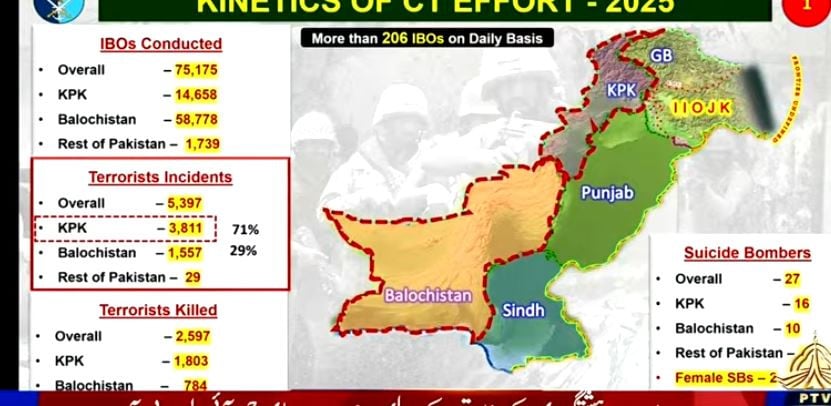
Chaudhry said 5,397 terrorist incidents were reported nationwide during the year. K-P was the worst affected, with 3,811 incidents, accounting for 71% of the total. Balochistan recorded 1,557 incidents, or 29%, while only 29 incidents were reported elsewhere.
Security forces killed 2,597 militants during the year, including 1,803 in K-P and 784 in Balochistan, he said. A total of 27 suicide bombers were reported, with 16 in K-P and 10 in Balochistan.
The DG ISPR said Fitna-al-Hindustan – a term he used to refer to Baloch militant groups – had no connection with Balochistan. He added that security forces faced intense challenges, with 1,235 soldiers martyred during operations.
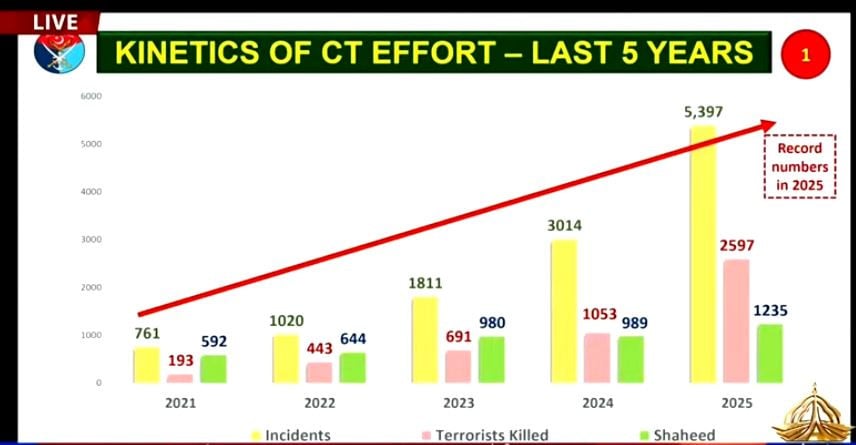
Presenting data from 2021 to 2025, Chaudhry said terrorism-related incidents showed a steady and then sharp rise. In 2021, there were 761 incidents, with 193 militants killed and 592 security personnel martyred.
In 2022, incidents increased to 1,020, with 443 militants killed and 644 personnel martyred, he said.
The situation worsened in 2023, when incidents rose to 1,811. During the year, 691 militants were killed and 980 security personnel lost their lives.
In 2024, incidents climbed further to 3,014, with 1,053 militants killed and 989 personnel martyred, he said.
“The surge peaked in 2025,” Chaudhry said. “Incidents jumped to 5,397, 2,597 militants were killed, and the number of martyred personnel reached its highest level at 1,235.”
He also outlined major attacks carried out during the year across the country, targeting military installations, law enforcement personnel, civilians and children.
On March 4, Bannu Cantonment in K-P was attacked, killing 18 people, including five law enforcement personnel and 13 civilians. Security forces killed 16 militants.
On March 11, the Jaffar Express was attacked in Bolan, killing 25 people — four law enforcement personnel and 21 civilians — while 33 militants were killed. On March 16, a bus carrying Frontier Corps personnel was attacked in Nushki, killing five people, including three law enforcement personnel and two civilians.
On May 21, a school bus was attacked in Khuzdar, killing five civilians. One militant was killed.
After a brief lull, attacks resumed in September. On September 2, Frontier Corps North headquarters in Bannu was attacked, killing six law enforcement personnel. On September 30, an attack on Frontier Corps headquarters in Quetta killed 11 people, including three law enforcement personnel and eight civilians.
On October 10, a police training school in Dera Ismail Khan was attacked, killing seven people — six law enforcement personnel and one civilian. In November, a cadet college in Wana was attacked, killing five people, including three law enforcement personnel and two civilians.
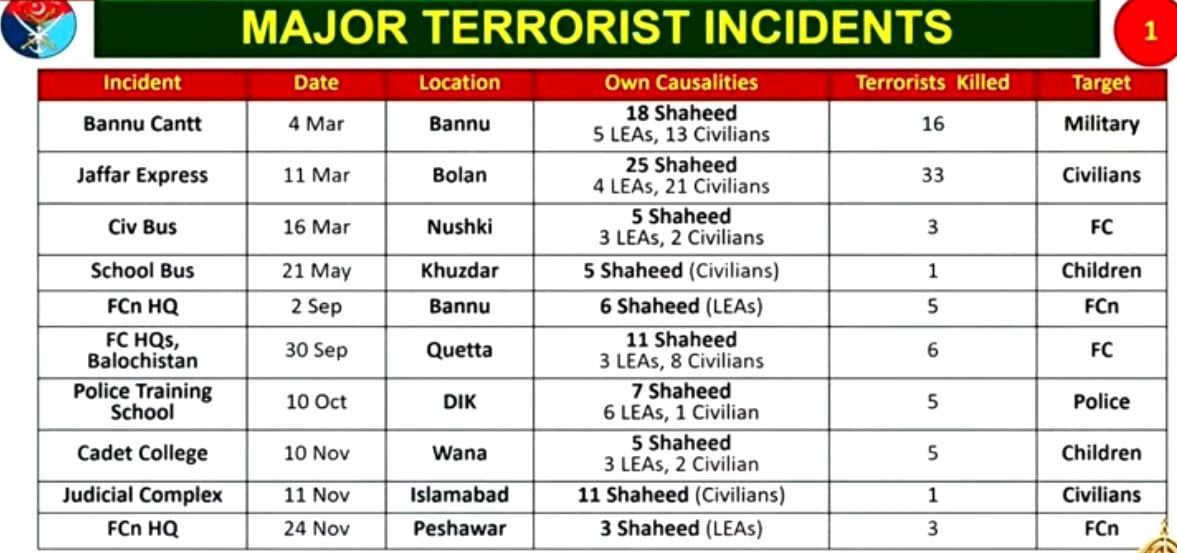
On November 11, an attack on the Judicial Complex in Islamabad killed 11 civilians. The final incident occurred on November 24 in Peshawar, where an attack on Frontier Corps North headquarters killed three law enforcement personnel.
Chaudhry said Fitna Al-Khawarij – a name used for banned TTP militants – were the first to use armed quadcopters, alleging full Indian support.
He said a specialised militant wing operated armed drones to target mosques, public places and residential areas, often using women and children as human shields.
“The Pakistan Army uses drones only for surveillance purposes,” Chaudhry said.
He rejected what he called a false narrative that the fight against terrorism was the military’s war alone, stressing that it was a national struggle.
“If the nation does not stand united, its consequences will reach homes, schools, markets and offices,” he warned.
