


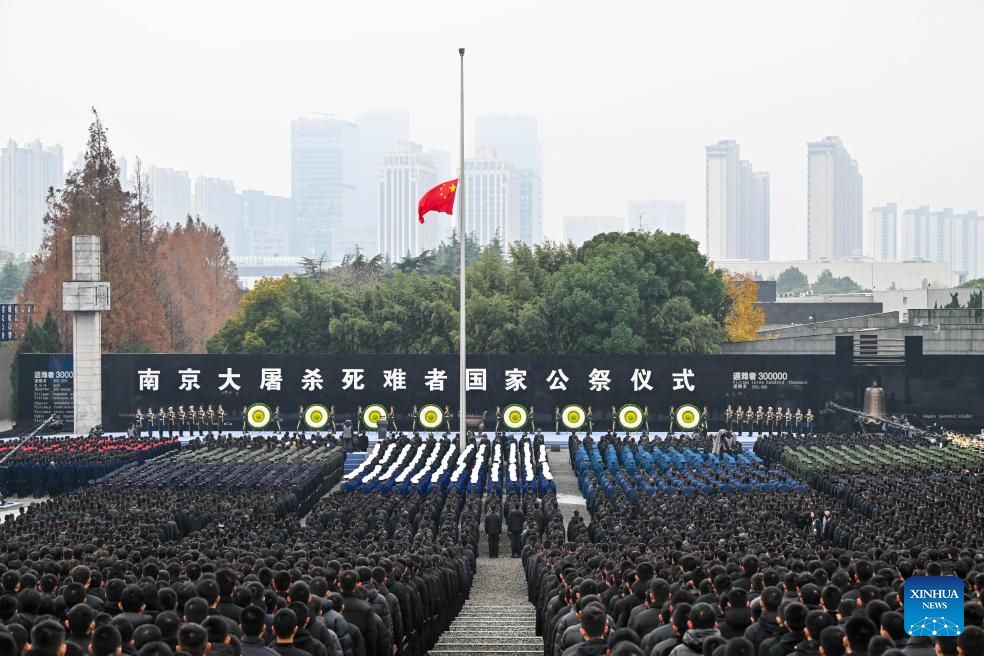

A national memorial ceremony for the Nanjing Massacre victims is held at the Memorial Hall of the Victims in Nanjing Massacre by Japanese Invaders in Nanjing, capital of east China’s Jiangsu Province, Dec. 13, 2025. The 12th national memorial day was observed in Nanjing on Saturday to honor about 300,000 victims killed by Japanese troops during the Nanjing Massacre, in a year that marks the 80th anniversary of the end of World War II (WWII). (Xinhua/Ji Chunpeng)
By Chen Zhuo
NANJING, Dec. 14 (Xinhuanet) — 3,000 doves soared into the sky amid echoes of the Bell of Peace on Saturday in Nanjing, capital of east China’s Jiangsu Province, carrying both grief for the dead and a quiet call for lasting peace.
Thousands dressed in dark attire with white flowers pinned to their chests stood in silence at the public square of the Memorial Hall of the Victims in Nanjing Massacre by Japanese Invaders, marking China’s 12th national memorial day.
At 10 a.m., the national memorial ceremony for the Nanjing Massacre victims began. The national anthem was played and when the final note faded, the crowd bowed their heads for a minute of silence in memory of the victims.
Eight wreaths were laid at the altar by honor guards. Later, young people recited a declaration of peace, followed by three resonant strikes of the Bell of Peace.
Eighty-eight years have passed since invading Japanese troops launched a six-week rampage that claimed the lives of approximately 300,000 Chinese civilians and unarmed soldiers. Yet for many gathered at the ceremony, the chill of that winter still lingers in memory.
One of the remaining 24 registered survivors of the massacre, Liu Minsheng, bears the scar from injuries inflicted in 1937. “The past offers lessons for the future,” the 91-year-old said. “China has become prosperous and we must never forget history and always cherish peace.”
Nearby stood Hu Jingya, who lost family members in the Nanjing Massacre. Her great-grandfather was shot dead by Japanese soldiers as the family fled burning homes. “Only when we face this history honestly, can we truly understand the value of peace today,” she said.
China officially designated December 13 as a national memorial day for the victims of the Nanjing Massacre in 2014.
Zhang Qing, whose great-grandfather once testified about the atrocities, said national commemoration ensures that individual testimonies are not lost to time. When a country remembers at this level, it stresses the importance of the history and tells future generations why strength and vigilance matter, she said.
The testimonies of survivors about the massacre were listed by UNESCO in the Memory of the World Register in 2015.
Chinese-American Lu Zhaoning, who has donated more than 3,000 historical artifacts and materials related to the massacre to museums and institutions, believes the decision to designate a national memorial day makes the tragedy internationally visible. “Global awareness of the massacre increased significantly,” he said.
Six members of Lu’s family were killed by the Japanese invaders. “That intertwining of family loss and national trauma fueled my decades-long effort to collect historical evidence,” said Lu.
Many citizens also commemorated the victims by visiting monuments across the city on Saturday.
“It was a painful memory for our nation,” said Zhang Yonggang who joined in the commemoration activities in the city. “We should cherish the peace today and make due contributions to our country.”
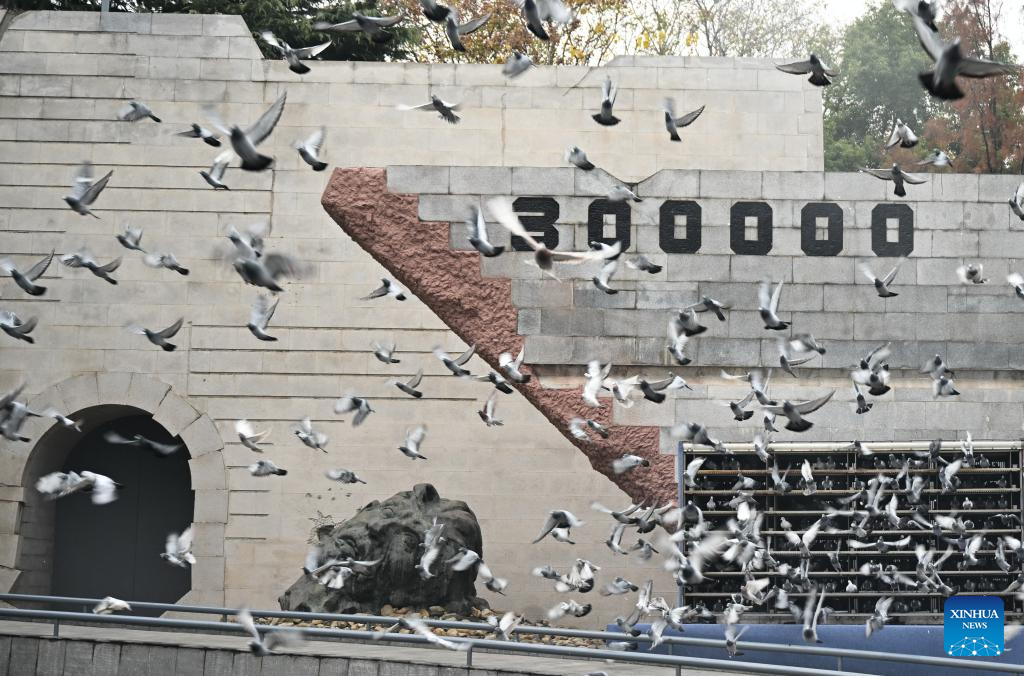
Doves are released during a national memorial ceremony for the Nanjing Massacre victims held at the Memorial Hall of the Victims in Nanjing Massacre by Japanese Invaders in Nanjing, capital of east China’s Jiangsu Province, Dec. 13, 2025. The 12th national memorial day was observed in Nanjing on Saturday to honor about 300,000 victims killed by Japanese troops during the Nanjing Massacre, in a year that marks the 80th anniversary of the end of World War II (WWII). (Xinhua/Li Xiang)
