


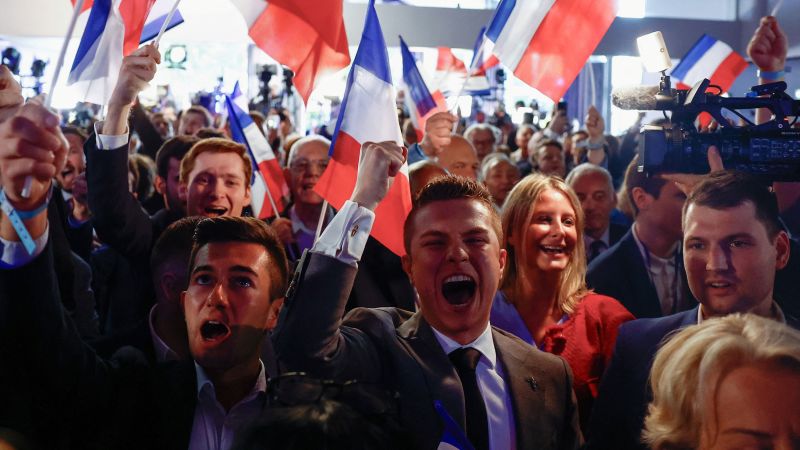
Sarah Maisonnier/Reuters
Supporters of the French far-right party National Rally gather in Paris after the polls closed for the European Parliament elections on June 9.
CNN
—
Europe’s shift to the right has been a long journey, and in the process the continent’s mainstream has become increasingly accepting of people who once held eurosceptic views, which were a minority.
The projected gains for the far-right in the European elections may seem modest in pure numerical terms, but they are significant.
The outcome poses a major challenge to the mainstream pro-European officials who dominate European Union institutions.
The rise of far-right parties may not be unexpected, and it does not pose an existential threat to the EU, but it does suggest that the Eurosceptic right may gain greater control over the EU’s direction in the coming years.
Over the next 24 hours, centrist parties, expected to remain the largest party in the European Parliament, are likely to discuss a “grand coalition” to counter the rise of the far-right, which has made significant gains while centrist parties remain in the lead.
On paper, these pro-EU parties can claim victory. In terms of numbers alone, the centre-right coalition held up. The centre-right European People’s Party, the centre-left Social Democrats and the liberal Renew Europe are the three biggest groups in the European Parliament. If you add the pro-EU Greens to the mix, the centre becomes by far the biggest group.
Even taking into account gains in seats for the far-right European Conservatives and Reformists and Identity Democrats parties, the mainstream pro-European centre still holds a healthy majority in parliament.
But the course of European politics is not always decided within the European Parliament, and it is not clear whether centrist forces are willing to cooperate.
These centrist groups are all pro-EU but have divergent policy positions, and a domestic political shift to the far right could make it increasingly attractive for centre-right parties to work with the far right at the European level.
This could complicate the appointment of the next European Commission, the EU’s executive body that sets the EU’s political direction. The deadline is several months away, providing plenty of time for maneuvering and potentially creating cooperation between the centre-right and the far-right.
A similar dynamic could play out when parliament votes on policies. Coalitions are not formal in the EU Parliament, where lawmakers vote on an issue-by-issue basis. It is not inconceivable that the centre-right could vote alongside the left on issues like aid to Ukraine, but with the far right on immigration or climate change.
It is not just European-level politics that will influence how these groups work together in Brussels: the domestic politics of member states will inevitably put pressure on how elected members of the European Parliament work with their colleagues.
Of the 27 EU member states, 13 currently have government leaders who are members of a European right-wing party. In the Netherlands, a new government is being formed and may be led by members of the ID party. There are also leaders who are not affiliated with any European party but who generally sympathize with right-wing ideas.
French President Emmanuel Macron has dissolved parliament and announced elections will be held later this month after what he expects to be a crushing defeat to his far-right rival Marine Le Pen.
Le Pen has already pushed Macron significantly to the right in France, and her administration has increasingly adopted anti-immigrant and anti-Muslim rhetoric. France could hold presidential elections in 2027, with Le Pen coming to power.
Sunday’s results do not indicate a dramatic or sudden shift to the right, but rather a more subtle and gradual change – a shift from the centre of European politics to the right that has been ongoing for several years.
The most visible recent example is the emergence of Giorgia Meloni as a major player in EU politics: In 2022, she was elected prime minister of Italy. Her domestic party, the Brothers of Italy, is the most right-wing party elected to the Italian government since wartime fascist leader Benito Mussolini.
Initially, authorities in Brussels feared that Mr. Meloni would be a firebrand trying to destroy the EU. During his tenure, he was an ally of European Commission President Ursula von der Leyen and worked with her on issues such as Ukraine.
She has used the influence she has gained to change the EU’s policy positions on issues important to her, particularly on immigration.
For most casual observers, the pinnacle of euroscepticism was probably the Brexit vote of 2016. It was the product of years of shifts in British domestic politics, with the centre-right pivoting to fend off the far right and ultimately culminating in its demise.
The difference between what happened in the UK and what is happening now is that Eurosceptics no longer want to leave the EU, they want to take over the EU.
Putting these provisional results in the context of further elections across the continent in the coming months and years, a takeover of the heart of the EU seems increasingly likely.
European elections are rarely about the EU per se, but rather 27 national elections taking place within the political context of those countries. They are often used as protest votes, with groups that are not in power at home doing well because voters know they don’t really run anything.
But what these results reveal is that a subtle shift to the right, dragging the center with it, is still occurring across Europe.
