


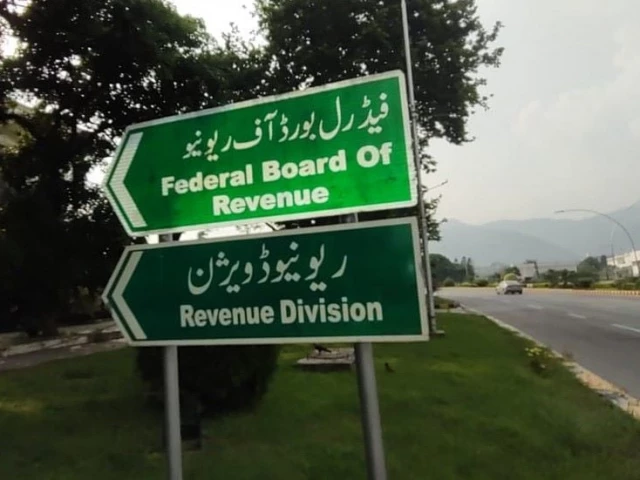
Federal Board of Revenue (FBR) orders online marketplaces to submit seller-wise transaction details for digital goods and services. Photo: Suhail Yusuf/Express
ISLAMABAD:
The tax machinery on Thursday told Prime Minister Shehbaz Sharif that it may miss the first half-year’s downward revised target by Rs560 billion without support from the office of the attorney general, amid a warning by the Ministry of Finance about the implications of a huge revenue shortfall for government expenditure.
The meeting on fiscal affairs came a day after the International Monetary Fund (IMF)’s Resident Representative, Mahir Binici, met PM Sharif and delivered a message from the executive board. There were no official details on the meeting between the IMF’s country head and the PM, but one official said that Binici had been invited merely for a cup of tea.
PM Sharif had convened a regular meeting on the Federal Board of Revenue (FBR)’s matters, but it became evident that the FBR was relying on others to do its job, while the wider economy also remained unprepared for take-off. According to sources, participants opined that any reduction in interest rates could propel economic growth but could again put pressure on already thin foreign exchange reserves.
This discussion was linked to the upcoming monetary policy meeting, which will review interest rates. Higher interest rates have, however, benefited the Ministry of Finance through increased central bank income.
Some participants argued that a depreciation of the rupee could support both exports and the FBR’s dwindling revenues. A nearly fixed exchange rate has eroded the competitive advantage of Pakistani exporters, and the IMF board has also asked Pakistan to implement a genuinely flexible exchange rate.
Falling revenue
Sources said the FBR management informed the prime minister that estimated recoveries of Rs200 billion from court cases this month could reduce the tax shortfall to Rs362 billion against the downward revised target.
The management sought assistance from the Attorney General of Pakistan for expeditious decisions in these cases. Without settlement of these cases in favour of the FBR, the tax shortfall is expected to reach Rs562 billion against the downward revised target, the sources added.
The original tax target for July-December was Rs6.7 trillion, later cut to Rs6.49 trillion. The FBR now faces at least Rs560 billion in shortfalls against the revised target. Against the original target, the shortfall will exceed Rs775 billion. The FBR has already sustained Rs413 billion in shortfalls in the first five months.
According to the PM’s Office, the premier was briefed on the progress of initiatives being taken to achieve revenue targets, digitise the economy, and curb tax evasion. He was also updated on pending tax cases in tribunals and various institutions.
The Federal Constitutional Court has scheduled the super tax case for next month, making it unlikely that the FBR will receive a ruling this month. The FBR has repeatedly assured the IMF that a super tax case could come at any time in its favour.
Sources said one participant warned that a major revenue shortfall may increase the chances of a mini-budget. The IMF approved the $1.2 billion loan package this week only after Pakistan assured it would introduce a mini-budget to compensate for revenue losses.
The finance ministry cautioned the PM that in case of a significant shortfall, expenses would have to be curtailed, as the IMF would not allow deviation from the primary surplus target.
The FBR chairman has provided 1,000 cars to his officers and authorised up to a fourfold increase in salaries in the hope of improving performance and achieving the original Rs14.13 trillion target for the year.
There were also discussions on the impact of lower fuel and electricity prices on FBR revenues.
The PM asked the FBR to clear refunds owed to oil marketing companies, but the FBR chairman sought funds from the finance ministry. The request was rejected.
An official handout from the PM’s Office said PM Sharif directed the FBR to intensify efforts to achieve the 11% tax-to-GDP ratio target. He appreciated the Customs Department for significantly reducing the duration of customs clearance through modern technology and artificial intelligence and directed that clearance times for imports and exports be further reduced.
He also instructed that tax enforcement be ensured across all sectors of the economy and commended the FBR and law enforcement agencies for their action against illegal cigarette factories.
The PM directed provincial governments to maintain full cooperation with the FBR in actions against tax evaders and illegal factories, as well as to ensure timely payment of sales tax refunds.
It was disclosed that a large cache of illegal cigarettes has been seized in recent days as a result of these actions.
