


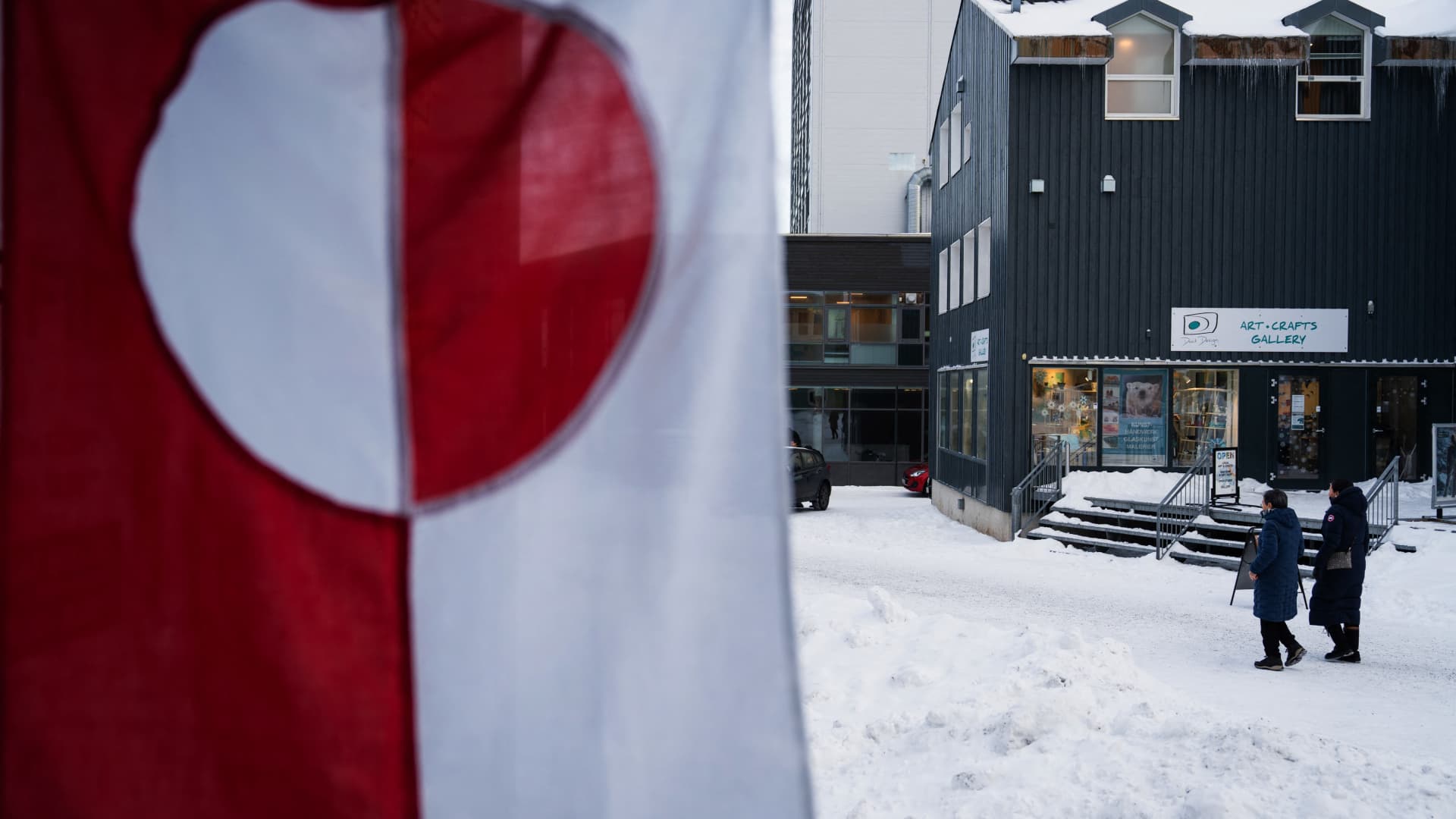
Greenlandic flags are fixed on a building in Nuuk, Greenland, on Jan. 14, 2026.
Alessandro Rampazzo | AFP | Getty Images
A high-stakes meeting between the U.S., Denmark and Greenland over the Arctic island’s future ended without a major breakthrough, amplifying concerns about the prospect of a near-term solution.
The White House meeting on Wednesday between U.S. Vice President JD Vance, U.S. Secretary of State Marco Rubio, Danish Foreign Minister Lars Lokke Rasmussen and Greenland’s Vivian Motzfeldt lasted for about an hour.
Denmark’s Rasmussen described the conversation as “frank but constructive,” but added that U.S. President Donald Trump’s repeated threats to take control of Greenland were “totally unacceptable.”
CNBC takes a look at five key takeaways from the White House showdown.
A working group
For some, the White House talks did achieve something significant. The U.S., Denmark and Greenland agreed to establish a high-level working group to try to determine a way forward for the self-governing Danish territory.
By doing so, Penny Naas, senior vice president at GMF, a Washington-based think tank, said the three countries had averted a worst-case scenario.
“Greenland’s strategic importance has made it a focal point of sustained U.S. interest, including periodic pushes for acquisition. Yet Greenlanders have been unequivocal: they value their deep ties with Denmark, NATO, and Europe, and do not see their future as part of the United States,” Naas told CNBC by email.
“Bridging this gap, between a U.S. administration that still signals a desire to ‘own’ Greenland and a Greenlandic population firmly committed to self determination, will require creativity and a realistic appreciation of the concerns on all sides,” she added.
Rasmussen said the working group planned to meet over the coming weeks in a bid to find a compromise. He said Denmark and Greenland were receptive to the possibility of the U.S. opening more military bases on the island — but insisted there were some “red lines” Washington could not cross.
Trump stands firm
Just hours before Wednesday’s meeting was set to get underway, Trump said anything less than Greenland becoming a part of the United States would be “unacceptable.”
He later reiterated this stance, telling reporters in the Oval Office: “We need Greenland for national security.”
Guntram Wolff, senior fellow at Bruegel, a Brussels-based think tank, said Trump’s push to take control of Greenland is seen as “totally unacceptable” to Europe and raises questions about the integrity of the NATO military alliance.
US President Donald Trump speaks during a signing ceremony in the Oval Office of the White House in Washington, DC, US, on Wednesday, Jan. 14, 2026.
Francis Chung | Politico | Bloomberg | Getty Images
“If the U.S. president says he can only defend what he owns, well what he is basically saying is he cannot defend Europe under any circumstances because he doesn’t own Europe, right?” Wolff told CNBC’s “Europe Early Edition” on Thursday. “And so, that means Article 5 of NATO, the support of the U.S. president for European security, cannot be taken for granted anymore,” he added.
NATO’s Article 5 mutual defense clause means that an attack against one NATO member is considered an attack against all allies. The U.S. and Denmark, which is responsible for the defense of Greenland, are both NATO members.
What about Russia and China?
Trump, who has long coveted control of the mineral-rich island, has repeatedly said in recent weeks that only the U.S. can counter an alleged threat from Russia and China to Greenland.
“The problem is there is not a thing that Denmark can do about it if Russia or China wants to occupy Greenland, but there is everything that we can do,” Trump said on Wednesday, adding that he can’t rely on Copenhagen to defend Greenland.
It is true that Russia and China have been deepening and widening their areas of cooperation in the Arctic, including with their militaries and dual use of infrastructure and research, said Marisol Maddox, a senior fellow at the Institute of Arctic Studies at Dartmouth University.
A Greenland flag flies as people walk on the day of a meeting between top U.S. officials and the foreign ministers of Denmark and Greenland, in Nuuk, Greenland, Jan. 14, 2026.
Marko Djurica | Reuters
“However, Greenland is not where we are seeing this activity. Where we are seeing joint Russian and Chinese military activity is off the coast of Alaska, which remains under-invested in by the US,” Maddox told CNBC by email.
“Since President Trump initially voiced concern about Greenland’s security, Denmark has stepped up and announced billions of dollars of game-changing defense investments,” Maddox said.
“Through Allied cooperation, we have successfully headed off predatory investments by Chinese state-linked companies in Greenland and other parts of the Arctic,” she added.
NATO to deploy troops to Greenland
At Denmark’s request, several NATO members have confirmed plans to send military personnel to Greenland this week as part of a joint exercise referred to as “Operation Arctic Endurance.”
Before the White House meeting, Denmark announced plans to beef up its military presence in Greenland, saying the activities could include guarding national infrastructure, deploying fighter aircraft and conducting naval operations.

Germany, France, Sweden and Norway have all confirmed plans to take part in a show of support for both Copenhagen and Nuuk.
“As part of the NATO alliance, it is a core priority for the Government of Greenland, that defence and security in and around Greenland are strengthened, and that this is achieved in close cooperation with our NATO allies,” Greenland’s Motzfeldt said in a statement.
Where do we go from here?
Looking ahead, analysts were struggling to see the potential for a solution to the standoff.
Rasmus Brun Pedersen, associate professor at Denmark’s Aarhus University, said he expects Denmark and NATO allies to bolster their military presence in Greenland as part of a push to convince the Trump administration that it is taking Arctic security seriously.
“We will have a significant arms increase of NATO in the region and hopefully that we be something that we can say to the United States, well you had some security concerns, look at this, we have reacted,” Pedersen told CNBC’s “Squawk Box Europe” on Thursday.

“And hopefully the United States will say, OK there were no troops before, but now that President Trump has been able to force its reluctant NATO allies to increase their presence in the region and that can be claimed as a victory.”
Pedersen warned, however, that the U.S. position shows that it might well turn out to be unconvinced by this strategy. “So, where the compromise lies, that’s a good question.”
