


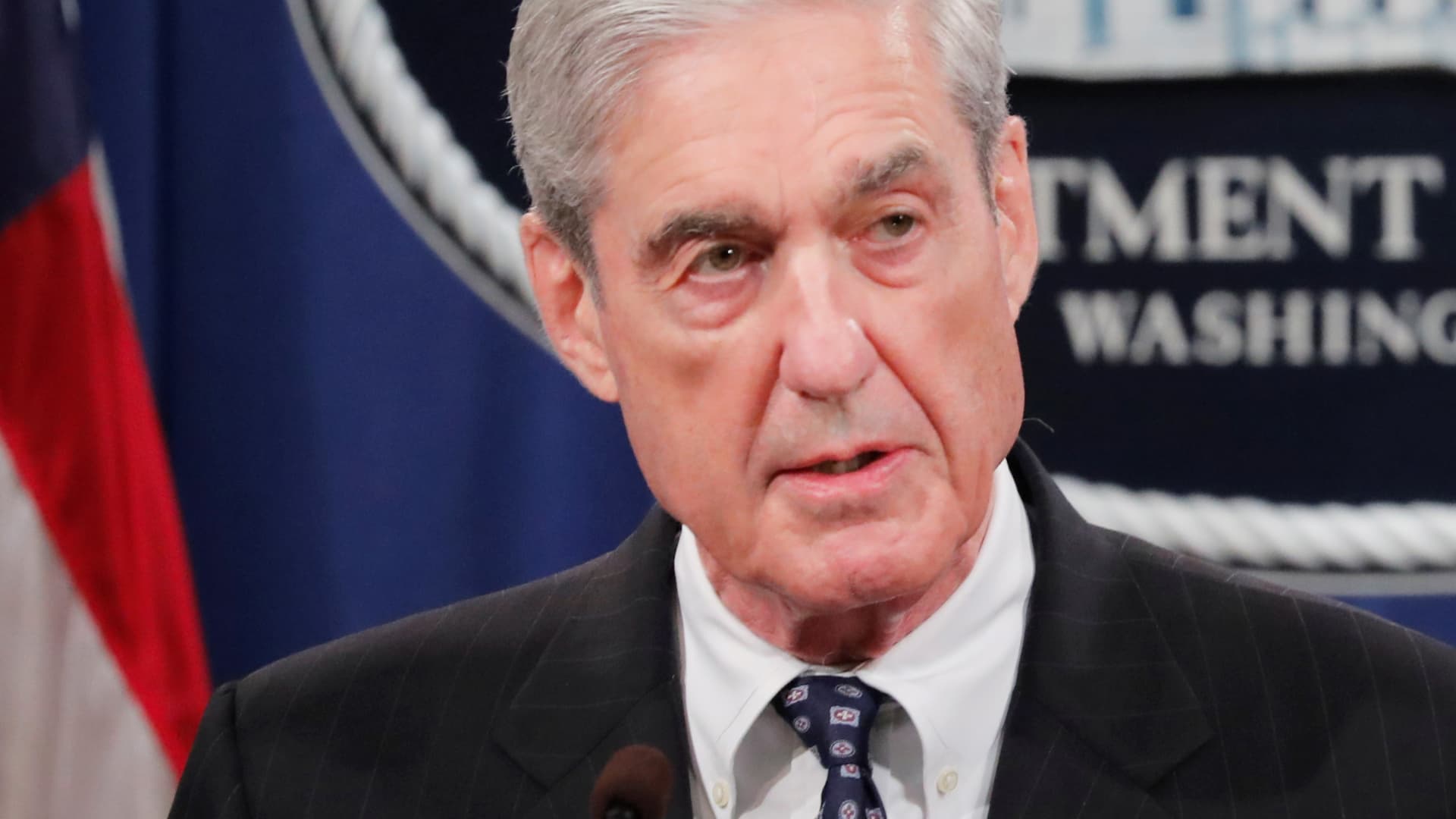
U.S. Special Counsel Robert Mueller makes a statement on his investigation into Russian interference in the 2016 U.S. presidential election at the Justice Department in Washington, May 29, 2019.
Jim Bourg | Reuters
Robert Mueller, former special counsel who investigated Russian interference in the 2016 presidential election, died Friday.
Mueller, also former director of the Federal Bureau of Investigation, was 81.
“With deep sadness, we are sharing the news that Bob passed away” on Friday night, his family said in a statement Saturday. “His family asks that their privacy be respected.”
MS Now first reported the news on Saturday.
Mueller concluded in 2019 that Russia interfered in the election in an effort to influence voters towards President Donald Trump’s 2016 campaign.
The Russia investigation and Mueller himself swiftly became lightning rods for Trump, who over the years has repeatedly called the probe a “witch hunt” and a “hoax.”
Shortly after Mueller’s death was reported, Trump said in a Truth Social post, “Good, I’m glad he’s dead.”
He added, “He can no longer hurt innocent people!”
From FBI director to special counsel
Mueller was the second-longest-serving director in FBI history, behind only J. Edgar Hoover. He began his tenure just one week before the Sept. 11 attacks in 2001, which became the catalyst for turning the agency’s priority from solving domestic crimes to fighting terrorism.
Mueller stayed in the post for 12 years after then-President Barack Obama asked him to remain on following his 10-year term. He entered private practice after leaving in 2013.
In 2017, he returned to public service after being appointed by Deputy Attorney General Rod Rosenstein to serve as special counsel in the Trump-Russia inquiry.
Mueller’s stern visage and taciturn demeanor matched the seriousness of the mission as his team spent nearly two years quietly conducting one of the most consequential yet divisive investigations in Justice Department history. He held no news conferences and made no public appearances during the investigation, remaining quiet despite attacks from Trump and his supporters and creating an aura of mystery around his work.
All told, Mueller brought criminal charges against six of the president’s associates, including his campaign chairman and first national security adviser.
His 448-page report, released in April 2019, identified substantial contacts between the Trump campaign and Russia but did not allege a criminal conspiracy. He laid out damaging details about Trump’s efforts to seize control of the investigation, and even shut it down, though Mueller declined to decide whether Trump had broken the law, in part because of department policy barring the indictment of a sitting president.
But, in perhaps the most memorable language of the report, Mueller pointedly noted: “If we had confidence after a thorough investigation of the facts that the president clearly did not commit obstruction of justice, we would so state. Based on the facts and the applicable legal standards, we are unable to reach that judgment.”
The nebulous conclusion did not deliver the knockout punch to the administration that some Trump opponents had hoped for, nor did it trigger a sustained push by House Democrats to impeach the president — though he was later tried and acquitted on separate allegations related to Ukraine.
The outcome also left room for Attorney General William Barr to insert his own views. He and his team made their own determination that Trump did not obstruct justice, and he and Mueller privately tangled over a four-page summary letter from Barr that Mueller felt did not adequately capture his report’s damaging conclusion.
Mueller deflated Democrats during a highly anticipated congressional hearing on his report when he offered terse, one-word answers and appeared uncertain in his testimony. Frequently, he seemed to waver on details of his investigation. It was hardly the commanding performance many had expected from Mueller, who had a towering reputation in Washington.
Over the next months, Barr made clear his own disagreements with the foundations of the Russia investigation, moving to dismiss a false-statements prosecution that Mueller had brought against former national security adviser Michael Flynn, even though that investigation ended in a guilty plea.
Mueller’s tenure as special counsel was the capstone of a career spent in government.
This is breaking news. Please refresh for updates.
—The Associated Press contributed to this report.
