


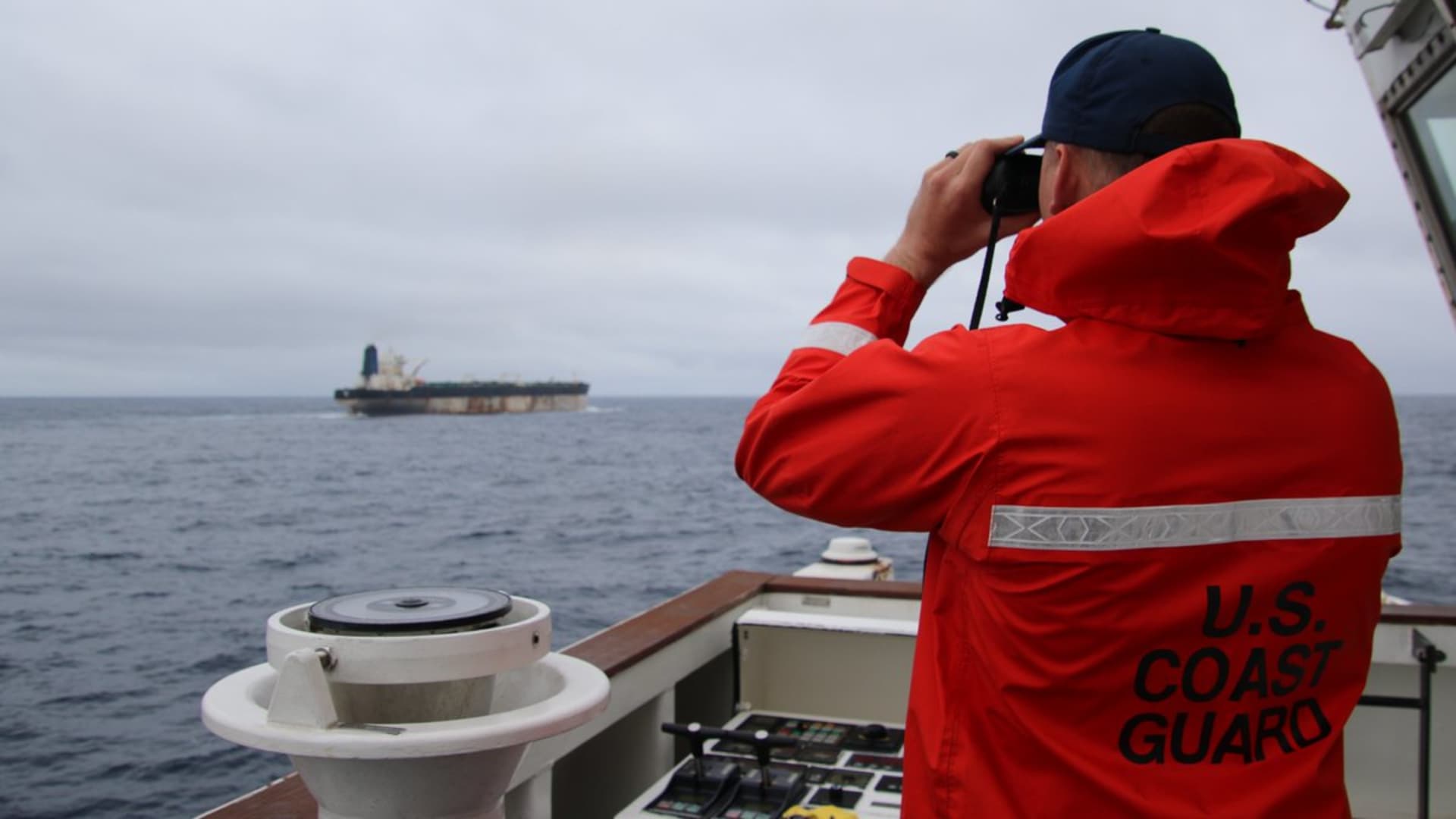
The oil tanker “Grinch” (R), suspected of belonging to the Russian’s shadow fleet, is seen outside the coast of Martigues near the port of Marseille-Fos on January 25, 2026, as it’s surveilled by the French Navy.
Thibaud Moritz | Afp | Getty Images
President Donald Trump announced a U.S. trade deal with India on Monday which he said includes a promise from India to stop buying Russian oil and potentially buy from the U.S. and Venezuela, but data shows the shadow fleet of tankers moving sanctioned crude continues to unload at Indian ports.
Global data and analytics firm Kpler’s vessel tracking shared with CNBC shows four tankers associated with Russia’s shadow fleet unloading or in the process of unloading sanctioned oil at Indian ports: the Giannis, unloading Urals at Chennai Refinery; the Nyxora, unloading Urals at Paradip Refinery; the Tiburon, unloading Urals at Vadinar Refinery; and the Seasons I, which is being tracked outside Vadinar on Tuesday morning but was yet to unload, according to Kpler.
In recent months, the global shadow fleet moving sanctioned oil, estimated to be as large as 1,400 vessels, has navigated around the tightening U.S. enforcement campaign on Venezuela and Iranian oil, and Europe’s interventions against the increasing flow of stateless tankers loading Russian crude.
A recent Lloyd’s List analysis on the global shadow fleet after the U.S. military actions in Venezuela found that out of the approximately 50 tankers that were full of Venezuelan oil, at least five tankers completed deliveries to China with the vessel’s Automatic Identification System (AIS) operating normally, and suggesting “the enforcement pressure has yet to bite.”
The U.S. recently completed its first sales of Venezuelan oil in the legal crude market.
Sanctioned Russian crude has also faced increasing enforcement measures. Recently, the French seized the tanker Grinch, which departed Murmansk earlier this month with a cargo of Russian oil. The French, with British assistance in tracking and monitoring, boarded the vessel to conduct a flag verification. The flag of the Comoros Islands has been deemed false. This seizure was the first instance of the EU-UK plan to interdict Russia’s shadow fleet. The sanctioning and seizure of the Russian shadow fleet is one of the efforts to cut Russian energy revenue to reduce Moscow’s ability to pursue its war in Ukraine.
India’s imports of Russian oil have reached a record level this year.
“In 2025, India’s oil imports from Russia made up 33% of the country’s total seaborne oil imports and 25 percent of Russia’s seaborne oil exports,” said Niels Rasmussen, chief shipping analyst at Bimco. “A new trade agreement between the U.S. and India could, according to U.S. President Donald Trump, put an end to that trade,” he said.
But Kremlin officials have pushed back, telling reporters they have not officially heard from India about any suspension of oil purchases by the Indian government.
India’s Prime Minister, Narendra Modi, has also yet to publicly confirm the terms of the trade deal Trump announced, though Indian officials have said an announcement will be coming. Trump’s announcement of the trade deal came days after the E.U. and India signed a major trade agreement slashing tariffs to zero on many goods over a number of years.
The Trump administration has been pressuring India during the trade war to stop buying Russian oil, and Trump said on Monday India should purchase oil from the U.S. or Venezuela. Even if it does stop importing Russian crude, Rasmussen says it could instead purchase more oil from the Persian Gulf.
Before Russia invaded Ukraine on February 24, 2022, up to two-thirds of India’s crude oil and oil product imports arrived from the Persian Gulf. In 2025, these crude imports had fallen to 45%, according to Bimco.
Rasmussen said he would not expect Russian oil exports to fall by a similar amount as Russia will likely aim to find new buyers, even if it requires a higher rebate to buyers of Russian oil. The shadow fleet often has to sell at a discount, and those discounts may increase as global enforcement measures tighten. Russian crude, because it is sanctioned, already trades at a lower price than crude sold on the public markets.
Kevin Book, managing director at ClearView Energy Partners, said if India does close the door on Russian oil, it will give other buyers of last resort more market power. “That could pressure Russian receipts to the downside. Barrels generally find a buyer. The question is the price,” he said.
But some analysts caution that a smaller market for Russian oil could make it harder for the shadow fleet to find additional employment in its bid to replace India.
“The only major country left to purchase Russian oil is China, and they may already have all the Russian oil that they want,” said Andy Lipow, president of Lipow Oil Associates.
With less crude oil out of Venezuela to feed the dark fleet and the Indian market potentially shut down, Lipow says many of those vessels may be idled or ultimately be scrapped.
But Book says the global shadow fleet is fungible, and if there is an opportunity to move sanctioned oil, the owners of these vessels will take advantage of it, with Venezuela an example. “The shadow fleet moves from one area of demand to another, and as long as sanctions remain in place against other major producing exporters, you can expect that there will still be some shadow vessels being used,” he said. “The tankers that were in Venezuelan trade would now go into Iranian and Russian trade.”
The U.S. has announced the seizure of the Bella-1 for violations of U.S. sanctions. The vessel, known as the Marinera after recently reflagging to Russia, was seized in the North Atlantic pursuant to a warrant issued by a U.S. federal court after being tracked by USCGC Munro.
Source: @US_EUCOM | U.S. Coast Guard | Via X
Despite the sanctioned crude crackdown, Russia has been quickly adding to its shadow fleet, reflagging vessels that once moved Venezuelan oil. In December, 17 sanctioned vessels were reflagged to Russia. One of the tankers seized by the U.S. in the blockade of Venezuelan oil was a recently reflagged Russian vessel.
Oil analysts say with the discounted sanctioned oil a separate market from conventional above-board crude oil commerce, all of the enforcement actions and tariffs continue to change the economics of the crude shipments. “The overall trade between nations matters,” Book said. “We are seeing oil flows have shifted locations through sanctions and then shifted again through tariffs. There will be logistical costs associated with these shifts.”
The higher costs come from shipping petroleum longer distances, as well as through intermediaries to circumvent sanctions. A prime example Book gave was the transport of Russian oil, which previously went to Europe, and is now often bound for China.
Book explained that economics in the oil refining business, where margins are tight, favor discounted sanctioned oil. “Discounts are extremely attractive to refiners,” he said, and that means the barrels of sanctioned oil being moved by the dark fleet “are going to find a home. As long as there are sanctions in place, sanctions circumvention and workarounds are likely,” Book added.
These workarounds end up being a plus for China, which is the primary buyer of Russian and Iranian crude. “The more fraught a barrel becomes, the more it generates a profit for its buyer and a discount for its seller. China is probably going to continue looking for distressed discounted barrels,” Book said.
The Marinera oil tanker is seen on January 14, 2026 in Burghead, Scotland. The Marinera oil tanker, previously known as the Bella 1, has entered UK waters at the request of the US to be replenished with “essential supplies.” The Russian-flagged tanker was seized by US forces on 7 January 2026, between Iceland and Scotland, for allegedly violating sanctions by transporting oil for Venezuela, Russia, and Iran.
Peter Summers | Getty Images
Lloyd’s Shadow Fleet Tracker, which covers the roughly 1,400 vessels that predominantly move sanctioned Russian oil, shows there has been an increasing flow of stateless tankers loaded with Russian oil, anchored in the waters of Malaysia. The increase continues despite the government’s pledge to shut it down. Malaysia has a trade agreement with the U.S. that restricts dealings with sanctioned entities.
Maritime intelligence from Kpler shows that the pressure of the U.S. brokering Venezuelan oil trades, and the existing sanctions on Russia and Iran, are forcing more of these vessels to conduct ship-to-ship transfers as part of their efforts to go dark when moving sanctioned oil.
“It is clear that there are still avid buyers of this sanctioned oil, namely China and India,” said Jean‑Charles Gordon, vice president of maritime and logistics at Kpler. “China consumes half of the Iranian oil.”
In 2025, 251 vessels were loaded with sanctioned Iranian oil — 217 of those vessels (86%) are sanctioned, the vessels are targeted by a government identifying them in moving the illicit oil, according to Kpler data. The remaining 34 vessels are in the active shadow fleet, which moves the sanctioned crude through deceptive practices. The majority of these vessels (96%) conducted dark ship-to-ship transfers; 77% spoofed their vessel location; and 72% turned off their vessel location beacons for prolonged stretches of time.
In 2025, there were 510 vessels loaded with sanctioned Russian oil, according to Kpler. Among those, 305, or 59% of the fleet, were sanctioned. Another 86 vessels representing roughly 17% of the total fleet would be considered “shadow fleet.” These vessels also engaged in spoofing vessel locations and prolonged AIS gaps.
“The dark fleet isn’t disappearing, it’s becoming more offshore, more fragmented, and more behaviorally extreme,” Gordon said.

