


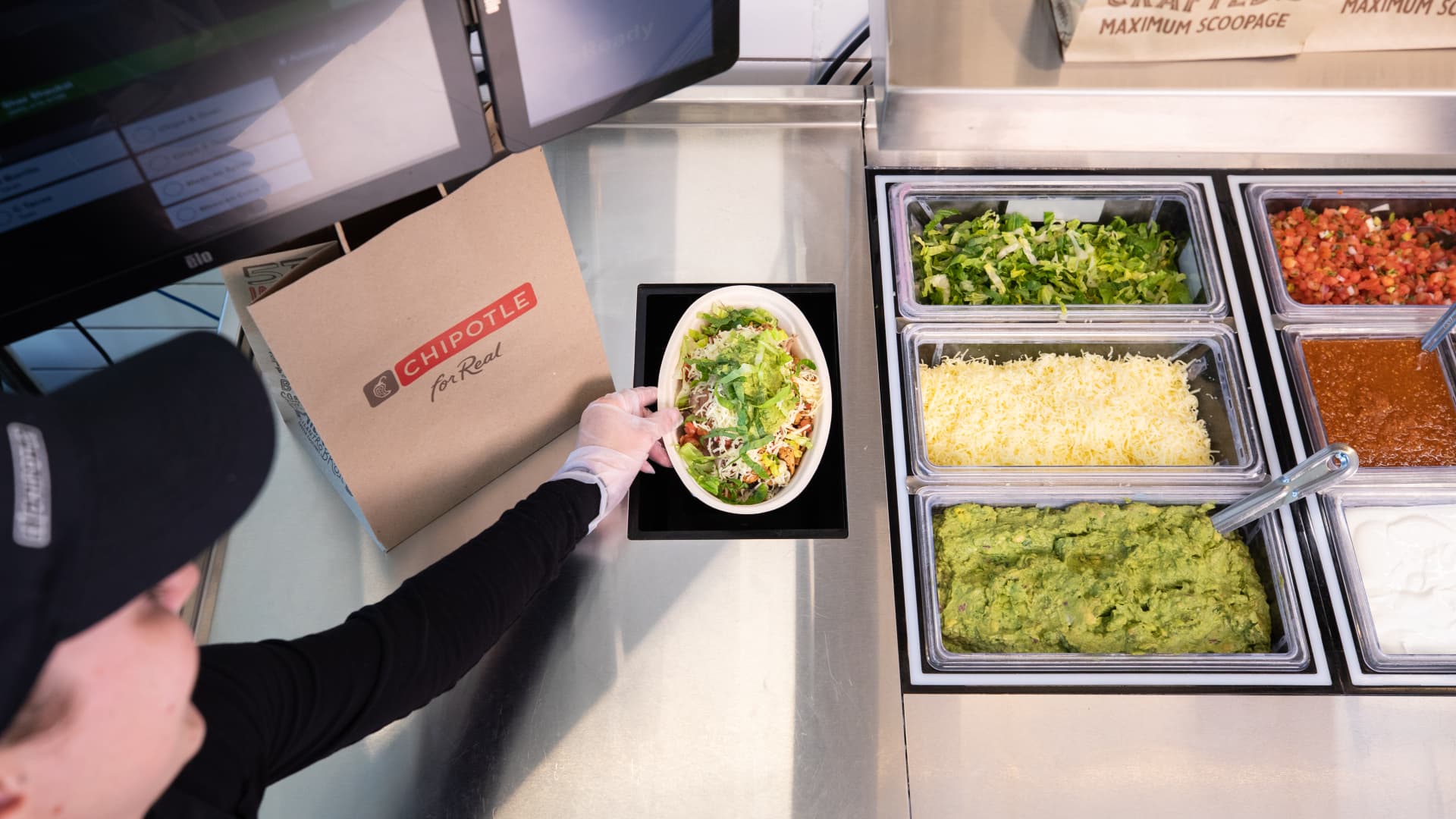

At a challenging time for the restaurant industry, major chains like Chipotle and Cava are putting money behind automated makelines from startup Hyphen.
The San Jose, California-based company aims to help restaurants achieve two key goals in a hyper-competitive environment: speedy throughput and good customer service. The technology makes for a less chaotic and more “elegant experience” for workers and guests alike, co-founder and CEO Stephen Klein told CNBC in an interview.
“We’re probably making a bowl every 10 to 15 seconds. At peak throughput, we have more capacity usually than they do demand, especially … for lunch and dinner rushes,” Klein said.
That efficiency has brought increased interest across the industry. In August 2025, Hyphen closed a Series B round of financing that included up to $10 million from Cava. Chipotle said it has invested a total of $25 million into Hyphen via its Cultivate Next venture fund through the third quarter of 2025.
The $25 million Series B round will help Hyphen scale its production and rollout across restaurants in the U.S. Its production will ramp with Re:Build Manufacturing, a company based in Kalamazoo, Michigan. Chipotle’s Hyphen makeline is in San Jose for modification after an in-restaurant test. Cava will test and pilot its tech for a second makeline to serve digital and takeout orders in the back of its kitchen in the future.
A finished burrito bowl assembled by Chipotle and Hyphen’s automation technology.
Source: Chipotle Mexican Grill
Hyphen’s technology solves for both a speed and labor issue, helping to automate part of the service process that can be repetitive and challenging to fill.
“You can have, somebody is selling ingredients on top, while the rest of this stuff is happening underneath,” he said of the makeline, which relies on a series of robotic hands to prep salads and bowls under a long table, out of public view, sending them down the row.
The makelines cost between $50,000 and $100,000 to purchase, and restaurant customers are often getting a return on investment in under a year, Klein said. They operate 95% of the time, but during the rare moments they’re down, workers can jump in to complete orders, the way an escalator would turn into stairs, he said.
Another key feature is cutting down on food waste. The technology tracks ingredients “down to the gram,” Klein said.
“We’re perfectly portioning every ingredient, we’re able to help them save on food costs, or at least reduce food costs in some way,” he said.
The idea of the company began when Klein and his co-founder Daniel Fukuba built a fully robotic food truck, which launched in Los Angeles three months before the pandemic started. They changed gears to launch Hyphen soon after that.
“When the pandemic happened, we kind of just had to share that into another direction. We had luckily been talking to other restaurant partners about licensing our technology for them, and we decided … it just made a lot more sense to help restaurants that are already around today,” Klein said.
Technology innovation will likely continue to be a key trend in the restaurant sector after a brutal year for many of the industry’s leaders. Shares of Cava and Chipotle are down nearly 50% and 40% year-to-date, respectively, after pullbacks from key demographics including younger consumers. Sweetgreen, another competitor in the healthy salad and bowl space, is down nearly 80% on the year.
Sweetgreen sold its robotics unit, Spyce, to mealtime platform Wonder earlier this year for $186.4 million. Sweetgreen had acquired Spyce to build its automated Infinite Kitchens, and it will continue to use the technology.
Klein said Hyphen is talking to major brands and food service providers for college campuses and office parks as it looks to not only evolve the makeline, but also provide data that comes from the food prep and distribution. The company aims to develop more software in the future, including tools for food prep scheduling to be used in the back of the house.
One area that’s not on the menu, at least for now, is the fast food sector.
“We’re really trying to help people that have really a high mix or high customization in terms of what their guests are ordering, as well as high volume. So that’s kind of our strike zone,” he said.

