


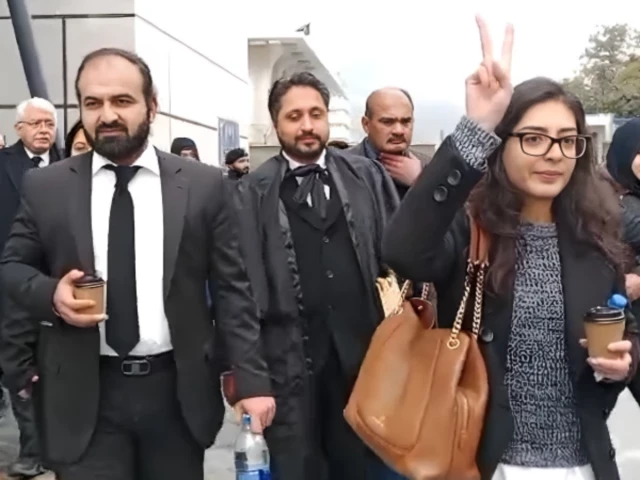
Lawyer and rights activist Imaan Mazari and her husband, advocate Hadi Ali Chattha. PHOTO: EXPRESS
ISLAMABAD:
Human rights lawyer Imaan Mazari and her husband, Advocate Hadi Ali Chattha, were convicted by a district and sessions court in Islamabad in a case pertaining to controversial social media posts on Saturday and sentenced to 17-year prison terms.
The case centres on alleged controversial posts and reposts on X, formerly Twitter, which authorities have described as “anti-state”. The National Cyber Crime Investigation Agency (NCCIA) had registered the case in August last year under the Prevention of Electronic Crimes Act (Peca) 2016, alleging that the content was intended to incite divisions and portray state institutions negatively.
The couple were produced before the court through a video link, with Mazari alleging mistreatment in custody and announcing a boycott of the proceedings.
Additional District and Sessions Judge Muhammad Afzal Majoka announced the verdict. Special prosecutors Barrister Fahad and Rana Usman were present in the courtroom at the time of the verdict, while none of the lawyers representing the couple were present.
The written order, a copy of which is available with The Express Tribune, said: “From perusal of the tweets, re-tweets and posts of accused persons it follows that they have stated the Pakistan as terrorist state, the detention under section 11-EEE of ATA as illegal detention and have praised proscribed organisations and individual and claimed the judiciary as biased. Ordinarily, this form of narrative employs emotive language, selective presentation of facts, historical grievances, or ideological framing with the object of eroding public confidence in core state institutions, including the judiciary, the armed forces, the legislature, and law-enforcement agencies. In certain instances, it may extend to the glorification of resistance, rebellion, or the denial of the state’s lawful authority.
“In constitutional and national security jurisprudence, courts have consistently drawn a distinction between protected democratic dissent and an anti-state narrative by examining the intent, content, context, and foreseeable impact of the expression in question. Particular weight is accorded to whether such expression incites violence, promotes secession, encourages terrorism, or creates a real, proximate, and tangible threat to public order and national security.
“While robust criticism of the state and its functionaries is an essential feature of a democratic society and falls within the ambit of freedom of expression, an anti-state narrative is judicially understood as speech or conduct that crosses the permissible boundary of dissent and enters the domain of subversion, destabilisation, or incitement against the state itself. In such circumstances, reasonable restrictions imposed by constitutional and statutory law are held to be justified. The accused persons crossed the permissible boundaries under the law by their tweets, re-tweets and posts; thus, has committed the offence under Section 9/10/26-A of Peca.”
Regarding Section 11 of Peca, the order said that none of the witnesses claimed that the accused had tried to advance interfaith, sectarian or racial hatred through hate speech, so both were acquitted of the charge.
The details of their convictions and sentences are as follows:
Peca Section 9: Rigorous imprisonment for five years each with a fine of Rs5 million each, with one-year simple imprisonment in case of default
Peca Section 10: Rigorous imprisonment for 10 years each with a fine of Rs30m each, with two-year simple imprisonment in case of default
Peca Section 26A: Rigorous imprisonment for five years each with a fine of Rs1m each, with six-month simple imprisonment in case of default
The order did not say that the sentences would be served concurrently.
“The convicts are present in custody in some other case on video link. They be kept in jail to undergo their sentences. Benefit of Section 382-B (period of detention to be considered while awarding sentence of imprisonment) Cr.P.C (Criminal Procedure Code) is extended to the convicts. Warrants of commitment be issued,” the judge ordered.
At the outset, the judge asked the accused whether they would begin cross-examination, noting that it was the final day for cross-examination in light of Islamabad High Court orders.
“Is the media present in court?” Mazari asked during the hearing before alleging, “We are being subjected to torture. We are not being given food or water.”
Addressing the judge directly, she said, “You are just doing your job,” and added, “Everything that is happening is because of you.”
Mazari then announced, “We are boycotting the court proceedings.”
The judge responded by asking, “You mean you do not want to be part of the proceedings?” and told them to “wait for the decision.”
Before the hearing concluded, Mazari and Chattha stood up and left their chairs while still on the video link. Judge Majoka ordered the court staff to record the entire proceedings, saying, “Record everything and provide it to me.”
Earlier in the day, the court allowed Mazari and her husband to be produced via video link after police sought permission, citing security concerns and requesting five to six hours to ensure their physical production.
Read: Lawyers Imaan, Hadi sent on 14-day judicial remand by Islamabad ATC after arrest
Judge Majoka had earlier directed the senior superintendent of police (operations) and the deputy director of the National Cyber Crime Investigation Agency to ensure the accused were presented before the court at 10am. He had remarked that today was the last day for cross-examination under the high court’s order.
Police officials submitted their reply during the hearing, stating that due to security issues and other reasons, video-link appearance should be allowed.
Mazari and Chattha were arrested on Friday near the underpass outside the Serena Hotel while on their way to the district courts. An anti-terrorism court later sent them on a 14-day judicial remand.
Former human rights minister Shireen Mazari, Imaan’s mother, said in a post on X that the couple had been “covertly presented” before the anti-terrorism court; lawyers were not allowed inside, and the first information report was not provided despite court orders.
She later claimed they were “never even presented before the judge” and were kept in a vehicle and taken away to conceal their condition following what she described as violence during and after arrest.
According to the FIR shared by Shireen, the case includes charges under multiple sections of the Pakistan Penal Code, the Peaceful Assembly and Public Order Act, and the Anti-Terrorism Act. The case relates to a protest by lawyers against a session of the Judicial Commission of Pakistan on February 10 last year.
Journalists present at the scene alleged that police personnel forcibly seized mobile phones from reporters covering the arrests. Journalist Asad Ali Toor told The Express Tribune he saw police manhandle Mazari and severely beat her husband during the arrest.
Islamabad High Court Bar Association (IHCBA) President Wajid Gilani and former senator Mustafa Nawaz Khokar also condemned the arrests, with Khokar saying the inclusion of terrorism charges over a peaceful protest “trivialises the anti-terrorism law.”
Case background
The social media posts case reached the IHC after the trial court’s November 19 proceedings, during which testimonies of all prosecution witnesses were recorded. Mazari and Chattha had challenged procedural irregularities, including recording evidence in their absence and the appointment of state-appointed counsel without their consent, prompting the IHC’s intervention.
Legal bodies, including the Islamabad Bar Association, have criticised aspects of the proceedings, arguing that the defendants’ right to a fair defence has been undermined.
Read More: Politicians, journalists decry ‘motivated and manufactured’ arrest of Imaan, Hadi
Their plea to transfer the case was heard by the high court, which declined to grant an immediate stay. The couple then approached the Supreme Court, which temporarily halted the trial until the high court completed its hearing.
The district court later resumed cross-examinations, but fresh arrest warrants were issued for Imaan and Hadi, prompting their presence in court again. On Monday, the IHC had granted protective bail, barring their arrest and directing them to appear before the court.
Meanwhile, the couple has been facing hearings related to other FIRs this week. One newly surfaced FIR, registered at Kohsar Police Station on July 26, 2025, was filed on the complaint of Superintendent of Police Safdar Hussain in connection with a protest by the Balock Yakjehti Committee (BYC) at the National Press Club under multiple sections of the Anti-Terrorism Act.
In a separate case, an Islamabad Anti-Terrorism Court on Thursday had rejected their pre-arrest bail applications in connection with an altercation outside the IHC. The couple, who remained inside the IHC premises during the hearing, were arrested the following day in Islamabad while reportedly heading to the district courts.
