


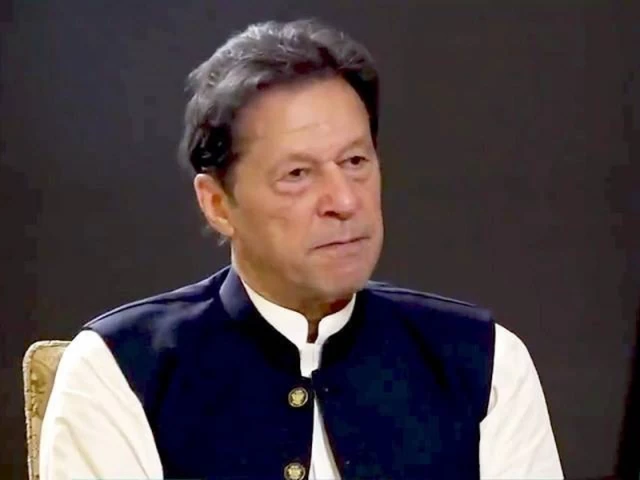
Pakistan Tehreek-e-Insaf founder Imran Khan. Photo: File
ISLAMABAD:
A growing chorus within the legal community has voiced serious concern over what it describes as the superior judiciary’s failure to ensure the availability of basic rights to former prime minister Imran Khan during his imprisonment.
Senior lawyers say the findings contained in the report submitted by lawyer Salman Safdar regarding Imran Khan’s living conditions point to grave violations of the jail manual.
For them, the issue has moved beyond routine prison administration and entered the domain of constitutional guarantees and judicial responsibility.
Lawyer Faisal Siddiqui stressed judges must recognise the gravity of the situation. “Judges should realise that, like Bhutto, this is another judicial murder in the making. The only difference is that this will be a result of judicial inaction, not judicial decision.”
However, despite the criticism, one member of the PTI legal team remains optimistic, saying he expects Imran Khan’s bail and release from jail soon.
On the other hand, lawyer Sameer Khosa, who has represented PTI in several cases, termed the report a damning indictment of the jail administration, the government and the superior judiciary.
“The jail administration criminally neglected Imran Khan’s complaints regarding his eyesight and health,” he said.
“The courts failed to ensure adequate access to medical professionals despite several applications to this effect. The government underplayed the seriousness of his condition, the treatment, and his post-treatment condition.”
He said that the Islamabad High Court (IHC) failed to fix numerous contempt petitions against the previous superintendent of jail, allowing his criminal negligence to continue while depriving meetings with lawyers and family that could have highlighted the issue earlier.
“It establishes beyond any doubt that Imran Khan is being subjected to cruel, inhuman, and degrading treatment in violation of the Constitution and Pakistan’s international law obligations under the ICCPR and the Convention Against Torture,” he added
Lawyer Abdul Moiz Jaferii said that after allegedly taking away almost all of his mandate, the state has also seen fit to take most of the sight in Imran Khan’s right eye.
“It is nothing less than a theft. Too scared to let him out for treatment, too scared to admit that they did take him to a hospital until denying it stopped serving any purpose, the state cannot now claim it was the fault of the jail doctor or the warden,” he added.
Jaferii further said that this loss lies at the doorstep of the houses of power populated by men who do not enjoy the will of the people to be in them. Don’t trust my saying so? Just ask the people. Only count their votes properly this time, he added.
In contrast, lawyer Hafiz Ehsaan Ahmad Khokhar, commenting on the submission of the report regarding jail conditions of Imran Khan, stated that the report appears fair and in conformity with the governing legal framework, particularly the Prisons Act, 1894 and the Pakistan Prison Rules/Jail Manual.
He observed that under Section 4 and Section 24 of the Prisons Act, 1894, prison administration is obligated to ensure safe custody, proper accommodation, and lawful treatment of prisoners.
Furthermore, the chapters relating to “Treatment of Prisoners” and “Privileges and Facilities” under the jail manual provide for regulated access to reading material, interviews with family members and communication facilities, subject to security and classification rules.
He emphasised that even a convicted or under-trial prisoner retains fundamental protections under Article 9 (security of person) and Article 14 (dignity of man) of the Constitution, and that such statutory facilities are rights regulated by law, not executive discretion.
Commenting specifically on medical treatment, Hafiz Ehsaan Ahmad Khokhar referred to Sections 37 and 39 of the Prisons Act, 1894, which mandate the appointment of medical officers and regular examination of prisoners and empower prison authorities to provide necessary medical care.
“The jail manual further elaborates that where specialised treatment is required, the prisoner may be referred to outside hospitals or examined by medical specialists with the approval of the competent authority.
He stated that the federal government’s positive response in permitting examination by outside medical experts is fully consistent with the statutory mandate and constitutional obligation to preserve life and health under Article 9. Such facilitation, he added, strengthens the rule of law and dispels allegations of maltreatment.
Regarding communication and reading facilities, he noted that the jail manual contains specific provisions regulating interviews, correspondence and access to books, subject to censorship and security screening.
These provisions allow prisoners to communicate with close family members and receive approved books and newspapers.
He stressed that the provision of phone facilities for communication with children and access to books falls squarely within the permissible framework of prison law and is not an extraordinary concession.
He added that denial of such lawful facilities without justification would itself be contrary to Sections 40 and 41 of the Prisons Act, which prohibit unnecessary harshness and impose duties on prison authorities to maintain humane conditions.
On the constitutional plane, Hafiz Ehsaan Ahmad Khokhar observed that in view of the 26th and 27th Amendments, whereby a distinct Federal Constitutional Court (FCC) framework has been introduced, questions may arise as to the extent of the SC’s original jurisdiction in issuing administrative directions relating to prison management.
However, he appreciated that Chief Justice Yahya Afridi exercised limited and focused intervention confined to three core areas – medical facility, communication and access to reading material – thereby demonstrating judicial restraint and adherence to constitutional boundaries.
He further remarked that recent political developments, including high-level engagements between key office holders, the appointment of leaders of the opposition in both houses, restraint in public discourse, particularly the avoidance of institutional criticism, and signals favouring dialogue, have contributed to a constructive environment.
He said that it is now incumbent upon all political stakeholders to pursue structured dialogue within the constitutional framework for national stability, economic confidence and institutional harmony, and that the court’s restrained approach in the present proceedings reflects constitutional maturity and balance.
