


PUBLISHED
May 18, 2025
KARACHI:
Until just after midnight on May 7, Ghufran Khalid, 24, didn’t expect to be surprised. Like many of his peers, Khalid was used to the steady thrum of hostilities with India. Escalations in Kashmir, exchanges across the Line of Control — these were grim fixtures in a long, bitter history.
On April 22, a deadly attack on tourists in Pahalgam, in Indian Illegally Occupied Jammu and Kashmir (IIOJK), claimed the lives of 26 men. The Resistance Front, a relatively new separatist group calling for Kashmiri independence, claimed responsibility. Indian authorities allege that the TRF is a proxy of Lashkar-e-Taiba, a Pakistan-based militant outfit that has largely faded from prominence. Islamabad denied involvement and called for an impartial investigation.
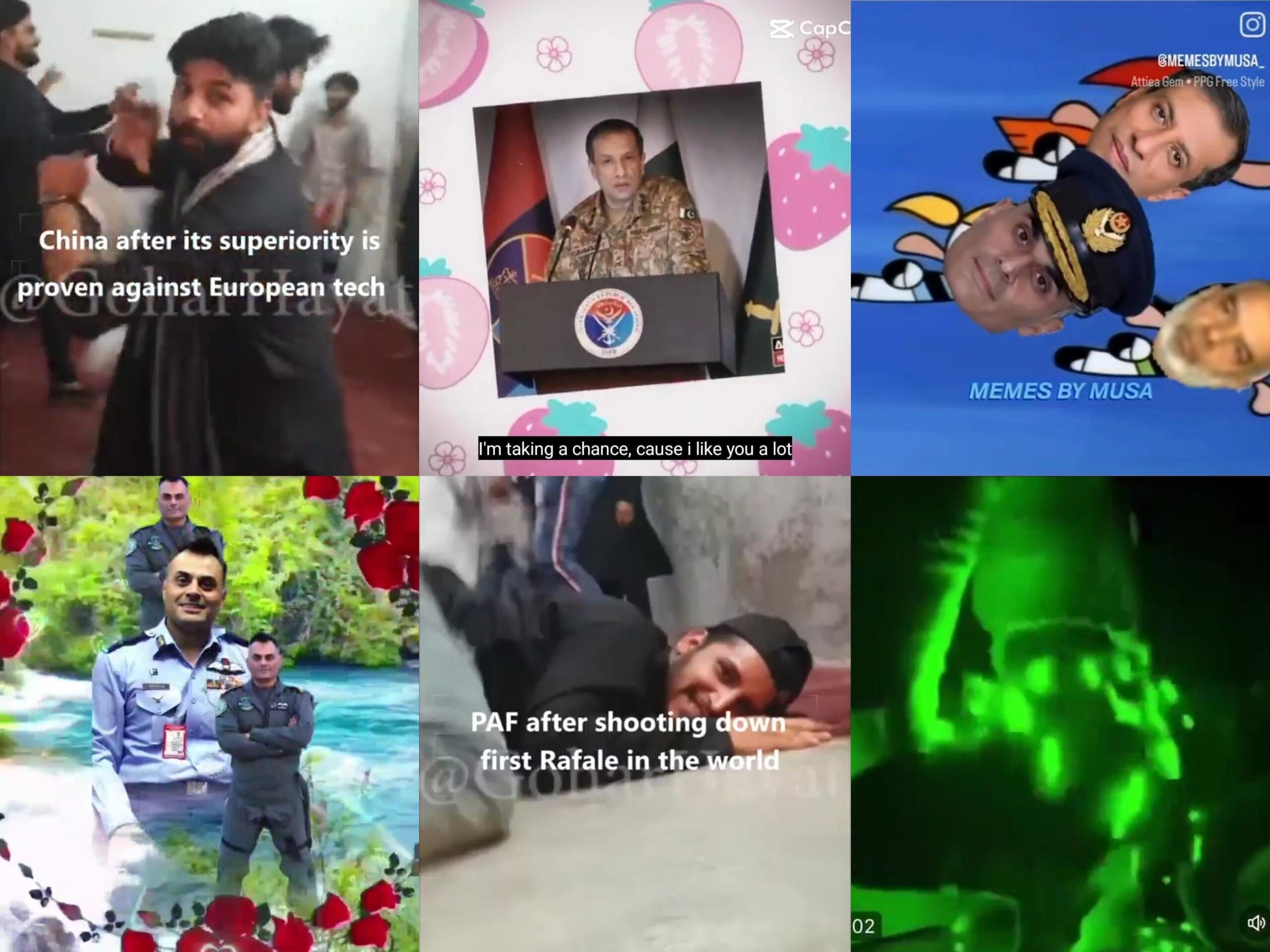
None of this, however, registered as “real” danger to Khalid. He belongs to a generation raised online — digitally native, perennially ironic. In the wake of Pahalgam, Pakistan’s youth turned not to civil defence drills, but to memes.
“Before the attack, the memes were definitely coming from a place of security,” Khalid told The Express Tribune. “Pakistan and India have a standoff every few years. I thought this would pass, too, until India actually attacked the mainland.”
Pakistanis didn’t learn to laugh through crises overnight. But time and again, the credit for the influx of memes in response to a poorly lost cricket match, a morning show host’s misgivings about Formula 1, or the establishment’s crackdown on a political party has been given to the vaguely defined “Gen Z”.
According to Pew Research Center, Gen Z begins with those born in 1997, making them the first cohort to grow up entirely within the Internet’s orbit. In Pakistan, they are also the first generation to come of age without the memory of a conventional war.
Gen Z — and now Gen Alpha — have long been caricatured as unserious, the generation historians might just skip. This recurring punchline, often voiced by the youth themselves, reveals how they view their place in time. Even war, it seems, loses its sacredness for those shaped by the endless scroll of digital absurdity.
Trending #resistance
The Pakistan Armed Forces launched “Operation Bunyanum Marsoos” on May 10, in response to the Indian military’s offensive — dubbed “Operation Sindoor” — which began overnight between May 6 and 7. The cross-border aggression resulted in significant civilian casualties, including women, children, and the elderly.
While Pakistan’s response was broadly seen — both online and offline — as a necessary measure to defend national sovereignty, for civilians, May 10 marked the culmination of four days of mounting fear and uncertainty.
One of the most active accounts during this time, an anonymous X user known as “roman roy apologist”, 24, described their posts as commentary that just happens to be funny. “My generation’s humour is very unserious because what is there to be serious about?” they told The Express Tribune. “COVID-19 showed how fragile and impermanent our institutions are. The ongoing genocide in Gaza reveals the media’s hypocrisy every day. All the institutions that were respected by older generations are now on trial right in front of us.”
This kind of low-effort humour is often classified as “brainrot” in the evolving internet vernacular, where charisma is “rizz,” beauty becomes a “face card,” and delusion is simply “delulu.” Alternative language has always been central to resistance. But online, where everything is fleeting and driven by opaque algorithmic tides, the line between meaningful alternative and passing trend is hard to trace. To live by trends and under systems that rarely explain themselves is to risk having no definable core. Still, the generational dismissal of being skipped by history comes far too easily.
“For three days, I texted friends in Islamabad, Peshawar, Lahore, and Karachi, checking if they were safe during attacks,” Khalid confessed. “I alternated between tense, angry, and joking on X. Bantering with Indians became a way to vent frustration.”
While Khalid mined humour to cope, “Mahobilli”, a 40-year-old content strategist, remained largely unfazed. “I’m a millennial. I’ve been through so much of it,” she said, recalling the Kargil War and General Pervez Musharraf’s 1999 coup. “A lot has happened around the LOC — Pulwama, for example. Maybe if we’d had digital platforms then, our reactions would have been similar. Gen Z has much more information than we ever did. We learned about Kargil over a decade; they see it all within minutes.”
‘No real exit’
To say Gen Z (and Gen Alpha) is shaped by the architecture of the Internet is not to suggest they lack flesh, feeling, or real-world stakes. Instead, it reflects how these generations grapple, almost instinctively, with the Internet’s core paradox: everything online is fleeting but leaves behind a permanent footprint.
Few were surprised when the Pakistani armed forces thanked “cyber warriors.” Like soldiers at the front, these users absorb and respond to information in real time. The battlefield and timeline are one and the same.
“The credit goes to Gen Z,” Mahobilli said. “Despite their anxieties, they know how funny they are. And they use it, fully aware of how much it enrages the other side to be laughed at.”
Categories like Millennial, Gen Z, and Gen Alpha specify age cohorts, but online, they increasingly describe cultural sensibilities, shaped less by the year of birth than by proximity to the algorithm. What marks Gen Z and Alpha is not just youth, but a heightened temporality: an instinct for living in a feed that updates itself, endlessly. This is something even millennials and boomers can get behind if they are willing.
Jokes about “Skibidi Toilet,” “gyatt,” and “looksmaxxing” originate in the unruly sprawl of digital subcultures, complete with their amateur, sexual, or conservative registers. Whether a sense of humour can be bracketed by age is an entirely separate rabbit hole. But this recent India-Pakistan flare-up offers a case study in how timelines encourage engagement more than allegiance. Pakistan today hosts a singular, reference-literate Internet generation where getting the joke matters more than picking a side. Here, boomers might find themselves saying “aura farming” before chanting “Pakistan Zindabad.”
Reducing Pakistan’s humour-in-crisis as naïve trolling or Gen Z tomfoolery misses a wider digital choreography that processes national anxiety. “Pakistani Twitter,” in particular, has become a node of potent cultural production, outliving X itself. It has endured far more than Elon Musk’s unpopular redesigns — Grok, the vanishing “Likes” tab, and X Premium’s paywalled perks. According to Datareportal, as of January 2024, only 4.5 million Pakistanis were on X, accounting for just 1.9 per cent of the population. Yet despite its modest reach, it has survived government bans, FIA notices, and cybercrime laws targeting activists.
According to Zoya Rehman, a feminist researcher and political organiser based in Islamabad, the state’s escalating control over digital platforms reflects how the Internet remains one of the few spaces for counter-narratives.
“The unbanning of X during this time, despite its relatively small user base, is more than just strategic communication,” Rehman told The Express Tribune. “It’s also a tacit recognition that digital discourse matters, precisely because it is seen as insular, yet powerful.”
She identifies a turning point around the 2018–2019 period, when feminist and student movements, anti-establishment voices, the Pashtun Tahafuz Movement (PTM), and Baloch resistance began asserting themselves more visibly online. COVID-19, she notes, only deepened this shift by intensifying digital connectivity while compounding individual isolation.
“Much of what circulates now oscillates between sincere disillusionment and algorithmically induced detachment,” Rehman added. “The state clamps down with predictable bluntness, but users are also shifting, toward irony, refusal, or a desire to disengage. This is not necessarily apathy; it may be a survival instinct in an environment that demands performance but offers no real exit.”
One example of this is the Nach Punjaban recap. A clip — twenty-three seconds of shaky, handheld footage showing a group of young men dancing to Abrarul Haq’s Nach Punjaban — has become a kind of ritual response to major political events on Pakistani Twitter. Each dancer in the frame is symbolically assigned a role in the news cycle, their exaggerated, often slapstick movements mapping out a satire of statecraft. The meme predates both Musk’s acquisition of Twitter and the government’s X ban, standing as an archive of an internet public that isn’t easily quantified, but unmistakably knows the language of rhythm, reference, and ridicule.
Elsewhere, the timeline explodes to make way for new ruptures. Take the viral video of a woman wrapped in green fairy lights, twerking to Awaz’s patriotic anthem Ay Jawan. With over 149,000 views on X alone, the clip surfaced with playful claims of newfound patriotism.
“That twerking video only works because the woman is anonymous,” noted roman roy apologist. “The minute they find out who she is, she goes from object to person, and she’ll be cancelled, if not lynched.” Critics of the video argue that it uses humour as a pretext to sexualise women. Fans find it an amusing, synchronised blend of beat and dance. It is possible — perhaps even necessary — to look beyond the voyeurism or moral panic and read this as an expansion of what constitutes patriotic expression. In a timeline shaped less by reverence than participation, Ay Jawan no longer belongs to the state. It belongs to the scroll.
The war will be fancammed
If restoring X’s access aimed to foster unity, it succeeded, if only by blurring patriotism and fanfare. One of the more curious outcomes was the rise of the political fancam — short, fan-made video edits usually reserved for pop stars — setting its sights on the armed forces and political elite.
On May 9, during a high-level press conference addressing tensions with India, Pakistan Army spokesperson Lt Gen Ahmed Sharif Chaudhry appeared alongside Pakistan Air Force (PAF) DGPR Air Vice Marshal Aurangzeb Ahmed and Pakistan Navy’s Vice Admiral Raja Rab Nawaz. While users on X live-tweeted updates in real time, it wasn’t long before the trio’s public appearance became the subject of “stan culture”.
Multiple fancams soon superimposed AVM Aurangzeb into pink, heart-saturated animated templates, set to the sugary highs of K-pop and trending audio. DG ISPR Ahmed Sharif also appeared in a few, albeit with less fanfare. But while Gen Z and Alpha embraced the format with what seemed like genuine admiration — full on “thirsting” and all — millennials took a different route. Their contributions leaned into self-aware cringeworthy nostalgia, producing wedding-style floral edits reminiscent of late 1990s/early 2000s media aesthetics, with songs like Dil Laga Liya Maine. Much to the dismay of some women earnestly enjoying the thirst edits, men jumped in too, often not to participate, but to parody, layering the trend with their own sexually charged humour and ironic detachment.
Even political figures not typically “stanned” online, such as Bilawal Bhutto Zardari, inspired admiring video montage reels.
The virality of this digital adoration spilled offline. By the time the trio returned for a second press conference on May 12 to brief the public on the success of “Operation Bunyan un Marsoos,” Vice Admiral Rab Nawaz — previously memed for saying nothing in the first press conference — finished with a pointed quip referencing his online persona as “the silent guy.”
Khalid suggests Pakistanis can be convinced to support anyone or anything, as long as the fancam is “sick enough.” Conversely, Rehman, who has worked extensively with digital spaces under a feminist lens, interprets the “pookiefication” of armed forces and fancams as more than naive celebration. “More often, they carry an undercurrent of horror, satire, or some kind of dissociative commentary. These gestures reflect a disfigured emotional grammar. One shaped by grief inherited without closure,” she explained.
The language of fear
It hardly matters whether the Internet generation has lived through blackouts, missiles, or sirens. Their history is not one of memory but of hyper-awareness of an ambient now, not a haunted past.
At the same time, it would be wrong to say they are strangers to the horrors of war.
“It’s easy to say we haven’t seen real war,” said Maryam Aftab, 27, a medical doctor who also creates digital content. “As if we didn’t grow up during the War on Terror. As if we didn’t live through the APS attack. As if we didn’t watch cities shut down overnight, hear gunshots echo through Karachi, or lose phone signals because a political rally turned into a riot.”
Aftab, who describes herself as a “full-time doomscroller by personality,” said the experience of living through repeated cycles of violence has shaped how her generation responds to current events. “We might not have seen trenches like our grandparents did in the 1971 war,” she said, “but we’ve seen body counts on TV screens and suicide blasts in our neighbourhoods. So no, we’re not laughing because we’re out of touch. We’re laughing because we are painfully in touch. Humour is the only language that makes the fear speakable.”
This dissonance between the perception of detachment and the lived experience of violence is not new. According to Rehman, the tendency to label Gen Z and Gen Alpha as frivolous reflects less on the generations themselves and more on a broader inability to comprehend how young people absorb and respond to violence in an age of constant exposure. “These are not generations raised in the absence of war, but within its mediated omnipresence: bombings on timelines, livestreams, hashtags as memorials.”
“The question is no longer whether digital space matters, but whether we are building anything that can outlast the platform itself. Algorithms will not protect us, and neither will visibility. Resistance must be rooted not just in content, but in infrastructure, platforms, and data ethics,” she added.
