


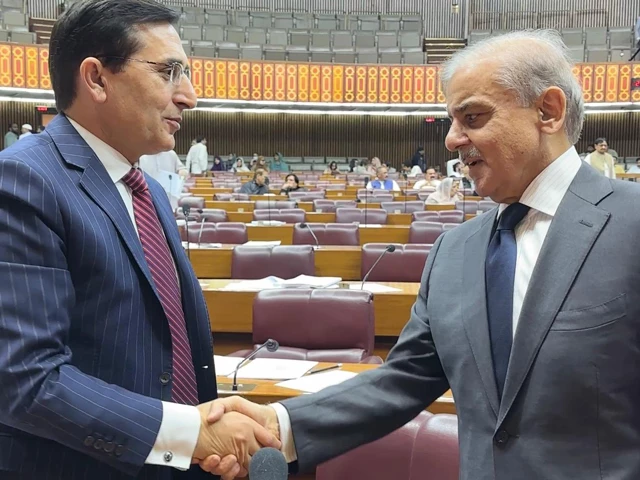
Prime Minister Shehbaz Sharif and PTI Chairman Barrister Gohar Ali Khan shake hands during a National Assembly session on Thursday, June 26, 2025. Photo: X/Government of Pakistan
ISLAMABAD:
With Pakistan Tehreek-e-Insaf (PTI) stepping up preparations for a street movement and the establishment maintaining a firm stance against the opposition party, Pakistan’s political landscape remains fraught with uncertainty and deepening mistrust.
Against this backdrop, a senior minister in the PML-N government has once again floated the idea of a high-level dialogue involving the country’s principal power centres, an idea that has surfaced before but never progressed beyond rhetoric.
Prime Minister’s Adviser on Political Affairs Rana Sanaullah recently outlined what he described as a meeting of the country’s five key stakeholders.
According to Sanaullah, two of these are Prime Minister Shehbaz Sharif and PML-N supremo Nawaz Sharif, while the third is President Asif Ali Zardari.
The fourth, he said, is incarcerated PTI founder Imran Khan, adding that “everyone knows who the fifth is”, a remark widely interpreted as a reference to the military leadership.
In effect, Sanaullah’s remarks amounted to a call for dialogue between Pakistan’s political leadership and the establishment. However, analysts note that identifying stakeholders is far easier than persuading them to sit across the table.
Previous attempts at arranging such high-level engagements have failed, prompting scepticism over whether the latest proposal represents anything more than a political soundbite.
Former PTI leader Fawad Chaudhry dismissed the feasibility of the proposal under prevailing conditions.
“It is not possible in the current political climate,” he said, arguing that the real obstacle lies in the unwillingness of both the government and the establishment to engage in genuine dialogue.
His remarks underscore the depth of mistrust that continues to paralyse political engagement.
Senior journalist and political analyst Mazhar Abbas echoed that assessment, saying that Sanaullah’s proposal lacked practical substance.
“Rana Sanaullah’s proposal lacks practical follow-through,” Abbas said, stressing that the responsibility for initiating dialogue rests with the government.
He argued that confidence-building measures, including notifying leaders of the opposition in parliament and allowing PTI leaders access to Imran Khan, were prerequisites for any meaningful engagement. In the absence of such steps, he suggested, the proposal appeared more symbolic than actionable.
Veteran political analyst Hassan Askari also expressed doubts, saying dialogue was unlikely under current circumstances due to wide political differences and entrenched mistrust. Without genuine confidence-building measures, he warned, the political deadlock would persist.
Adding another layer of complexity, Rana Sanaullah has said that confidence-building would only be possible if social media accounts allegedly running hate campaigns against the army and its leadership were shut down.
Responding to this, Mazhar Abbas said such concerns could be raised once talks were underway. The immediate priority, he argued, should be to initiate dialogue rather than set preconditions that further delay engagement.
Hassan Askari, meanwhile, emphasised that confidence-building must be reciprocal.
“Just as Rana Sanaullah is making a demand, PTI also has certain demands. Both sides need to compromise rather than one expecting the other to act without offering anything in return,” he said. “Confidence-building occurs on a reciprocal basis.”
As debate continues over stalled dialogue, attention has also turned to whether Nawaz Sharif could play a more active role – an idea floated by Mehmood Khan Achakzai and other PML-N figures.
Mazhar Abbas noted that Achakzai enjoys direct access to Nawaz Sharif and that the former prime minister could take the initiative. Given their cordial relationship, Sharif’s involvement could help open channels between the government and the opposition.
Hassan Askari, however, urged caution, arguing that it was premature to speculate about Nawaz Sharif’s role. In his view, those who wield real power must first align. Without an understanding between the prime minister and the army chief, he said, dialogue would remain elusive.
Similar questions have been raised about President Zardari’s potential role in breaking the impasse. Abbas observed that Zardari could not act independently and that his involvement would hinge on a broader agreement between the government and the opposition.
Askari concurred, saying the president held no autonomous authority in this regard. Real influence, he argued, lies with the prime minister, the establishment, and Imran Khan – and until these three accommodate one another, meaningful dialogue will remain out of reach.
Viewed in this light, prospects for flexibility from the establishment appear limited. Mazhar Abbas noted that the establishment continues to maintain a hard line on PTI, Afghanistan, and terrorism-related issues, leaving little room for immediate accommodation.
Hassan Askari agreed, concluding that dialogue would only become possible when stakeholders prioritise engagement over confrontation, take reciprocal steps, and move beyond entrenched grievances. Until then, Pakistan, he said, remains trapped in political limbo.
